显示标签为“plane”的博文。显示所有博文

2019年7月26日星期五

When Your Plane Drops 20,000 Feet and Oxygen Masks Drop

oxygen masks in an airplane cabin; Public Domain imagePosted: 01/28/2013 | January 28th, 2013

Last week, I woke up at 4am to begin a long journey to Eleuthera, Bahamas, for a quick four-day trip. It was going to be a long day on very little sleep. First, Boston to New York, then to Fort Lauderdale before taking my final flight to the Bahamas. I was flying United, my least favorite carrier, but the ticket was free, so I had little choice in the matter.

Shortly after I boarded my plane in New York, the safety briefing began to play. “When the seat belt sign illuminates, you must fasten your seat belt. Insert the metal fittings one into the other and tighten by pulling on the loose end of the strap… In the event of a decompression, an oxygen mask will automatically appear in front of you. To start the flow of oxygen, pull the mask toward you. Place it firmly over your nose and mouth… although the bag does not inflate…” and so on. I’ve heard the safety briefing thousands of times, so I tuned it out and tried to sleep.

Pop. Pop. Pop.

I woke up to the sound of my eardrums popping. “What’s going on?” I thought, shifting in my seat and trying to fall back asleep.

Pop. Pop. Pop.

As my eardrums began to sound like popcorn in a microwave, I couldn’t fall back asleep. They were small, frequent pops, and in my zombie-like state, I couldn’t place why this was happening.

I opened my eyes in a haze when it happened.

All of a sudden, the oxygen masks deployed from above. I looked confusedly at the people next to me. And then in the seats around me. There had been no turbulence. Was this a mistake? Half asleep, I didn’t know what to make of it.

All of a sudden, a voice boomed over the PA system. “Put on your masks.”

Holy crap! This was no mistake.
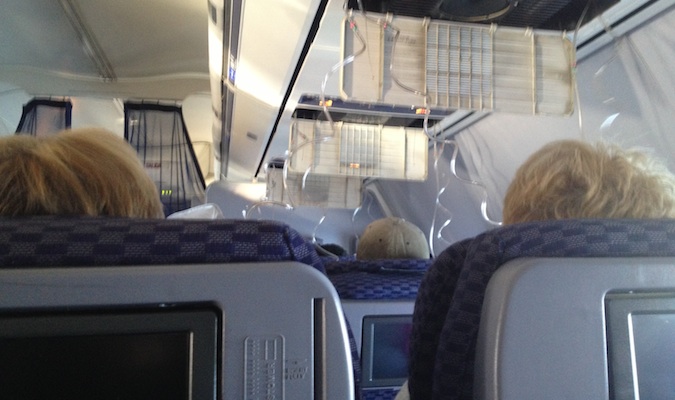
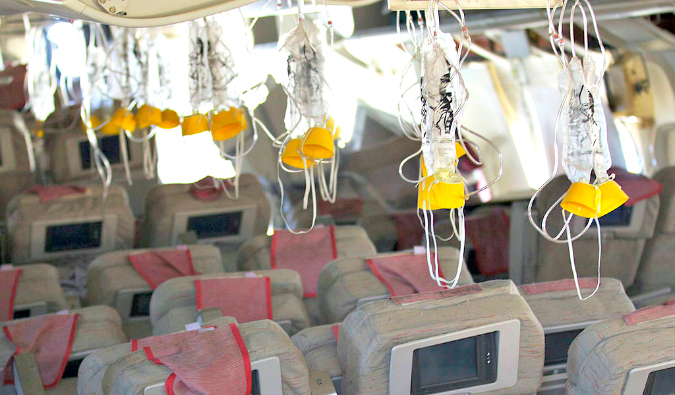
Oxygen masks after the airplane depressurized on a United Airlines flight

I reached for my mask. How did that safety briefing go again? “In the event of an emergency, oxygen masks will deploy…” I tried to remember in my sleepy state. After all those safety briefings, you realize you’ve become numb to them, tuned them out. Then when an emergency happens, you think, “What the heck do I do again?”

I put on the mask and fumbled to tighten the strings, taking unnecessarily deep breaths, worried that if I didn’t, I’d suffocate. I looked around. The business traveler next to me kept reading the paper. The woman sitting diagonally from me and the couple to my right all looked petrified. In front of me, I could hear a woman telling her kids, “Mommy loves you, Mommy loves you,” over and over again.

As the situation unfolded, I thought to myself that we had probably just lost cabin pressure, and it was nothing to worry about. We hadn’t taken a dive; we hadn’t hit turbulence.

But minutes passed. And then more and more. There were no announcements about what was going on. Of course I wanted the pilots solving problems, not chatting to me, but the dearth of information made those minutes last forever.
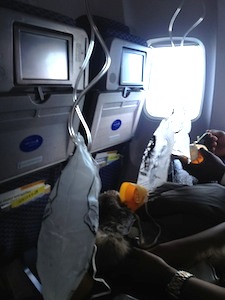
Oxygen masks after the airplane depressurizedThen suddenly, we dropped, and we dropped fast. My heart leapt out of my chest. “Maybe there is something really wrong with the plane!” All those fears I have about heights and flying were suddenly realized.

There is nothing scarier than having your plane drop 20,000 feet in seconds. It’s a feeling I never want to experience again in my life.

We soon leveled out, and I later learned that when you lose cabin pressure, you have to drop below 10,000 feet to prevent a loss of consciousness.

Soon, the flight attendants walked casually down the aisle wearing their masks. If you ask any frequent flier, they’ll always tell you that if the flight attendants aren’t scared, you don’t need to be either.

Finally, the captain came on the PA system and explained that, yes, the cabin had lost pressure and, no, there was nothing to worry about, but yes, we would be making an emergency landing.

You always wonder how you’d react in a situation like this. When those masks fall and your plane descends rapidly, will your life flash before your eyes? Will everyone be screaming? Will it be chaos? Will you know what to do?

Surprisingly, none of that happened. My life didn’t flash before my eyes. Everyone stayed calm. We were more in a state of confusion than anything else.
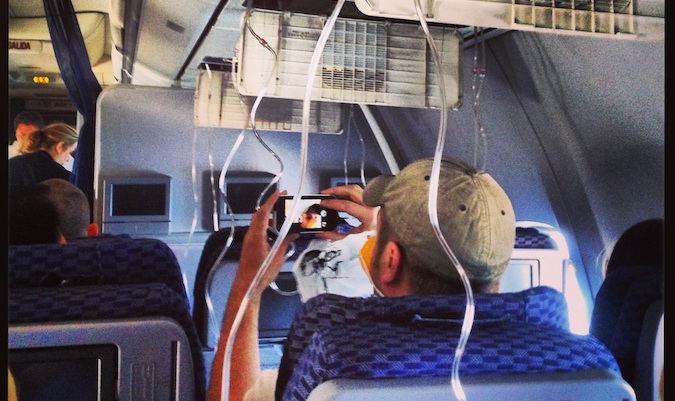
Airline passengers taking pictures after the plane depressurized and oxygen masks came down

After we landed, my friends and I laughed and talked about it as we sat in Charleston’s airport drinking beer and waiting for a new flight. “Here’s to our first emergency landing!” we cheered.

Yet as I thought about what had happened, I realized just how helpless we are when that plane door closes. Your life is in the hands of two people you will never see or meet. Anything can happen, and you have no control over it. You simply have to trust that they know what they’re doing.

Events like this hit you with the realization that no matter how well you plan your life, all the control you think you have is an illusion. Life happens without you, and you’re really just along for the ride. It’s moments like this that make you relax and live a little. It’s taken a few days for that notion to settle, in but when you realize you have no control, life gets put in perspective.

Go where life takes you, and enjoy the adventure. Have fun. Do what you love. Be with who you love.

Because one day, you’re 35,000 feet above the Atlantic, the masks come down, and the only thing you can do is say to yourself, “If this is it, I regret nothing.”

P.S. These photos were taken after I realized I wasn’t going to die. Additionally, I don’t blame United completely. This could have happened on any airline, but when I overheard the captain say that this was the second time this had happened to him in a week, I got uneasy about the standard of United maintenance.

How to Spend 24 Hours in an Airplane

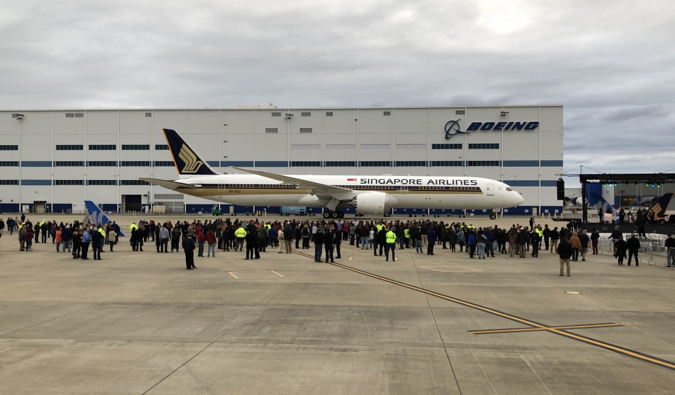
Inside Singapore Airlines' new 787-10 Dreamliner series
I’m an aviation geek, which means I love all things related to planes (even if I’m terrified of flying). Planes fascinate me. They have like 8,000 parts and weigh multiple tons but still manage to stay up in the sky without falling apart! I mean have you ever seen one of those bolts holding up a wing? It boggles my mind how such a tiny thing can hold so much weight. Thank you, aerodynamics, engineering, and the workers at Airbus and Boeing!

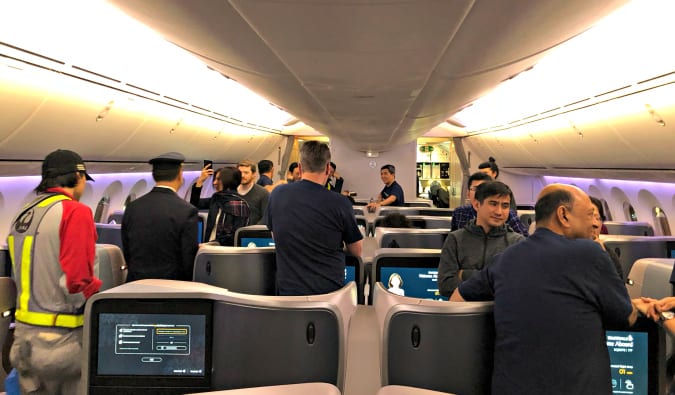
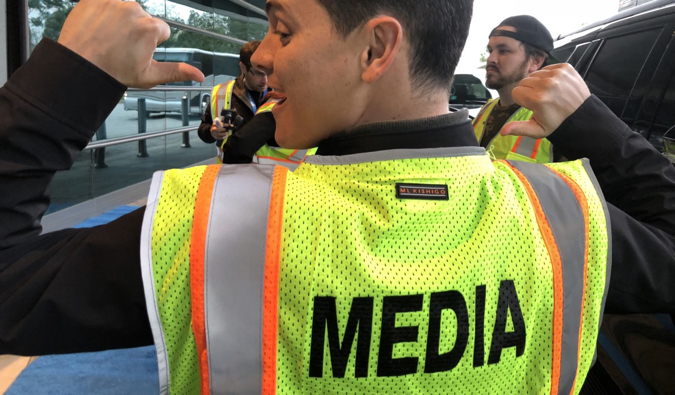
In March, I was invited to the Boeing plant in South Carolina for the delivery of Singapore Airlines’ new 787-10, the first 10-series Dreamliner plane. As part of the invited media crew (including some other AV geeks, like Brian Kelly, Ben Mutzabaugh , Zach Honing, and Kendis Gibson), we spent a few days at the plant (in my next post, I’ll take ya behind the scenes at the Boeing plant and in the flight simulator) and then flew the delivery flight from Charleston to Singapore.

It was truly one of the coolest experiences I’ve ever had. For those other guys, it’s par for the course. They go on these all the time. But, for me, this was brand new! I mean, getting invited to the factory and then to fly on the first flight? Woah! So cool.

But South Carolina to Singapore is a long flight. The total flight time is 22 hours. The total time on the plane for us? 24.5 hours, as we weren’t allowed to leave the airplane during our refueling stop in Osaka.

That’s right. I spent a little more than an entire day inside an airplane.

And how does one spend a full day on a plane? Here’s how:

Hour 1
We board the plane (Boeing has their own gateway at their plant), where we are greeted by the crew and Singapore Airline executives. I sit down in my business-class seat, get my pre-flight champagne, and marvel at the new in-flight entertainment (IFE) system. It was the best I’ve seen. The screen is huge and super sharp, and the system saves all your information and preferences so you can get back to your movies quickly. It also minimizes the back-and-forth between menus by keeping options open at the bottom of the screen while you scroll and loads them without having to toggle. Compared to the crappy IFEs we have in the states, it was like magic.

Hour 2
After takeoff, I start to watch Justice League. It’s terrible, so I move to the galley to get drunk…I mean sample the wine selection. OK, we got drunk. There’s no other way to put it. Those flight attendants pour heavy glasses.

Hour 3
Continue to drink in the galley.

Hour 4
Inside Singapore Airlines' new 787-10 Dreamliner series
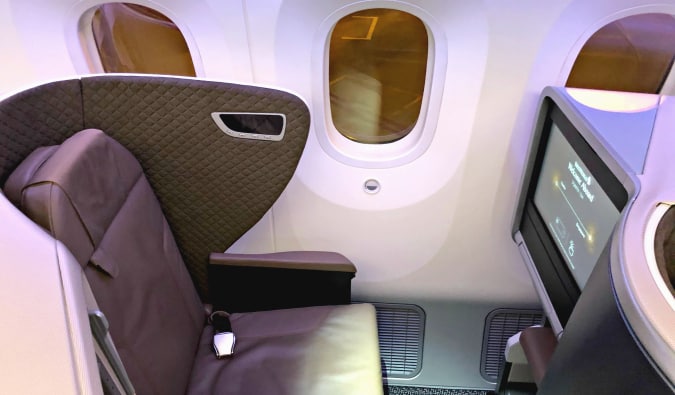
After getting sufficiently toasted, I bid everyone good night and go back to my seat. While the other AV geeks pick apart the seat for length, angles, cubby access, and everything in between, I am just happy to be able to sleep in such a wonderful seat. The seat is 26 inches wide, which is plenty long enough for a guy like me. The padded interior muffles noise and is set back enough so that you can create a little cocoon hidden from the rest of the cabin.

Hour 5
Keep sleeping.

Hour 6
More sleeping.

Hour 7
Counting sheep.

Hour 8
Dreaming of Batman. Wait? Am I Batman?

Hour 9
Still out like a light.

Hour 10
Eventually, I come to and pound some water to get rid of my hangover. I feel pretty good for someone who got just six hours of sleep. I wander the cabin quietly as most of the other passengers on the plane are still asleep. I have the dinner I missed and begrudgingly finish Justice League (seriously, it’s terrible).

Hour 11
I spend an hour writing blog posts and working on my upcoming memoir about my decade as a nomad. (More on that in the future!)

Hour 12
Now, I’m going stir crazy because I’ve been in this plane for 12 hours and still have another 12 more to go! I drink another glass of wine and keep on writing. It’s pretty unexciting. I’m at the point where the novelty has worn off and start to fidget around.

Hour 13
Work some more while watching Geostorm (another terrible movie). I’m not sure what is with me and terrible movies but I seem to gravitate towards them on planes. I think it’s because it’s good time to just get lost and not think. I just want to see cheesy plots and stuff blow up.

Hour 14
Time for another nap!

Hour 15
Inside Singapore Airlines' new 787-10 Dreamliner series
I wake up and notice everyone is also getting up so I go chat with people. It was really interesting being on a plane with journalists. Here I am under no deadline (I mean this article is for something happened two months ago), and these guys are furiously filing stories for when we land so they can all be the first to report on the plane. Here are some of the articles they wrote:

Singapore Airlines New 787-10 in Photos (Flight Global)
Boeing Delivers the World’s First 787-10 Dreamliner to Singapore Airlines (The Points Guy)
The New Singapore Airlines Boeing 787-10 (Sam Chui)
That New Airplane Smell (USA Today)

Hour 16
The cabin lights finally come on and we get ready to land. There’s a light snack, I write some more, and then get to reading a book.

Hour 17
After 16 hours, we’re in Osaka. By now, you’re probably wondering how the plane made it so far? I mean this plane is only supposed to be able to go fly around 8,055 miles and Osaka is 7,255 miles away. Simple: without a fully loaded cabin of people and luggage, the plane was extra light and can make it very far on a very full tank of gas!

Hour 18
While on the ground, they refuel the plane, switch out the crew, and bring in some new food (catered by Singapore Airlines this time and not Boeing). I watch all journalists make videos and do interviews then chat with the CEO of Singapore Airlines, who gives me some sushi recommendations in Singapore (I never got to eat at them but he recommended Kuiiya and Chobei). The most I did was take some photos.

Hour 19
Takeoff time again.

Hour 20
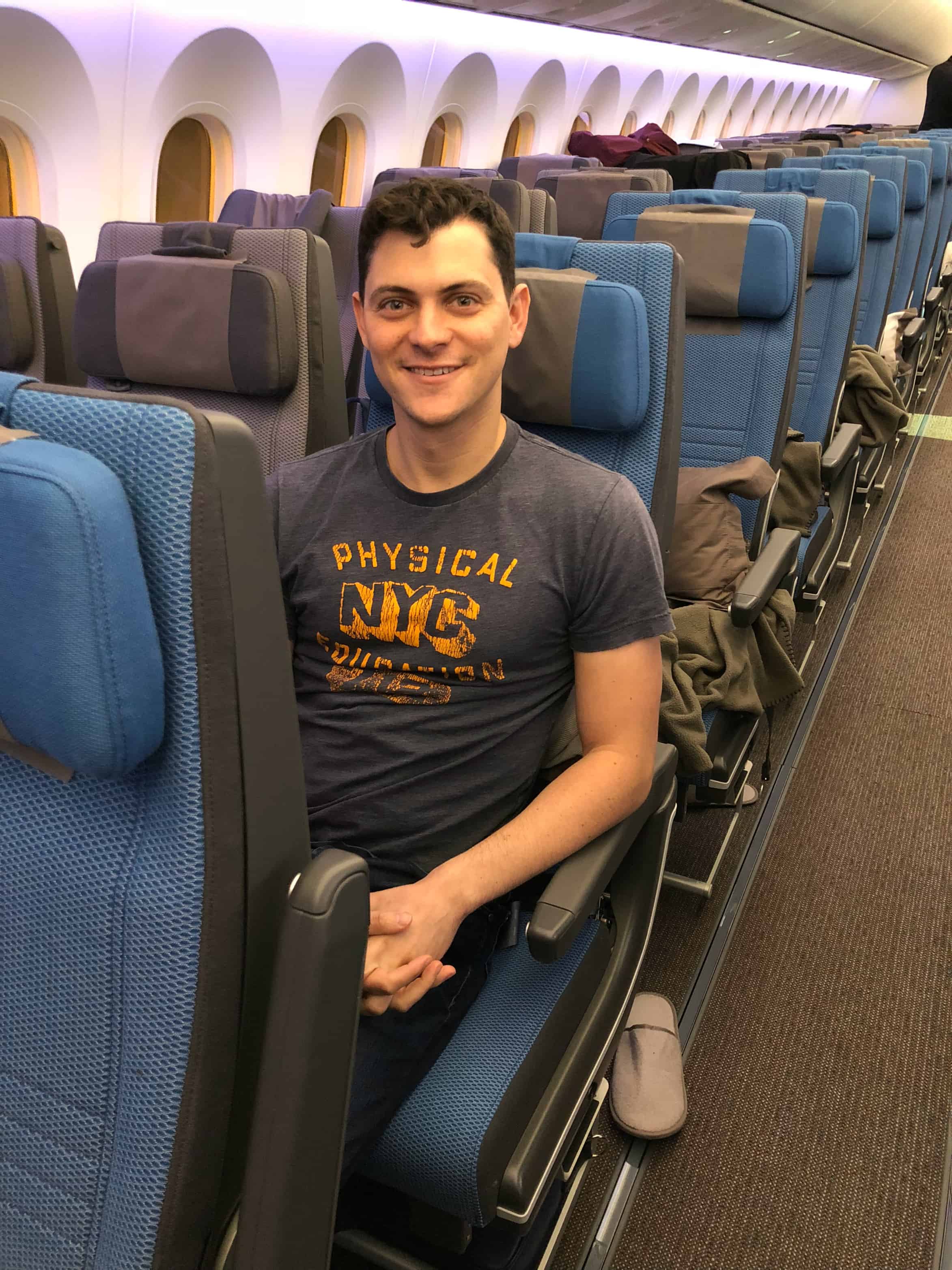
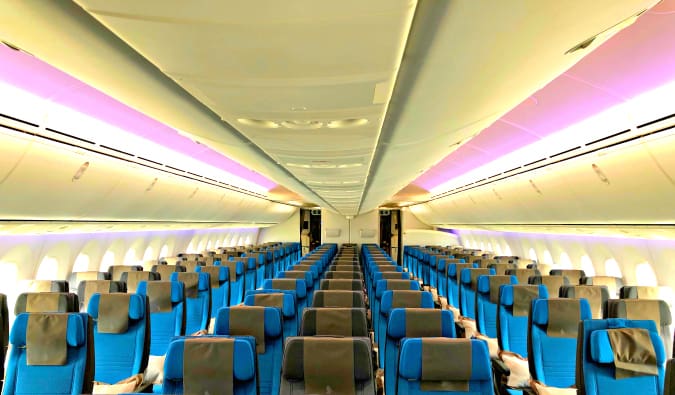
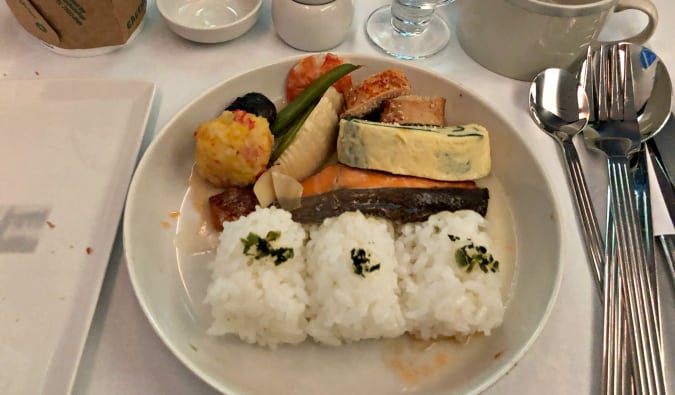
Matt Kepnes sitting in economy class on Singapore Airlines' new DreamlinerAfter another breakfast (delicious eggs with spinach and seaweed), I move to economy class to see what it’s like back there while trying not to wake up all the Singapore Airlines employees trying to sleep. There’s a lot of legroom and the seat has a steep recline (which is good when you recline but bad when the person in front of you reclines since it cuts off a lot of your space). The seats are also really comfy and with a soft padding. After Qatar’s A350 economy, they might be my favorite economy seats.
Hour 21
I take advantage of having my own row in economy to go for another nap.

Hour 22
Dreamland.

Hour 23
breakfast onboard the Dreamliner
I wake up and go back business class for breakfast. The sun is coming up and we’re getting ready to land. I’ve given up on movies and just started writing. Before we land, I take some photos, chat to some folks, and see who wants to get dinner. (We ended up a terrible place. It’s best not spoken of but let’s just say this person got their recommendation off TripAdvisor and it further cemented my view that TripAdvisor sucks!)

Hour 24
cargo ships in Singapore
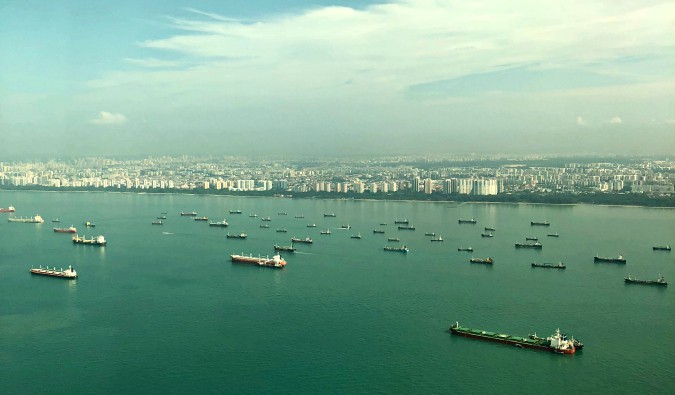
Time to land in Singapore. I’m always awed by the fleet of cargo ships off the coast of Singapore. As far as the eye can see, the denizens of global trade go to and fro as we land and pull into the gate, we are welcomed with water cannons and a celebratory event.

***Spending 24 hours in a plane was an experience I’ll (probably) never have again, but surprisingly, it wasn’t as bad as I had thought it would be. The Dreamliner is pressured at only 6,000 feet compared to other planes which are pressured at altitudes around 8,000 feet. feet. So, walking off the plane, I felt pretty refreshed and less fatigued. I never really noticed it before but after spending 24 hours in a tube, that science Boeing was talking about does really hold up to snuff.

Spending 24 hours in a plane was an experience I’ll (probably) never have again, but surprisingly, it wasn’t as bad as I had thought it would be. The Dreamliner is pressured at only 6,000 feet compared to other planes which are pressured at altitudes around 8,000 feet. feet. So, walking off the plane, I felt pretty refreshed and less fatigued. I never really noticed it before but after spending 24 hours in a tube, that science Boeing was talking about does really hold up to snuff.

I didn’t feel as jetlagged or that normal gross feeling I have after a long international flight. (Who else loves to shower right away after a long flight? Anyone? Makes me feel refreshed!)

This new Singapore 787-10 will be a regional craft so, at most, you’ll be in this plane for only about six hours. They are only going to fly it around Asia and Australia to start. I would say this will be one of the nicest six hours you’ll have on a plane, no matter what class you are in.

I have a new favorite plane to fly around Asia, which, thanks to Singapore’s partnerships with Chase, American Express, SPG, and Citi, as well their partnership with United means I can use points to do it for free! I already was a huge fan of Singapore Airlines and this plane just makes me love them even more!

But, the next time I get on this plane, I’ll be happy it won’t be for another 24 hours. That’s a little too long for me.

Note: I was part of the press core for the launch of this plane. Singapore Airlines covered my hotel, flight, and any meals I had during official events. I was not compensated monetarily for this.

Inside The Factory: How a Boeing is Built

Updated: 07/17/18 | July 17th, 2018

Though I’m terrified of flying, the experience also thrills me. There you are, cruising in a metal tube at 37,000 feet while watching a movie, texting your friends, and — if you’re a travel hacker (and you should be) — enjoying fine food and liquor.

I can never get over the fact that planes, which can weigh up to 485 tons and contain, like, up to 6 million parts, can even get into the air — and stay there! Yes, I know all about aerodynamics (“it’s just lift!”), but it’s still so damn cool!

So when I was invited to my first aviation press event at the end of March, I was beyond excited. I don’t get a lot of media invites since I don’t report on breaking industry news, but when I was asked if I wanted to tour the Boeing facility in Charleston, South Carolina, as part of Singapore Airlines’ 787-10 launch, I immediately said yes.

Watch a plane get built? Fly a flight simulator? Yes. Yes! YES!

At the Boeing plant, we were treated to tours of the Dreamliner assembly process. We went to the production facilities where, after a long and boring press conference on flight specs and fuel savings, we finally got to go down to the factory floor to see the good stuff. Walking on the floor and seeing these metal behemoths really gave me a sense of wonder and awe.

Like, “Damn, that’s a plane!”

Before this, I had only a rough idea of how planes are built, how engines work, and the complicated manufacturing process that’s required to put it all together. I mean, I’ve watched a few documentaries on flying. But unlike most of the other aviation press there, I couldn’t tell one plane or engine from another, discuss avionics or contracts between suppliers, or who designs what seat fabric.

So I was excited to learn about the factory assembly process and how a plane becomes a plane.

At the plant, there are three areas to the plant: rear body, midbody, and final assembly.

The rear body process is where the tail of the plane is made, and the Charleston plant makes all the tail sections for all the 787 Dreamliners (minus the fins). One thing I did know before this trip was that they use carbon fibers, which have several advantages over traditional composite metal, including high tensile strength, low weight, high chemical resistance, high-temperature tolerance, and low thermal expansion. Basically, they are stronger and lighter than traditional metal. They take a tacky composite carbon fiber tape and spin it together around a shell to make the tail sections, called Section 47, where the passengers are (Why Section 47? No one knows. There aren’t actually 47 sections to the plane. That’s just what they call it!), and Section 48, which is the very end of the plane, where the fins will be attached. It’s kind of cool to think about. When you fly a 787, you’re basically flying a plane that mostly started as a thread. Science, man, science!

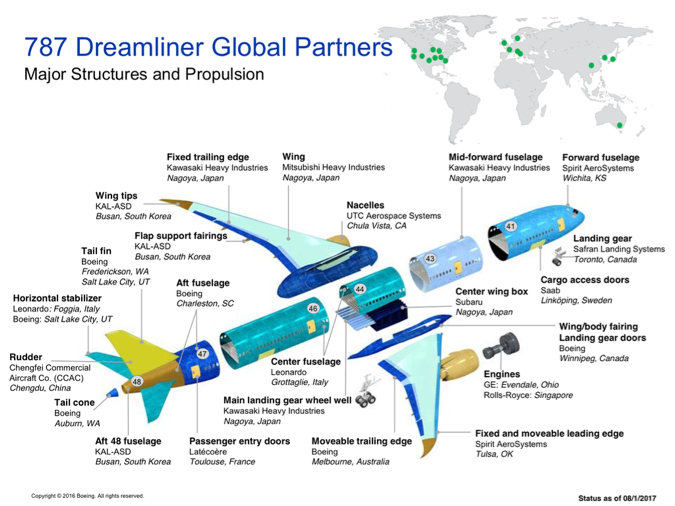
All the other parts of the plan are built elsewhere around the world and then flown in on this weird-looking plane called the Dreamlifter: part of the front of the body (called the forward fuselage) is built in Wichita, Kansas; another part of the forward fuselage is built in Kawasaki, Japan; the center fuselage is built in Alenia, Italy; and the wings are built in Japan, Oklahoma, and Australia. Here’s an image Boeing gave me to give ya an idea of how global Dreamliner production is:

a graphic of how a plane works

During the midbody process, some of the electrical systems and ducts are added to the plane. They also “snap” together the fuselage sections that are flown in from around the world. Basically, there’s a thin lip in each of the sections, and a machine use fasteners to put them together, which is both exciting and considerably unnerving to see because you realize just how amazing it is that it takes so few parts and how few things are holding this places together. For example, they have just seven rivets that snap the wing to the plane (later, during final assembly) and hold all that weight. Nope, they aren’t welded together. It’s like an oversized Lego set!”

Watching them put the fuselage together this was the most interesting part of the plant didn’t allow photographs, which was a shame. But, since Sam Chui is a badass aviation blogger, they gave him access to film it, so watch this video:

From there, it’s on to final assembly where, over the course of seven stations, all the sections are lined up and put together using a “just in time” factory model. It’s here the wings and engines get put on, the interiors are added, the plane is turned on for the first time, systems are tested, and the finished aircraft is driven out of the hangar for test flights.

This final assembly takes approximately 83 days.

Kinda crazy, huh? You never realize just how much goes into a plane. It’s quite impressive that such a coordinated, global operation can produce such a finely tuned piece of machinery that can essentially fly forever with proper maintenance.

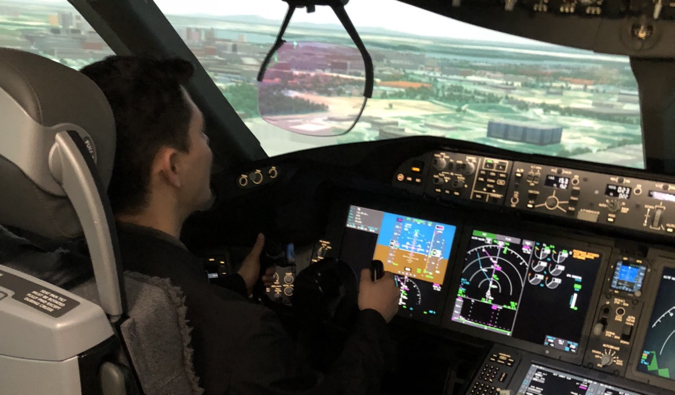
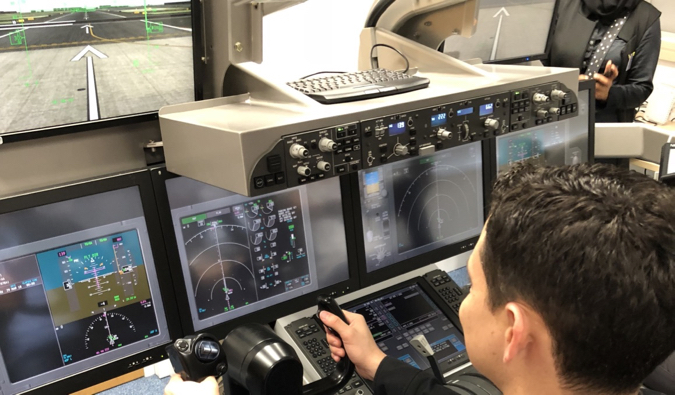
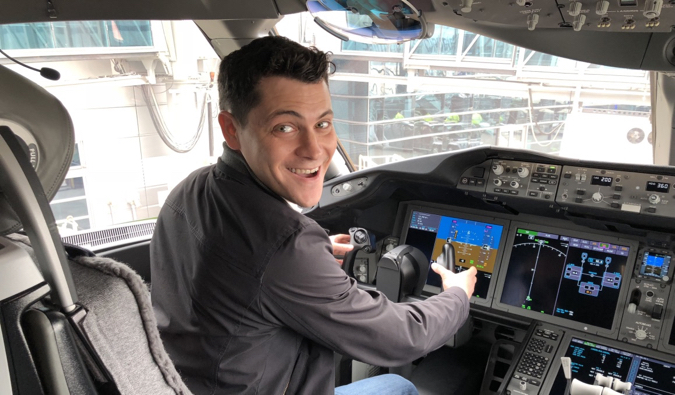
Then, after a 24 hour flight to Singapore, we were taken to where Singapore Airlines trains its crew in safety and service and, while I found it pretty interesting, the real fun was flying a 737 flight simulator back at the Boeing office in town. These multimillion-dollar machines simulate the full motion of a flight. After a brief demonstration, each journalist was allowed a few minutes to “fly.” I giddily sat down in the chair as the pilot let me cruise around for a bit.

I was like a kid in a candy store.

“Can I bank? Can I land? Let’s do a takeoff!” I exclaimed.

“If we have time, we can go again and I’ll release the autopilot,” the instructor coolly said after my thirty seconds was up.

Luckily, we did have time.

“Ready?” he asked as I stepped back into the seat.

“YES!”

We started in midair, he released the controls, and I flew around a simulation of Singapore for a bit.

“Not bad,” he said. “Ready to land?”

“Sure, but can we do a go-around?”

Taking the controls, I aborted my landing, turned up, and banked left so we could do one more circuit. Just as I was enjoying the bliss of the computer-generated scenery, I crashed!

I had forgotten to look at the screen and see my altitude, so while I thought I was just going left, I was actually banking down — and boom! We died.

I guess I won’t be a pilot anytime soon. There is a surprisingly large number of controls and numbers you need to pay attention to on a modern aircraft, especially when you release the autopilot!

Afterward, we got to go into another simulator that allowed pilots to practice takeoffs. It wasn’t a full-motion simulator, but it was designed to get you to take off and feel the movement of the controls.

This time, I successfully, took off and no one died. So you’re safe with me!

***

For a long time, I’ve been terrified of flying — and watching a plane get built and learning about aviation did nothing to assuage that fear. I’m still unnerved by every little bump (the flight I am currently writing this on has been nothing but bumps!), but I have a new appreciation for how complex and strong planes are, how many safety systems are built into them, how hard it is to fly one, and just how damn amazing it is we live in the age of jet travel!

Editor’s Note: I was a media guest of Singapore Airlines and Boeing for this event. They covered all my expenses during these press days.

2019年7月25日星期四

Weird Reasons Planes Turn Around Mid-flight

Turning a plane around mid-flight is a rare occurrence and is often due to some sort of pressing mechanical issue. But on occasion an unforeseeable, non-technological event happens that forces the plane to make an unexpected u-turn. That’s exactly what happened Thursday night when a plane going from New York to Tennessee had to make an emergency landing in West Virginia—because a bird hit the windshield.

Airport spokesman Mike Plante said the pilot alerted air traffic controllers they were going to make an emergency landing at 4:50 p.m., after a bird struck the plane and cracked the windshield.

It's not the only flight to have been forced to turn around because of encounters with birds. Earlier this week a plane lost an engine because of a bird strike, causing the Washington, D.C.-bound flight to return to Key West International Airport. Flight FR3445 to Palma de Mallorca in Spain returned to Manchester Airport after the plane collided with a bird shortly after takeoff. An American flight returned mid-journey to JFK Airport after the pilot hit a flock of geese after takeoff. And in 2010 a Beirut flight had to turn around when a bird got caught in the plane’s fan blades. Luckily, no one was injured in these cases, and the planes made it safely to the ground.

These freak events aren’t the only bizarre things to happen to or on a plane that force it to turn around. Over the years there’s been tales stories of airborne incidents that have caused mid-air detours. From odd smells and foreign creatures taking over the cabin to a mystery illness and an impromptu passenger performing Whitney Houston, these are some of the weirdest reasons planes have had to turn around.

Jordi Lippe-McGraw is a Contributing Digital Reporter with Travel + Leisure. Follow her on Twitter and Instagram @WellTraveler.