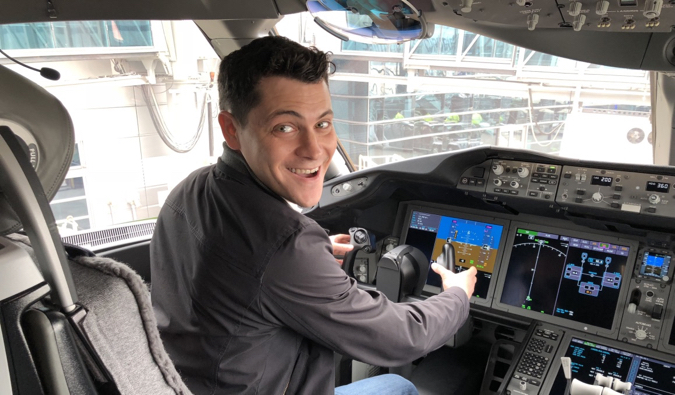
显示标签为“flying”的博文。显示所有博文

2019年7月26日星期五

Inside The Factory: How a Boeing is Built

Updated: 07/17/18 | July 17th, 2018

Though I’m terrified of flying, the experience also thrills me. There you are, cruising in a metal tube at 37,000 feet while watching a movie, texting your friends, and — if you’re a travel hacker (and you should be) — enjoying fine food and liquor.

I can never get over the fact that planes, which can weigh up to 485 tons and contain, like, up to 6 million parts, can even get into the air — and stay there! Yes, I know all about aerodynamics (“it’s just lift!”), but it’s still so damn cool!

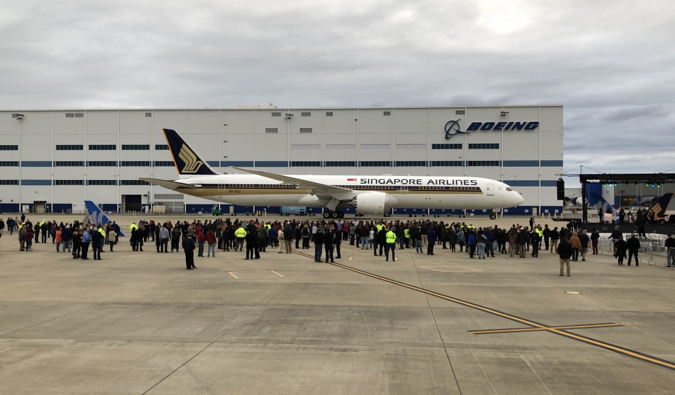
So when I was invited to my first aviation press event at the end of March, I was beyond excited. I don’t get a lot of media invites since I don’t report on breaking industry news, but when I was asked if I wanted to tour the Boeing facility in Charleston, South Carolina, as part of Singapore Airlines’ 787-10 launch, I immediately said yes.

Watch a plane get built? Fly a flight simulator? Yes. Yes! YES!

At the Boeing plant, we were treated to tours of the Dreamliner assembly process. We went to the production facilities where, after a long and boring press conference on flight specs and fuel savings, we finally got to go down to the factory floor to see the good stuff. Walking on the floor and seeing these metal behemoths really gave me a sense of wonder and awe.

Like, “Damn, that’s a plane!”

Before this, I had only a rough idea of how planes are built, how engines work, and the complicated manufacturing process that’s required to put it all together. I mean, I’ve watched a few documentaries on flying. But unlike most of the other aviation press there, I couldn’t tell one plane or engine from another, discuss avionics or contracts between suppliers, or who designs what seat fabric.
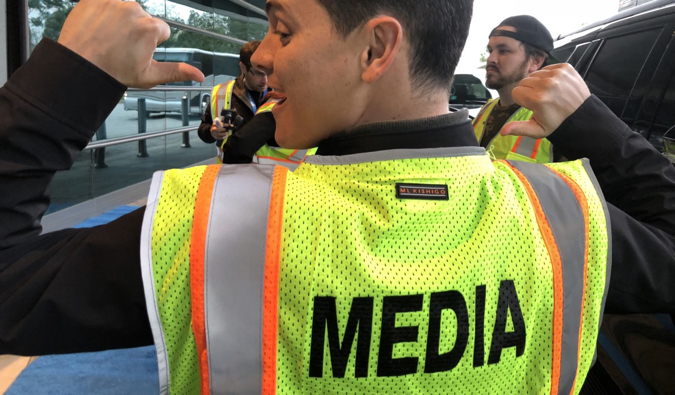
So I was excited to learn about the factory assembly process and how a plane becomes a plane.

At the plant, there are three areas to the plant: rear body, midbody, and final assembly.

The rear body process is where the tail of the plane is made, and the Charleston plant makes all the tail sections for all the 787 Dreamliners (minus the fins). One thing I did know before this trip was that they use carbon fibers, which have several advantages over traditional composite metal, including high tensile strength, low weight, high chemical resistance, high-temperature tolerance, and low thermal expansion. Basically, they are stronger and lighter than traditional metal. They take a tacky composite carbon fiber tape and spin it together around a shell to make the tail sections, called Section 47, where the passengers are (Why Section 47? No one knows. There aren’t actually 47 sections to the plane. That’s just what they call it!), and Section 48, which is the very end of the plane, where the fins will be attached. It’s kind of cool to think about. When you fly a 787, you’re basically flying a plane that mostly started as a thread. Science, man, science!

All the other parts of the plan are built elsewhere around the world and then flown in on this weird-looking plane called the Dreamlifter: part of the front of the body (called the forward fuselage) is built in Wichita, Kansas; another part of the forward fuselage is built in Kawasaki, Japan; the center fuselage is built in Alenia, Italy; and the wings are built in Japan, Oklahoma, and Australia. Here’s an image Boeing gave me to give ya an idea of how global Dreamliner production is:
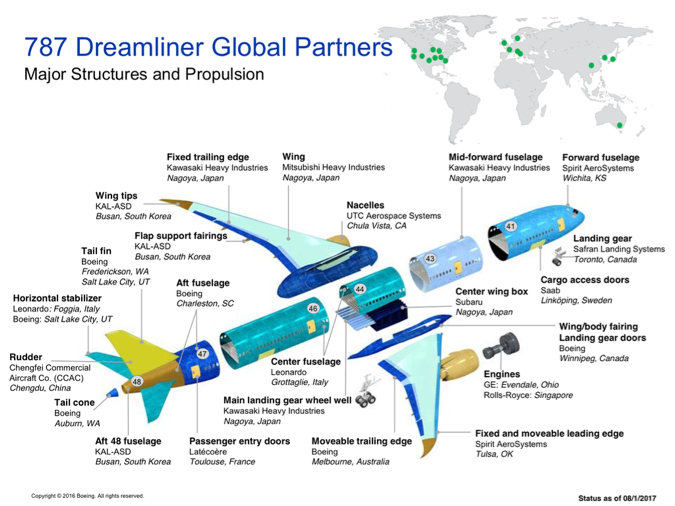
a graphic of how a plane works

During the midbody process, some of the electrical systems and ducts are added to the plane. They also “snap” together the fuselage sections that are flown in from around the world. Basically, there’s a thin lip in each of the sections, and a machine use fasteners to put them together, which is both exciting and considerably unnerving to see because you realize just how amazing it is that it takes so few parts and how few things are holding this places together. For example, they have just seven rivets that snap the wing to the plane (later, during final assembly) and hold all that weight. Nope, they aren’t welded together. It’s like an oversized Lego set!”

Watching them put the fuselage together this was the most interesting part of the plant didn’t allow photographs, which was a shame. But, since Sam Chui is a badass aviation blogger, they gave him access to film it, so watch this video:

From there, it’s on to final assembly where, over the course of seven stations, all the sections are lined up and put together using a “just in time” factory model. It’s here the wings and engines get put on, the interiors are added, the plane is turned on for the first time, systems are tested, and the finished aircraft is driven out of the hangar for test flights.

This final assembly takes approximately 83 days.

Kinda crazy, huh? You never realize just how much goes into a plane. It’s quite impressive that such a coordinated, global operation can produce such a finely tuned piece of machinery that can essentially fly forever with proper maintenance.
Then, after a 24 hour flight to Singapore, we were taken to where Singapore Airlines trains its crew in safety and service and, while I found it pretty interesting, the real fun was flying a 737 flight simulator back at the Boeing office in town. These multimillion-dollar machines simulate the full motion of a flight. After a brief demonstration, each journalist was allowed a few minutes to “fly.” I giddily sat down in the chair as the pilot let me cruise around for a bit.

I was like a kid in a candy store.

“Can I bank? Can I land? Let’s do a takeoff!” I exclaimed.

“If we have time, we can go again and I’ll release the autopilot,” the instructor coolly said after my thirty seconds was up.

Luckily, we did have time.
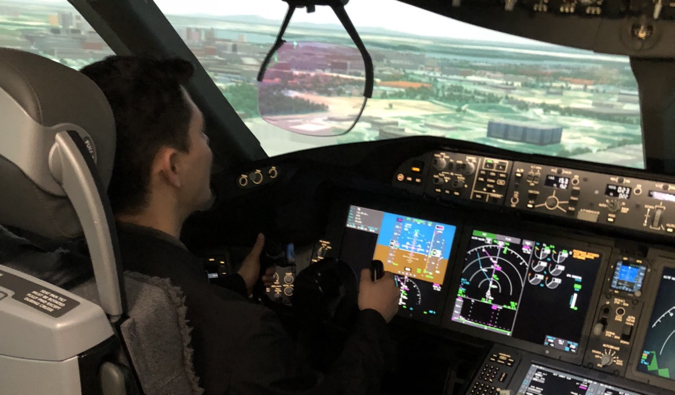
“Ready?” he asked as I stepped back into the seat.

“YES!”

We started in midair, he released the controls, and I flew around a simulation of Singapore for a bit.

“Not bad,” he said. “Ready to land?”

“Sure, but can we do a go-around?”

Taking the controls, I aborted my landing, turned up, and banked left so we could do one more circuit. Just as I was enjoying the bliss of the computer-generated scenery, I crashed!

I had forgotten to look at the screen and see my altitude, so while I thought I was just going left, I was actually banking down — and boom! We died.

I guess I won’t be a pilot anytime soon. There is a surprisingly large number of controls and numbers you need to pay attention to on a modern aircraft, especially when you release the autopilot!
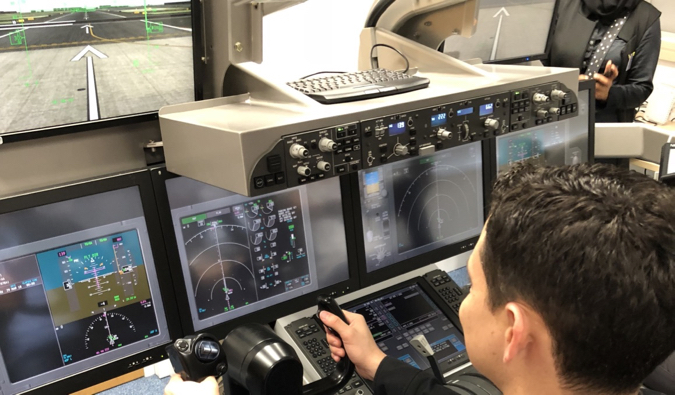
Afterward, we got to go into another simulator that allowed pilots to practice takeoffs. It wasn’t a full-motion simulator, but it was designed to get you to take off and feel the movement of the controls.

This time, I successfully, took off and no one died. So you’re safe with me!

***

For a long time, I’ve been terrified of flying — and watching a plane get built and learning about aviation did nothing to assuage that fear. I’m still unnerved by every little bump (the flight I am currently writing this on has been nothing but bumps!), but I have a new appreciation for how complex and strong planes are, how many safety systems are built into them, how hard it is to fly one, and just how damn amazing it is we live in the age of jet travel!

Editor’s Note: I was a media guest of Singapore Airlines and Boeing for this event. They covered all my expenses during these press days.

Flying at 35,000 Feet with Heather Poole

Heather PooleI first met Heather Poole at a travel blog conference. We got along very well and I had been reading her blog for awhile. She writes about life as a flight attendant. Recently, she published a book, Cruising Attitude: Tales of Crashpads, Crew Drama, and Crazy Passengers at 35,000 Feet, about life as a flight attendant. I, ironically, picked it up at an airport and read it on a plane. She found time at 35,000 feet to talk about her job and book.

Nomadic Matt: You’re a flight attendant. What’s that like?
Heather Poole: Even though the job has changed a lot over the years, it can still be a lot of fun. But patience is a must, more so than ever before. Flight attendants are the face of the airline, and passengers have a tendency to take things out on us, even if what happened is not our fault. Besides being friendly and outgoing, we also have to be able to adapt to change easily. This is why we always have backup plans A, B, and C, because there’s always something bound to go wrong in the airline industry: mechanicals, delays, cancellations. They happen. Even on Christmas Eve. If there are kids at home, this can be one of the most difficult aspects of the job. Flight attendants also are very independent. It’s not uncommon to meet a coworker for the first time on a trip and then not see them again for a few months, maybe even years. The best part about the job is when we step off the airplane; we always leave the stress of the flight behind. Every flight is a new flight, which means every day is a new adventure.

How often do flight attendants work? Do they fly a lot of the same routes over and over again?
Our schedules average around 85 hours a month. But don’t let the number fool you. That’s flying time only. Most flight attendants work way more than that. Time on the ground doesn’t count toward our pay and therefore isn’t included in our monthly schedules. This is why we want to spend as much time as possible in the air, not hopping from city to city with lots of time between flights on the ground. Airline seniority determines the kind of trip a flight attendant can hold. This explains why most international long-haul flights are staffed with senior crews. Once we have enough seniority to hold a good trip, it’s the only trip we’re going to work until we’re senior enough to hold an even better one. Schedules are set up with a day or two off between each trip, but many of us will “trip trade” with other flight attendants to work a few trips in a row in order to maximize our time off on the ground.

Any hint on the airline you work for?
One of the big ones.

What did your coworkers think of you writing this book?
I don’t know that most of them even know I’ve written a book. And if they do know, they probably just assume I’m still writing it. I’ve been talking about writing this book for years.

Did your airline know, and were there any restrictions placed on you?
I didn’t ask for their permission to write the book, and I certainly didn’t call anyone up at headquarters to make an announcement about it either. Flight attendants learn to lay low very early on in their careers. But I’ve been blogging about flying for a long time. I’m fairly certain they know who I am. Just keep in mind my book is not an airline exposé. It’s about what it’s like to be a flight attendant. It doesn’t really matter who we work for; the job is pretty much the same wherever you go. Plus half of the book takes place on the ground, because it’s not just a job, it’s a lifestyle. That’s what I set out to write about. Plus, there are so many misconceptions about flight attendants I decided to set the record straight.

What is one really juicy story you left out?
One story that got deleted was about a celebrity who claimed to have magical powers after a passenger fell unconscious. To this day, we still don’t know if it was his magical powers or the husband who kept nudging his wife in the arm in an effort to make her come to and see the celebrity he was excitedly talking about that made her gain consciousness again.

With so many changes to the airline industry over the years, would you recommend that someone become a flight attendant?
It’s a great job for someone who hates the idea of working a 9-to-5 job. But it’s not easy in the beginning. Our living conditions are pretty extreme. This is why so many flight attendants either last a lifetime or just a few weeks.

Has the job gotten worse over the last few years because of all the problems in the airline industry?
Of course it’s gotten worse, just like lots of other jobs in America. Most people don’t know that flight attendants start out making $14,000-18,000 the first year. With cutbacks, they’ll be making less! So not only do we make less, we’re working much longer hours followed by shorter layovers. Think 8-10 hours at an airport hotel on domestic routes. Mix in a delay, and there’s barely enough time to eat, sleep, AND shower. That said, I’m still flying and I don’t feel like quitting — yet. Once I can no longer manipulate my schedule the way I want/need to is the day I might have to say buh-bye. I dread that day.

In the book, you talk about how New York City is your “base,” but I know you don’t live in NYC. How can a flight attendant be based somewhere they don’t live?
Instead of driving to work, we take a plane to work. It’s called commuting, and it’s getting harder and harder to do these days. I once saw two flight attendants come to blows over the one and only jump seat on the last flight out. Between trips we stay at a “crash pad.” Instead of paying for a room, we pay for a bed. Sometimes we’ll even share the bed (not at the same time!). Commuters mean business. We’re in and out as quickly as possible. The name of the game is to get as many flying hours in as we can in a short amount of time, so we can fly back home and enjoy a stretch of days off before we have to do it again.

Are a lot of people getting into the profession these days?
In 2010 Delta announced an opening for 1,000 flight attendants. Over 100,000 people applied. These days it’s much harder to find work with an airline now that being a flight attendant is considered a career, not just a job. Turnover isn’t as high as it once was, and competition has gotten fierce.

In your book, you talk a lot about the difficulty in dating as a flight attendant. As someone on the move a lot, I can relate to that. Do lots of flight attendants have problems dating? Do they all end up with pilots?
It’s hard enough dealing with an unusual job without finding a partner who can deal with it. This is why so many relationships end up crashing and burning after someone in the relationship becomes a flight attendant. Because it’s either quit or break up. Then of course once you find someone, it takes twice as long to realize that person might not be right for you due to the fact that we’re not on the ground as often as regular people. And then there are those who want to date flight attendants just because it’s easier to juggle multiple partners when one of them isn’t home half the time. As for pilots, we tend to either love them or hate them, maybe a little too much! To be fair I’m pretty sure the same thing can be said for the way they feel about us.

If you could tell people three things on how to behave on a flight, what would they be?
Be nice. Be nice. Be nice. We’re all in the same boat — er, plane — together. Wait until we’re safe and sound on the ground if you must freak out.

Any tips for getting an upgrade from coach?
Do people still think there’s a chance of that happening? Don’t get me wrong, miracles do happen, but not often. Flights are full, and frequent fliers know exactly where their name is on the list these days.

What’s the secret to at least getting an extra meal or free drink?
Very rarely do we have extra meals on board. In first and business class we’re usually catered right on the money. In coach we barely have enough to serve half a plane full of passengers who are willing to purchase food. As for free drinks, flight attendants have been known to comp drinks to passengers who help out by doing nice things like switching seats so a family can sit together.

You can find out more about Heather Poole on Twitter. You can click here and get her book from Amazon.

2019年7月25日星期四

Uber Is Partnering With NASA — How Soon Can We Really Expect to Fly to Work?

Uber is pushing to become the world’s next airline — without buying any planes. Instead, the company believes that a fleet of flying cars could solve the dilemma of daily commutes to work and between meetings in our growing, congested cities.

And with the announcement on Wednesday that Uber has secured a contract with NASA to develop software to make “flying taxis” possible, that push seems one step closer to reality.

The private car service company's argument is compelling. As the company reports in a whitepaper about its vision for “vertical take-off and landing” —  or VTOL — vehicles:

“The average San Francisco resident spent 230 hours commuting between work and home — that’s half a million hours of productivity lost every single day. In Los Angeles and Sydney, residents spend seven whole working weeks each year commuting, two of which are wasted unproductively stuck in gridlock. In many global megacities, the problem is more severe: the average commute in Mumbai exceeds a staggering 90 minutes.”

We can all relate to that. After growing up watching George Jetson take off each day in his automobile-briefcase-spaceship-thingamajig, who wouldn’t want to fly to work instead of sitting on a highway?

The idea of flying through McDonald's for a burger, as imagined by Luc Besson in “The Fifth Element” is somewhat appealing. But if the movie taught us anything, it’s that you never know when a superhuman will fall from the sky and wreck your ride — and that managing a fleet of flying taxis is somewhat complicated.

Flying Uber

So how realistic is Uber’s plan, announced earlier this year, to start offering flying taxi services in Dallas, Dubai and Los Angeles by 2020?

We asked an expert industry watcher, Tim Robinson, editor in chief of AEROSPACE, the flagship magazine of the Royal Aeronautical Society in London. As it happens, the future of flying cars is something of an obsession for him.

“[2020] is only two years away now, unless they have something hidden in Area 51. I don't know how exactly that would work. Airbus reckons it might be ready in 5-7 years, at least in terms of a full workable model. The key is going to be getting a regulator who will let you trial this. So Dubai is a good example,” Robinson said. “Interestingly, the Chinese Ehang — the one-person passenger drone — will be trialed in the U.K. next year ... These are small-scale trials, so I think 2020 would be a little bit optimistic.”

Ehang isn’t the only one-man drone to fly. The Lilium Jet, developed by intrepid entrepreneurs in Germany, has also had a successful maiden flight in Munich this year, and earned $90 million in funding to see the project through.

“This is an area where there is a lot excitement and there are a lot of startups getting involved,” Robinson said. But a lot of pieces still have to come together: “I think you need people who understand safety, and who understand that it's going to be part of a system as a whole ... If your small quadcopter goes wrong in mid air, and you lose your drone, that's fine, but with people onboard it's a different process.”

And after addressing airworthiness and safety, there's more, he says.

“Second, how do you integrate flying cars? How does it work in the airspace? How does it link? Have you got the infrastructure thought out? How will it integrate with [air traffic control]?” Robinson asked. “Those things separate the more sort of science-fiction ones from the people with a realistic chance of making this work.”

Take-Off Delays

In fairness to Uber, they’ve addressed some of these questions.

During the Web Summit conference in Lisbon on Wednesday, Jeff Holden, Uber’s chief product officer, announced a new partnership with NASA to develop a dedicated air-traffic management system which would support the company’s plans to launch flying taxis.

NASA said that it intends to extend programs already underway with the FAA to manage the airspace for drone applications. Uber would be part of the fourth phase of this program, which is scheduled to start in 2019.

In their proposal for flying taxis, Uber also addresses some of Robinson’s other questions by suggesting that it could use existing urban infrastructure, like helipads. Plus, Uber argued in its proposal, building VTOL infrastructure based on a “distributed network of ‘vertipoints’” would be cheaper than building more roads and bridges. Besides, VTOL aircraft would be electric and would reduce the CO2 impact of today’s cars and, Uber says they would be much quieter than cars for this reason.

Robinson is not so convinced about the noise, though, when considering estimates of future fleets of 30,000 cars flying around in a city.

“If you think of a small quadcopter drone, and the buzzing sound it makes, can you get the noise down?” he asks, and Uber says it can: “At flying altitude, noise from advanced electric vehicles will be barely audible. Even during take-off and landing, the noise will be comparable to existing background noise.”

Uber also believes the problem of air traffic management can be fixed, sort of. “Urban airspace is actually open for business today, and with ATC systems exactly as they are, a VTOL service could be launched and even scaled to possibly hundreds of vehicles,” Uber proposes. Part of their argument is that VTOL would fly at much lower altitudes than airplanes and might not even need air traffic control as we know it today. Automated systems might do a good job to separate VTOL from drones and helicopters. Still the ride-share company is aware that there may be some complications. “There are promising initiatives underway, but they will play out over many years and their pace may ultimately bottleneck growth,” Uber states. Robinson sees another hurdle for flying taxis which might be harder to overcome: our fear of flying. That’s been around for years, even though airplanes are the safest form of transport. Robinson believes the solution might be found on the ground. “If people get used to driving in autonomous cars, then small pilotless air vehicles is less of a leap,” he says. “Eventually, people would be so accepting of autonomy that it will be like getting on a lift with no lift operator today; or getting on an autonomous train or subway system. Nobody thinks twice about that. Or chairlifts or cable cars.” Bottom line, both Uber and Robinson agree that a future full of flying cars is a very exciting prospect.

Our Top 6 Flying Cars

With many VTOL aircraft proposals in development, these are the five flying cars we’re most excited about.

12 Steps to Getting Over Your Fear of Flying

Humans are not meant to be airborne — or at least that’s what people like me, who are terrified of flying, like to tell whoever is sitting next to us on our transatlantic. Like most others who share this particular fear, my early life was characterized by carefree travel. It wasn't until my early 20s that I started panicking every time I needed to catch a plane. I became certain that this would be the flight to buck all those safety statistics.

Still, Pinterest boards and Instagram photos taunted me. Everyone photographed in travel imagery frolics or lounges — there's no sign of the shaky mess I become just thinking about flying to the Caribbean or Santorini. When I fly, I have to dose up on anti-anxiety medication just to step on board, and then I sleep my way to the destination.

I’m not the only wannabe adventurer that gets uncomfortable on airplanes. Technology has evolved far faster than human biology, so while we want to be as futuristic as the machines we’ve built, I like to think our more basic instincts are still catching up. To me, everything about being in an airplane — sitting in cramped quarters, not being in control, being literal miles up in the air — makes me feel in danger, like prey.

I have faith that all of us can conquer this fear. To test the theory, I’ve compiled techniques for combating the phobia, in hopes of making everybody's dreams of far-flung adventuring come true. As is the case with any treatment, not every solution presented will be a cure-all; what may work for one could do nothing for another. And it’s important to treat any phobia conquest as a gradual process that (like, oh hey, an airplane flight) will have its ups and downs.

What It's Really Like Flying Business Class on Emirates

Many years ago, when I flew Emirates for the first time—to India via Dubai—my experience was a revelation. This was the early days of the Middle Eastern carrier’s expansion, and it hadn’t yet entered entered into the global consciousness as a world-class brand. Yet here was a thoroughly modern experience: brand-new aircraft product; a sophisticated, international flight crew; some of the best entertainment, dining, and amenities in the air.

On that trip, I flew both in business and in first class—first was especially noteworthy, with semi-enclosed cabins which at that time were a totally new phenomenon—and both were exceptional experiences. I felt I had definitely experienced an airline on the up and up, an assessment that proved correct.

Fast forward to today and, despite that positive early experience, I haven’t actually flown Emirates too much over the years. Although the airline’s rapid expansion of routes and fleet—including its enthusiastic and early embrace of the Airbus A380—make routing through its Dubai hub easy, for those of us who guard our status in one alliance or another, the inability to earn miles/points from Emirates flights on most of the major carriers serves as a not insignificant deterrent. (If you’re a loyalist of Alaska, Virgin America, or JetBlue, or a handful of international carriers like Korean Air, Quantas, and Japan Airlines, then you’re in luck, but those with status on American, United, or Delta won’t accrue points from Emirates flights—no matter how long.)

So a few months ago, when Emirates offered to fly me in business class to the Seychelles via Dubai—the carrier has some of the easiest connections to the Indian Ocean nation—I decided to give it a go, to evaluate whether it’s worth it for most travelers to forego the miles in exchange for what is meant to be an exceptional experience.

My conclusion is that Emirates, at least in business class, still stands out relative to other carriers in certain aspects and is on par with top-tier competitive products in most others, and it’s therefore well worth considering, particularly in instances where direct flights from the U.S. to your final destination are not an option and the routing through Dubai provides a convenient connection.

Read on for a step-by-step description of the experience on one leg of my journey: flying home to New York from Dubai on an A380.

10 of the Most Over-the-Top Flight Amenities Available in First Class

Airlines are one-upping each other in order to attract first and business class passengers who demand one-of-a-kind inflight service, high-end amenities, and cuisine from award-winning celebrity chefs. And that’s just the beginning.

Take Etihad, the national airline of the United Arab Emirates. For travelers with deep pockets, it offers The Residence, a three-room suite including a living room, a separate bedroom with a double bed pristinely tucked in Pratesi fine linens, and a private bathroom complete with an en-suite shower. If that weren’t enough, the cabin comes with your very own personal chef—meals will be served on 24-karat gold-plated tableware as well as crystal glassware designed by Vera Wang for Wedgwood—and a dedicated butler. Said butler will be in constant contact with a concierge team on the ground that can book tables at top restaurants in London or hard-to-get theater tickets in New York City. If you’re traveling with kids, the Flying Nannies program—entertaining kids with crafts, magic tricks, and more—is sure to appeal.

Read on for 11 more airlines that make flying something to be enjoyed, not just endured.

12 Photos That Make Us Miss the Golden Age of Flying

With so many complaints about airlines today from baggage fees to limited in-flight service, it seems nearly impossible to imagine a time where flying was luxurious. But in honor of Scandinavian Airlines’ 70th anniversary, the company has released select images showing off the Golden Age of plane travel.

Taken in the 1950s through 1980s, these photos reveal the lengths they would go to provide a fine dining experience—a far cry from the microwave meals we have today. The pictures show smiling guests as they are greeted by flight attendants who are carting everything from caviar and lobster to a whole leg of carved ham.

The cabin crew is seen using real knives, clearly a sign that these flights were before the days of constant security threats. And there would even be a chef in formal garb, down to the toques, preparing a seafood platter for the passengers.

Other features of this nostalgic time included the use of porcelain teacups, and guests were offered a wide variety of drinks including beer, wine, and champagne to complement their trips. In addition, many of these photos were taken before there were different classes on the airplanes, so everyone got the royal treatment.

Menu items (yes they had menus) at that time featured things like consommé, roast chicken, crepes with mushrooms and bacon, and Bavarian cream with rum.

More images are set to be released closer to the anniversary, but take a look through these incredible images of the Golden Age of flying in the meantime.