
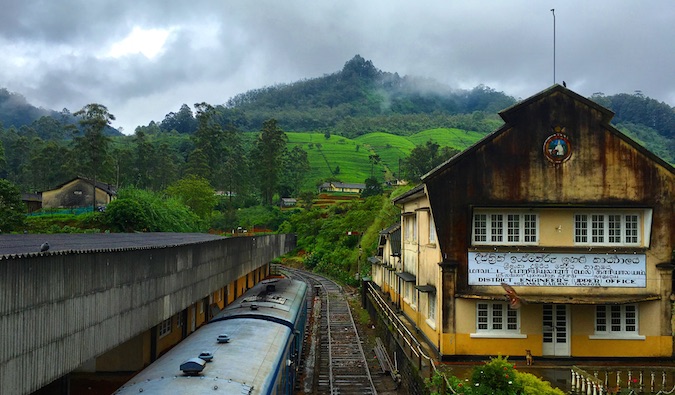
Updated: 1/5/2019 | January 5th, 2019
1/5/2019 | January 5th, 2019
My visit to Sri Lanka — a jewel–shaped country in the Indian Ocean — was an unexpected surprise. I didn’t have a lot of expectations for the trip. But it turned out to be an amazing experience. I loved every bit of Sri Lanka: the verdant landscape, the delicious food; the crumbling, overgrown ruins; the abundant wildlife; and (especially) the welcoming locals who took hospitality to the next level.
Traveling Sri Lanka is a relatively easy thing to do. It can be a little chaotic, with overcrowded buses moving along clogged roads where lanes are mere suggestions, and trains packed to the gills with people hanging off the edges (which actually is kind of fun). But English is widely spoken so once you get used the chaos, it isn’t too difficult to get around.
But there are a few things you should know before you visit Sri Lanka to avoid getting scammed, overspending, and, like me, missing some of the scenic trains!
Here’s my guide to visiting Sri Lanka:
Sri Lanka Travel Guide: 14 Things to Know for Your Visit
Travel Tip #1: Don’t drink the water – You shouldn’t really drink the water in Sri Lanka, so bring a reusable water bottle with a purifier. It’s really hot, so to keep hydrated, you’d probably spend 300 rupees ($2 USD) per day on plastic bottles of water at 60 rupees ($0.40 USD) each. But a water bottle with a purifier costs just $20 USD (though my preferred brand Lifestraw is slightly more). Over the course of a two-week trip, that’s an $8 USD savings (and you help the environment too)!
Travel Tip #2: Eat the local food– Outside of the major cities of Colombo and Kandy, you won’t find many non-Sri Lankan or non-Indian food options. What you do find is a poor excuse for Western food that is overpriced and often a chain. Stick to the local food! It’s super delicious. I never knew much about Sri Lankan food before hand but now I’m hooked! Just eat it all! Balaji Dosai in Kandy; Ahinsa in Sigiriya; Upali’s in Colombo; Hot Hut in Nuwara Eliya; and the restaurants across from the bus station in Anuradhapura were some of my favorite.
Travel Tip #3: More about food– Food, besides being crazy good, is also really cheap in Sri Lanka! Local food costs about $1-3 USD per meal for simple dishes of dosas (a kind of pancake), kottu (a dish made of roti (flatbread), vegetables, egg and/or meat, and spices), rice, chicken, and everything in between. At restaurants with table service, you’ll pay closer to $5 USD.
Travel Tip #4: Sri Lanka isn’t a party– Don’t expect too many chances to drink alcohol. Outside the coastal tourist towns and the capital of Colombo, there isn’t much nightlife or opportunities to drink. While you can always crack a beer at your guesthouse, Sri Lanka isn’t home to a big drinking/nightlife culture. Expect your nights to be tame.
Travel Tip #5: Hire the Tuk-tuks– You can hire drivers cheaply. Any tuk-tuk driver will let you hire them for the day. Expect to pay around $20 USD for the day. Moreover, tuk-tuk drivers are pretty honest, except in Colombo, where they will try to scam and overcharge you. Elsewhere in the country, you’ll get a fair deal. There’s no need to try to bargain hard.
Travel Tip #6: Take the airport bus – There is a train to the airport you can take from Colombo Fort. It’s the cheapest way to get there, at 30 rupees ($0.20 USD). A tuk-tuk ride is about 2,500 rupees ($17 USD), and buses to the airport cost 110 rupees ($0.75 USD) and leave about every 30 minutes from Colombo Central Bus Station or Mawatha Bus Station.
Travel Tip #7: Travel by train: Train travel, while often slower, are the cheapest way to get around. Some typical routes: Colombo to Jaffna is 150-445 rupees ($1-3 USD), Jaffna to Anuradhapura is 150-295 rupees ($1-2 USD), Kandy to Nuwara Eliya is 85-280 rupees ($0.60-1.90 USD), and Colombo to Galle is 150-295 rupees ($1-2 USD).
Travel Tip #8: Book your train in advance: If you are taking the scenic train from Kandy to Nuwara Eliya or Ella (or vice versa) and want a seat, book it in advance through a travel agency, as tickets can’t be booked in person at the station unless it’s done four days before departure. You can always (and only) get a cramped second-class ticket (where you’ll learn the new meaning of a tight squeeze) on the day of departure. Many people will tell you to get to the station at 7am to buy a train ticket, but they don’t start selling them until 8am, so don’t listen to those people. Also, the concept of “sold out” doesn’t apply to “cattle class.”
Travel Tip 9: Show up early at Sigiriya: If you are visiting Sigiriya, get there when it opens at 8am to avoid huge lines and crowds at the site. If you are there after 10am, the crowds are so overwhelming it’s not worth visiting. It takes an hour to walk up as it’s single-file all the way!
Travel Tip 10: Skip the ticket line at Anuradhapura: If you are visiting Anuradhapura, tickets are $25 USD but are never checked unless you are entering the museum. (I also noticed Western tourists were the only ones ever asked to show a ticket at the museum.) Enter the site without paying by using the tiny road just southeast of the museum.
Travel Tip #11: Bring flip-flops to temples: You’ll have to take your socks and shoes off before visiting temples, even if they are outdoors, so bring flip-flops to keep your socks clean!
Travel Tip #12: Don’t expect high-end hostels: Hostels are really basic (fan, mosquito net, electric shower) but at $4-6 USD per dorm bed, you can’t go wrong.
Travel Tip #13: Day trip to Galle: Galle is only worth a day trip. Don’t stay over in the town. There is not much to do there at all.
Travel Tip #14: Find cheap accommodation: There are a lot of cheap accommodation throughout the country. You’ll usually get breakfast with your room too. Private rooms with your own bathroom start at $10 USD per night. Add $5 if you want air conditioning.
Visiting Sri Lanka: How Much Does it Cost?
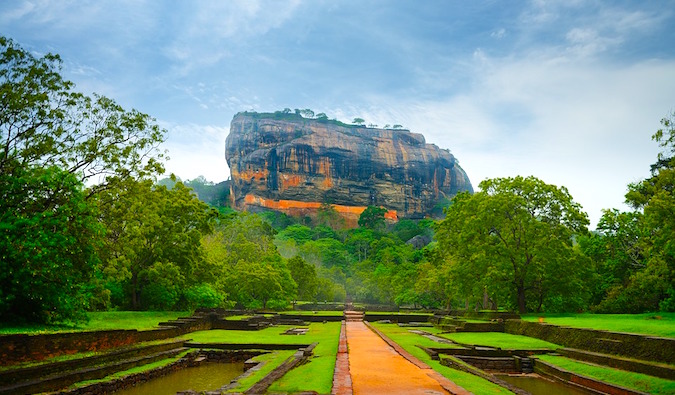
Sri Lanka is a cheap country to visit. Even when you splurge, it’s not that expensive. Overall, I would say you couldn’t need more than a budget of $30 – 40 USD per day. The country is very cheap, especially if you stick to delicious local or Indian cuisine (the food is so cheap there’s no reason to grocery shop and cook your own meals), avoid the overpriced Western style restaurants (local food tastes much better anyways), travel second class and on buses, and don’t go crazy with the accommodation. Ever though I was on a budget, I didn’t go as low as I could (dorms every night, only Sri Lankan food, minimal activities, etc) and still found it was hard to break the bank. The expensive days in which I took a tour or decided to try some fancy restaurant were balanced out on the other days I didn’t.
Sri Lanka is a cheap country to visit. Even when you splurge, it’s not that expensive. Overall, I would say you couldn’t need more than a budget of $30 – 40 USD per day. The country is very cheap, especially if you stick to delicious local or Indian cuisine (the food is so cheap there’s no reason to grocery shop and cook your own meals), avoid the overpriced Western style restaurants (local food tastes much better anyways), travel second class and on buses, and don’t go crazy with the accommodation. Ever though I was on a budget, I didn’t go as low as I could (dorms every night, only Sri Lankan food, minimal activities, etc) and still found it was hard to break the bank. The expensive days in which I took a tour or decided to try some fancy restaurant were balanced out on the other days I didn’t.
Here is a list of prices to help you get an idea of costs in Sri Lanka:
- Airport taxi – 2,500 rupees
- National Museum in Colombo – 600 rupees
- Train from Jaffna to Anuradhapura – 340 rupees
- Bottle of water – 60 rupees
- Bus from Anuradhapura to Dambulla – 340 rupees
- Tuk-tuk from Dambulla to Sigiriya – 1,000 rupees
- Kottu chicken (and water) – 370 rupees
- Lunch 2 – 500 rupees
- Tuk-tuk – 200 rupees
- Bus from Dambulla to Kandy – 98 rupees
- Hostel in Kandy – 600 rupees
- Temple of the Tooth in Kandy – 1000 rupees
- Dosai dinner in Kandy – 200 rupees
- Train to Nuwara Eliya, second class – 160 rupees
- Beer – 500 rupees
- Bus to Tissamaharama (Tissa) – 240 rupees
- Bus to Galle – 307rupees
- Western lunch in Galle (burger and fries) – 1,200 rupees
What to See and Do in Sri Lanka: Itineraries By Region

Where should you go in Sri Lanka? Everywhere – if you have the time! Most travelers focus on the southern half of the country, with its hiking and beach towns. After decades of war, the north has a legacy of destruction that has yet to go away.
Where should you go in Sri Lanka? Everywhere – if you have the time! Most travelers focus on the southern half of the country, with its hiking and beach towns. After decades of war, the north has a legacy of destruction that has yet to go away.
Though I originally had planned to explore only the south due to my limited time there, I was offered the opportunity to talk to a member of Parliament in Jaffna up north and learn about the Tamil war, so I rearranged my route thus:
Colombo – Jaffna – Anuradhapura – Sigiriya/Dambulla – Kandy – Nuwara Eliya –Tissamaharama (Tissa) – Galle – Colombo
I was glad I did. Seeing the north gave me an added perspective on a portion of the country without hordes of other tourists. In fact, in my time up north, I saw only four Westerners.
And though Sri Lanka may look like a small island, there is a lot to see and do there! More than I imagined. Anuradhapura and Sigiriya both have amazing ancient ruins. Kandy is filled with hiking treks, a big Buddhist temple, and a butterfly garden. Nuwara Eliya is known for its hiking, Tissa is the gateway to Yala National Park (which has elephants and leopards), and Galle is a beautiful old Dutch fort town.

Even though I covered a lot of ground in my two weeks, I still missed many places, including Ella (more hiking), Arugam Bay (beaches), and most of the southern coast (more beaches and nightlife). I raced through the country and crammed too much into such a short period of time. I wouldn’t recommend going at such a breakneck pace.
Even though I covered a lot of ground in my two weeks, I still missed many places, including Ella (more hiking), Arugam Bay (beaches), and most of the southern coast (more beaches and nightlife). I raced through the country and crammed too much into such a short period of time. I wouldn’t recommend going at such a breakneck pace.
Where should YOU go?
I would break your Sri Lanka travels into two parts — the north/center and the south — and focus on one of those regions. There’s simply too much to do in the country and travel (buses and trains) around the country is too slow to try to cover so much ground in a limited time.
Unless you have more time, then the world is your oyster!
Suggested Sri Lanka Itineraries
Southern Route (two weeks): Colombo – Hikkaduwa – Galle – Mirissa – Tangalle – Tissa – Ella – Nuwara Eliya – Kandy – Colombo
Northern Route (two weeks): Colombo – Nuwara Eliya – Ella – Kandy – Sigiriya – Anuradhapura – Trincomalee – Jaffna – Colombo
North and South (four weeks): Colombo – Jaffna – Trincomalee – Anuradhapura – Sigiriya – Kandy – Nuwara Eliya – Ella – Tissa – Tangalle – Mirissa – Galle – Hikkaduwa – Colombo
If you have a month, you could do this entire route plus add in the coastal towns of Arugam Bay and Negombo. With two weeks, focus on either the southern coast or the central/northern areas.
One thing to know is that once you’ve done the major things in a city, there’s very little reason to stay. For example, Tissa is the gateway to Yala National Park. Tour operators run most tours in the early morning (a higher chance of seeing animals) so if you took one of those tours, you could be on a bus moving on to your next destination by lunch time. There’s really not much else in the town. The same could with Jaffna. Tick a few boxes and then move on. Galle is more a day trip from a nearby beach town than a place to spend a few days. There was so little to do there I just went back to Colombo instead of staying the night. Sigiriya and Dambulla can be done in two nights (though I added an extra night because I liked the family I was staying with). Nuwara Eliya, Ella, Kandy, Arugam Bay, Trincomalee – those places have more activities and are worth spending a longer time in.
Where to Stay in Sri Lanka
For accommodation, I really liked the following places to stay in Sri Lanka. They were the best beds, had the friendliest staf, and were a great spot to meet other travelers.
Where to Eat in Sri Lanka
For restaurants, besides the list above (item number 2), I would also recommend the Ministry of Crab. It’s an expensive seafood restaurant in Colombo but it’s delicious! Sri Lankan crab is famous worldwide and they have gigantic ones. It’s not cheap but sometimes, you just have to treat yourself. While I didn’t go out much, if you find yourself in Kandy, the Slightly Chilled Bar is a popular meeting spot and has wonderful views of the city (and the sunset).
****Sri Lanka is an easy country to visit, and with a few tips, you can travel there with ease. This is a very budget-friendly country, even if you go nuts on the attractions and tours. I didn’t spend a lot of money, averaging just $35 USD per day. (Any expensive days will be balanced out with the cheap days where you just walk around, hike, or sit on the beach!)Sri Lanka is an easy country to visit, and with a few tips, you can travel there with ease. This is a very budget-friendly country, even if you go nuts on the attractions and tours. I didn’t spend a lot of money, averaging just $35 USD per day. (Any expensive days will be balanced out with the cheap days where you just walk around, hike, or sit on the beach!)
Looking at the map of Sri Lanka, you might say, “Oh, it’s not that big. I bet I can cover a lot of ground in a short period if time.” You could, but you won’t “see” much. It will be too much of a blur. There is a lot to see and do in Sri Lanka and it takes awhile to travel around. Don’t rush your trip.
Sri Lanka may be small but it packs a powerful punch. Take your time to see this land of jungles, waterfalls, monkeys, delicious food, and lovely people!
Book Your Trip to Sri Lanka: Logistical Tips and Tricks
Book Your Flight
Find a cheap flight by using Skyscanner or Momondo. They are my two favorite search engines because they search websites and airlines around the globe so you always know no stone is left unturned.
Book Your Accommodation
You can book your hostel with Hostelworld. If you want to stay elsewhere, use Booking.com as they consistently return the cheapest rates for guesthouses and cheap hotels. I use them all the time.
Don’t Forget Travel Insurance
Travel insurance will protect you against illness, injury, theft, and cancellations. It’s comprehensive protection in case anything goes wrong. I never go on a trip without it as I’ve had to use it many times in the past. I’ve been using World Nomads for ten years. My favorite companies that offer the best service and value are:
- World Nomads (for everyone below 70)
- Insure My Trip (for those over 70)
Looking for the best companies to save money with?
Check out my resource page for the best companies to use when you travel! I list all the ones I use to save money when I travel – and I think will help you too!
Photo Credit: 3, 4



 For a complete A-to-Z guide on solo female travel, check out Kristin’s new book, Conquering Mountains. Besides discussing many of the practical tips of preparing and planning your trip, the book addresses the fears, safety, and emotional concerns women have about traveling alone. It features over 20 interviews with other female travel writers and travelers. Click here to learn more about the book, how it can help you, and you can start reading it today!