显示标签为“100”的博文。显示所有博文

2019年7月26日星期五

The 'Travel is Expensive' Myth: $100 for 5 Days in Stockholm

the streets of stockholmWhen I came to Stockholm in July, I found myself spending around $100 a day. That’s a lot of money, even for Stockholm. Eating out and going out frequently jacked up my living costs enormously. While I preach about budget travel, I am often not the best budget traveler. After all, this is my everyday life, and when I want sushi, I want to eat sushi! So I tend to splurge more often than not.

But as I reflected on how much money I was spending, I wondered what would happen if I flipped the equation. How long could I make $100 USD last in Stockholm? What if I decided to be ultra-frugal? I wanted an answer, especially since one of the reasons many people don’t come to this city (or travel in general) is because it’s so expensive. So I set out upon a quest to answer a single question:

“How long can I live on $100 USD in Stockholm without sacrificing too much of the comforts that I enjoy while traveling?”

The answer: five days.

Where Did The Money Go?

It took me five days to spend my $100 USD. In order to keep my costs down, I couchsurfed with a friend the whole week (something anyone can do by using hospitality networking sites). I walked everywhere instead of taking the train. I cooked all my own food. I only went out to a bar one night. My money basically went to food: groceries, lemonades, and brownies (my friend didn’t have Internet so I had to visit Internet cafés), and a few drinks.

That was it.

How Does This Relate To You?

Museum island in Stockholm
I don’t think my results are replicable for the everyday traveler. This experiment wasn’t meant to be an example I think you should follow. Living like a pauper was boring. Incredibly boring. Sure, I did some stuff, but not nearly as much as I would have liked. It was hard to go out with friends because even buying a soda could bust my budget. See that movie? Nope. Eat out? Definitely not. Filling the days was easy: I walked around a lot, took the free walking tours, hung out in parks, did a lot of wandering, or worked. I was never bored during the day. But the nights? The nights were agony. Well, I watched a lot of movies on my computer or sat there nursing a beer because I couldn’t afford to buy more. When you can’t spend any money, there’s not much to do at night besides watch TV, work out, and sleep.

But the purpose of this experiment wasn’t to have you follow me. The purpose of this experiment was to show that when you are committed, it is possible to have some fun while making your money last, even in a city like Stockholm, home of the $10 McDonald’s value meal.

People always say travel is too expensive, but if I can survive on $20 USD per day in Stockholm, then the excuse that travel is too expensive doesn’t really cut it.

Realistically, your average traveler is going to spend that $100 USD quicker than I did, but this experiment proves there are always ways to stretch your budget. No destination need be off limits.

Yes, flights cost a lot of money, but luckily there are many ways to get free and extremely cheap flights. Once you get to your destination, there are plenty of ways to save money too. Cooking your meals, Couchsurfing or house sitting for free accommodation, taking the free walking tours, getting a tourist card — the list goes on. But those ways only matter if you are willing to stay focused and determined.

Even in Stockholm there is a happy medium between $100 a week and $100 a day. Using the above-mentioned tips plus some city-specific tips — like sticking to beer (spirits are expensive), lunch buffets, taking advantage of student/youth discounts, or eating at the street carts — one can travel here for $40-70 USD per day. At that price, suddenly your dream trip looks more like reality.

Gamla Stan Stockholm near Slussen

If you are focused, avoid unnecessary expenses, and think outside the “hotel/eat out/sightsee” box, every destination can be within your budgetary grasp.

And that’s really what this experiment was about. It had nothing to do with Stockholm specifically and everything to do with the fact that I wanted to show you the effect that budgeting and out-of-the-box thinking has on travel costs.

Do I want you to travel like this for a week? No. Is what I did sustainable over a long period of time? No way. The first thing I did when my experiment was over was go out for sushi and crack a bottle of wine.

But saying that a place is “too expensive” is never an excuse. A place is only too expensive in your head. Everyone has a different travel style and their own budget, but there are always ways to travel for less than you think.

Even in “expensive” Stockholm.

Get the In-Depth Budget Guide to Stockholm!
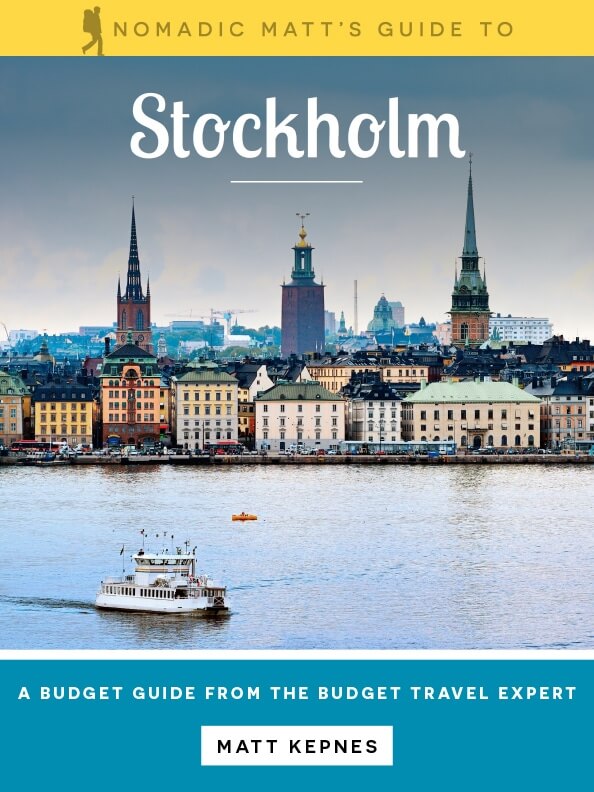
Nomadic Matt's Guide to StockholmFor more in-depth coverage of Stockholm, my 80 page guidebook is perfect for budget travelers like you! It cuts out the fluff found in other guides and gets straight to the practical information you need to travel and save money in one of the most beautiful cities in the world. You’ll find suggested itineraries, budgets, ways to save money, on and off the beaten path things to see and do, non-touristy restaurants, markets, and bars, and much more!! Click here to learn more and get started.

We’re 75% off completing this mission! Help us get to 100%!

Students from Victor
Dear fabulous reader,

I was in the shower (where I do some of my best thinking), pondering all the political fighting and social media outrage that seems to happen every week. Well, ok every day!!

Each day, people yell into the echo chamber.

I don’t know about you, but I have slight “outrage fatigue.” I can’t get up in arms anymore about a single speech or tweet, or what someone is wearing. I’m tired of it, and real problems don’t get solved that way.

They get solved by getting out there and doing something.

I recently read a great book called The Death of Expertise, which talks about how study after study has shown that people online tend to wall themselves off from opinions they don’t agree with because it’s easier than ever to just find information that confirms what you already believe.

But as travelers, we meet people from around the world. We experience cultures and values different than our own. I think is why travelers tend to be more open-minded than most. We have a broader perspective. We’ve been outsiders ourselves. We travel because we want to see the differences in the world, not hide from them.

Which is why, thinking about this topic, I am glad we have FLYTE, our community charity that raises money to send high school students on international trips to help expand their minds and put their education into practice. FLYTE aims to show kids that the world is much bigger — and full of more possibility — than they could ever imagine!

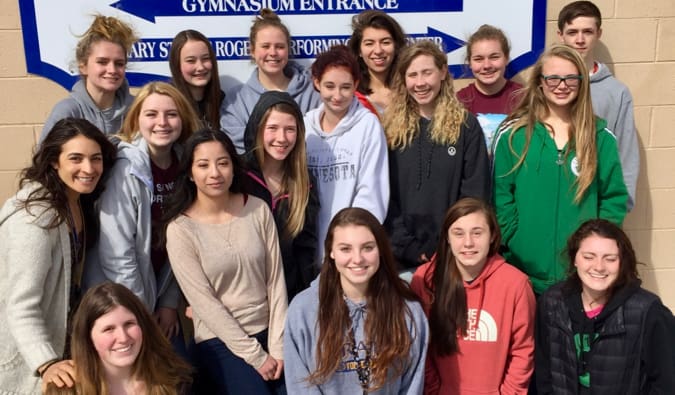
So far we’ve raised $26,000 to send these kids on a volunteering trip to Guatemala:

Students from Victor

These are the students from the Victor School in Victor, Montana, a small town of only 800 in rural Montana that is 96% white. Living so far outside a metropolitan area makes it hard for them to interact with a diverse range of people. Ten days in Guatemala isn’t a lot of time for us, but for these kids, it represents the start of a bigger, more important journey.

But we need another $7,000 more to make this trip happen!

And I’m asking for your help to help us get us to the finish line! On bended knee!

This trip is their chance to get out (even if only for a moment) and see the world, experience new cultures, and see the possibilities that exist beyond their small town. It’s a chance to spark an interest in the world and in education.

It is a chance to turn these kids — who, thanks to FLYTE, now have passports — into travelers and global citizens.

It is a chance for them put their schooling into practice.

It is a chance for them to see a world completely different than their own and develop empathy. To broaden their horizons and not just listen to what cable news or a curated social feed tells them.

It’s never been more important to broaden people’s perspective.

And it starts with these kids.

Because they will soon be the adults of the future.

For as little as $1, you can help us get there. If everyone who reads this website gave a dollar, we could make this – and many more like it – happen right away!

We can be the change we want to see in the world. Travel has done so much for us. So many people have been strangers in unknown lands.

If you’ve been wondering how you can pay it forward and get involved in building a better world, this is your chance.

I know this is a budget travel website and most of us don’t have a lot of money but for the cost of a few drinks, you can pay it forward and help great a new generation of responsible travelers!

  • $10
  • $25
  • $50
  • $100
$
    • One time
    • Monthly

NOTE: We are a 501(c)3 charity so your donations are tax exempt. (US residents only)

These kids, their teachers, and their parents will be forever changed by your generosity.

If you’re the type of person that believes love trumps hate, help us help these kids.

If you’re the kind of person that is looking for a way to spread the power of travel, help us help these kids.

Let’s pay all our travel kindness forward and send these kids from the small town of Victor to Guatemala!

Thank you so much for any support!

Sincerely,

Nomadic Matt

P.S. – Please help us share this organization and cause by forwarding this blog post to your friends and family or sharing it on social media! Let’s change some lives!

2019年7月25日星期四

You Can’t Join This Exclusive Club Until You’ve Been to 100 Countries (Video)

A globe-spanning Instagram feed may be considered the benchmark for being well traveled in 2017, but for the ultimate travel bragging rights, there’s the Travelers’ Century Club.

Billed as the world’s most elite travel community, the club is made up exclusively of people who have visited more than 100 countries — no small feat considering there are only 195 sovereign countries on Earth as defined by the U.S. Department of State.

Luckily for those interested, the club's definition of a country is quite broad, and has expanded to include 325 destinations like Prince Edward Island (a Canadian province) and Alaska (the U.S. state).

The club dates back to 1954, when it was founded in Los Angeles by a small group of world travelers, and has since expanded into a community of 1,400 members hailing from all around the globe.

Once admitted, members have access to a network of travelers with rare knowledge about little-known locales around the world. Want to know the best way to cross the treacherous waters surrounding the Pitcairn Islands? Or what to do if you find yourself in the middle of the Namib Desert with a flat tire? Travelers’ Century Club members can answer those questions and many more during regular in-person meet-ups.

Related: This Gorgeous Town in the Swiss Alps Will Pay You to Live There

Other member perks include organized travel excursions; educational seminars; social events across the 21 club chapters worldwide; access to exclusive guides that detail the world’s more difficult-to-reach destinations; as well as a membership card, certificate, and pin.

To apply, simply fill out the application form, tick off each of the 100 countries you’ve visited, and pay the $100 initiation fee. And just like that, you’ve got instant jet-set status.

This Is What Air Travel Will Actually Look Like In 100 Years

Say goodbye to turbulence, mechanical delays, and airport security lines, and hello to a slew of crazy innovations: according to insiders at Boeing, air travel is about to get a whole lot more exciting.

A hundred years ago, planes were limited to super-short flights (think less than a minute, in the case of the Wright Brothers) and military seaplanes. That’s when Boeing first entered the picture. So who is to say what air travel will look like in another century? 

If anyone is qualified to take a gander, it’s Brian Tillotson and Kevin Bowcutt, two of Boeing’s Senior Technical Fellows who specialize in space travel and hypersonics, respectively. They’re the ones on the front lines of aerospace innovation—engineers who think about crazy concepts like space travel and vertical liftoff, as well as practical innovations like airplanes that can diagnose their own mechanical failures or automatically avoid turbulence. Oh, and then there’s the whacky (but surprisingly practical) idea about making airplanes fully transparent—and not just so that you get a (scary) good view.

So on the eve of the company’s centennial, they talked to Travel + Leisure about the future of flight—in all its potential permutations. Also on the agenda were innovations that will change the way we travel to and through the airport—enhancements to security, the ways that smart home technology can enhance the safety and efficiency of airport terminals, and how our very day-to-day commutes might take to the skies.

It all sounds like something pulled out of the Jetsons, but some of these innovations are truly in the works—Tillotson and Bowcutt estimate that at least one of the following projects will actually come to fruition on a commercial scale by the year 2035. Others are further off in the horizon, but all are grounded in reality, whether they stem from existing technology or are in some early stage of development. Even if they don’t all pan out as expected, one thing is for sure: travelling in the year 2116 will be faster, greener, and a whole lot more exciting.