显示标签为“youve”的博文。显示所有博文

2019年7月26日星期五

6 Offbeat Things to Do in Istanbul

Offbeat Istanbul
This is a guest post by Emily Starbuck-Crone from Maiden Voyage Travel. Istanbul can be intimidating to first-time visitors, but here Emily offers some offbeat suggestions to dive into the heart of the city.

When I went to Istanbul, the big historical sites — the Blue Mosque, Hagia Sophia, Grand Bazaar, and Spice Market — blew me away. But I also wanted to find fun things to do that were less touristy.

Locals ended up giving us some great tips. One advised my partner and me to go to the Basilica Cistern, and that was the first we’d heard of it. This bizarre underground cavern turned out to be one of the highlights of my trip, and I didn’t even know it existed prior to that tip. I’m also glad that we heeded the advice to go to a real hammam (Turkish bath) rather than taking the easy route and going to a Westernized version in a fancy hotel.

Don’t miss Istanbul’s major sites. But once you’ve done them, here are some lesser-known gems and activities to explore:

Descend into the Basilica Cistern

A long hallway down the Basilica Cistern in Istanbul
I walked on top of this ancient cavern for days without realizing it. After entering an unassuming doorway and climbing down a gloomy set of stairs, we ended up in an underground former water reservoir built in the sixth century. It’s filled with centuries-old columns and is dim, only eerily lit in shades of orange. Koi fish swim in the standing water, and you have to walk on wooden planks to get around. You can hear drips echoing, and there are two mysterious statues with the head of Medusa. It feels like you’re in a scary movie.

Explore the Asian Side
Building on the Asian side of Istanbul
Istanbul is the only city in the world to straddle two continents; it spans from Europe to Asia. The Asian side, also called the Anatolian side, is separated from the European side by the Bosphorus Strait. You can take a bus over the famous Bosphorus Bridge, or you can ride over in a ferry. The city’s main tourist sites are on the European side, but if you’ve never been to Asia, it’s fun to cross over so you can say you’ve been there. If you’re interested in shopping, check out the popular markets in Kadiköy. Other worthy activities include touring the Beylerbeyi Palace, riding up to the top of Çamlica Hill for incredible views of the city, and strolling along Bagdat Caddesi to explore the many restaurants, cafés, and shops.

Visit a Real Hammam
(Picture not available—everyone was naked inside!)
Many of the swanky hotels in Istanbul have hammams, otherwise known as Turkish baths, but they aren’t the real deal. They’re made for Westerners looking for a cushy and modest experience. Real hammams have been a Turkish tradition for thousands of years, and they have served as both a place to cleanse and to socialize. Most hammams are separated by gender, and women generally go topless. You transition through several different rooms of different temperatures, one being a hot steam room much like a sauna. You can opt to pay an attendant to give you a thorough scrub-down — it’s rough but invigorating! We went to the Çemberlitai Hamami and really enjoyed it; another popular one is Cagaloglu. Both are in the Old Town.

Go to the Prince Islands
An offbeat activity is a horse and carriage ride through the streets of Princes' Island
This chain of nine islands off the coast of Istanbul provides a unique getaway from the crowds. An easy day trip during the warm months, the islands are just a quick ferry ride from the city. Most travelers visit the four larger islands, as the other five are very small and mostly residential. You can explore historic buildings, eat at tasty cafés, and see beautiful homes. Motorized transportation isn’t allowed on the islands, making them peaceful and quiet. You can get around by walking, bicycle, or horse and carriage.

Take a Ferry

View of castles taken from the ferry around the Turkish islands
A great way to explore this massive city is by boat. You’ll see many boats that offer paid tours of the Bosphorus, but if you want to save money and have more flexibility, take a regular ferry ride instead. The fare will be cheaper, and you won’t be competing for space with other tourists trying to take photos. You’ll pass by Topkapi Palace, the Bosphorus Bridge, gorgeous mansions, mosques with massive minarets, other castles and palaces, and more. You can hop off, eat some fresh seafood, and then head back.

Explore Jewish History

Jewish Istanbul
While Turkey is predominantly a Muslim country, it has a surprisingly long Jewish history. There are Jewish heritage tours you can take, or you can explore the stops on your own. Jews have lived in Turkey for thousands of years, but the population really grew during the Ottoman Empire (which includes some of Turkey) in the 1400s. Growth increased in 1492 when Spain expelled its Jews and the Ottoman Empire welcomed them (they had good business skills and came with money). Istanbul’s Galata and Balat quarters are steeped in Jewish history, and you can find historic synagogues there and in other areas throughout town. Istanbul also has a Jewish museum that is very good.

Watch the Fishermen on Galata Bridge
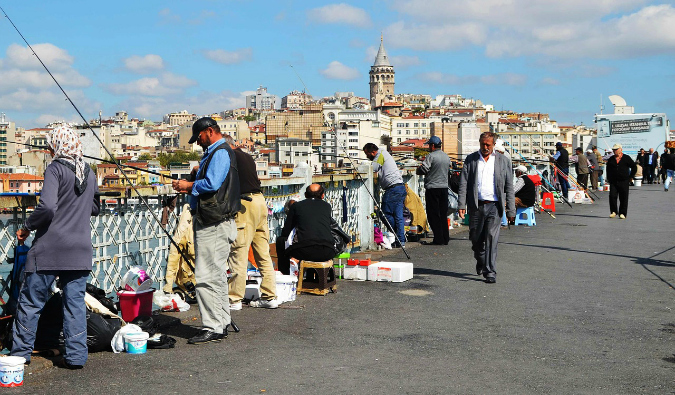
Lots of fisherman on Galata Bridge in Turkey on a cold day
Every day, dozens, if not hundreds, of local men form a row along the top level of the Galata Bridge and fish over the edge. It’s an incredible sight. They spend hours hoping to catch fresh seafood, and some of them will sell it to you while they’re still out there fishing. Many of the men don’t even make a catch; they seem to enjoy just standing there hanging their pole over the water. There’s also a fish market at the base of the bridge, and the many booths of fresh-caught fish are fun to look at (though it can also be a bit gross).

Istanbul is a very large and crowded city, and it can be intimidating. But it’s also home to some fascinating history. Regardless of how many of these attractions you’re able to fit in your first time in Istanbul, you’ll undoubtedly still be in awe of the city’s majestic architecture and complicated past.

Photo credit: 4

6 Lessons Learned from 3 Months in China

busy streets in china
China is a fascinating and rapidly changing country. Old customs and habits hang on as modern skyscrapers go up every second, the country becomes more of a global powerhouse, and people from around the world move there. Last year, my friend Scott Young, best known as a learning hacker who learned MIT’s entire computer science program in one year, said to me, “I’m going to travel the world for a year and learn languages.” I was thrilled with the idea! Today, he shares what he learned while living in China for three months — and how the media portrays countries is often very wrong.

Recently my friend Vat and I finished a three-month stay in China. The plan was, with minimal preparation, to arrive in China and speak as little English as possible, in order to learn Mandarin Chinese.

We shot a mini-documentary about the experience here:

The trip transformed my perception of China, from the unfair image it sometimes has in the West. In this article, I want to share the biggest lessons I learned about China, life, and travel from that experience.

Once you’re interested in the local culture, people open up more

scott with his homestay family in china
Originally Vat and I hadn’t planned on going to China at all. We were warned that China might not be the best place to meet friends, because people were unfriendly to Westerners. Instead, we were told to go to Taiwan.

Some visa complications made it impossible to stay the full three months in Taiwan, so we switched to a three-month stay in China at the last minute.

From the first day I arrived in Kunming, I had my perceptions flipped. Far from being insular and hostile to foreigners, people came up to talk to me the first time I went out on the street. It happened to be all in Chinese, so I didn’t understand much, but it did cause me to rethink my assumptions.

As my Chinese improved, this continued throughout my stay, from my landlord introducing me to people who could help us learn Chinese, to getting to know the couple who ran a noodle restaurant nearby.

If you’re interested in other people, their culture, and their language, they’ll be friendly to you. China isn’t an exception.

Don’t judge a country by its media coverage

colorful chinese streets with light trails photography
Hating China is a popular pastime of Western media. Some of the accusations are at least partially true: parts of China are quite polluted, political freedom isn’t the same as in the West, the Internet is firewalled, and some parts of China are quite poor.

I saw a very different kind of China. Kunming, where I lived for most of my stay, wasn’t polluted. I had frank conversations with Chinese people about communism, Tibet, and democracy. Some sites are blocked, but China has its own versions of YouTube, Netflix, eBay, and Google.

China is still developing, but the economic growth means that most people have seen their living standards improve rapidly in the last 20 years. People I spoke with were generally optimistic about the future.

Everything is food here

lots of food in a chinese shop
The relationship with food in China is fascinating, and I was amazed at the diversity of ingredients and flavors.

Western countries tend to simplify Chinese food down to chow mein, fried rice, and General Tso’s chicken. That’s a bit like saying Western cuisine is just burgers and sandwiches.

Chinese food in China, on the other hand, is some of the most varied food on the planet. Not only does regional diversity mean food can change completely from province to province, but nearly every imaginable ingredient finds its way into some kind of Chinese dish. Chicken, pork, beef, and vegetarian dishes are all options, of course, but where else can you eat fried insects, try stewed frog, or shop at a Walmart selling live turtles?

Food is also an avenue for connection. In the West, each individual has his or her own plate, separate from others. In China, each person has a bowl of rice and eats directly from shared plates in the center. While this style of eating makes it hard to dine individually in some restaurants, it creates a communal feeling, making food more than just nutrition.

Chinese is both incredibly interesting and extremely difficult

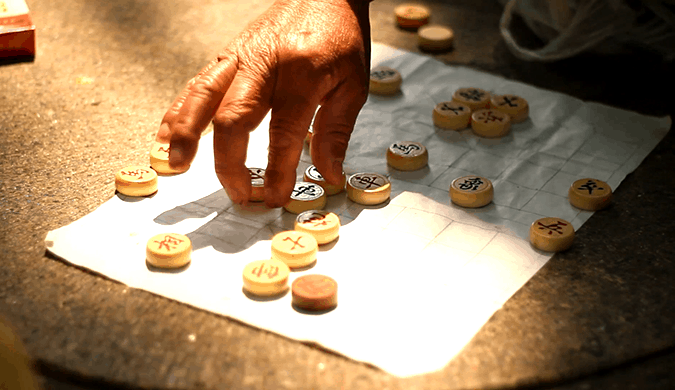
hand playing a complicated chinese street game
I won’t lie to you, learning Mandarin Chinese was a struggle. Thousands of characters, with many almost exactly alike. For example, try and spot the difference between these two characters:
chinese characters
Chinese is a tonal language, which means that the intonation doesn’t just change emphasis but also what words mean. My friend went to a restaurant and attempted to order “shu? ji?o” (boiled dumplings) but instead ordered “shuì jiào” (go to sleep).

Finally, few English words borrowed into the language survive unscathed, often sounding completely different from their original. McDonald’s, which is available throughout China, adopts the Chinese name “Mài dàng láo.”

While the Chinese language, like China itself, may seem daunting, it hides one of the most interesting linguistic systems on the planet. Chinese words have a tendency to be built up out of simpler pieces, like building a sentence out of Lego:

  • panda = “bear cat” (xióngm?o)
  • chameleon = “color change dragon” (biànsèlóng)
  • pumpkin = “south melon” (nángu?)
  • potato = “soil bean” (t?dòu)
  • university = “big learn” (dàxué)
  • movie = “electric shadow” (diàny?ng)

With great difficulties also come great rewards. Learning Chinese may have been mind-bending at times, but it also allowed Vat and me to interact with completely different people in China than an English-only perspective would allow.

Near the end of our stay, I conversed over tea with a tattooed Buddhist. Together we talked about Tibet, religion, and cultural differences. That conversation would never have happened had I refused to learn any Chinese.

You can count to 10 with one hand

The language differences extend even to simple gestures. The Chinese, for example, have a system of gestures for counting all the way up to 10 with just one hand.

If you’ve only been counting to five with one hand, you’ve been missing out. The Chinese have a system for counting 6, 7, 8, 9, and 10 all with just one hand. Months after leaving China, I caught myself using this method to count things while I held a book with the other hand.

One to five are what you’d expect, but see this video for six to ten:

The first time I saw this, I was in a store and the shopkeeper was telling me the price was 10 yuan, indicating it with forefinger and middle fingers crossed. I saw this several times before I realized they were telling me the price and not just holding out hopes that I’d come back to buy more.

China has the best places you’ve never heard of

incredible bamboo forest path
Ask people which places they know of in China and most people will raise their hand for Shanghai and Beijing. The more geographically inclined might get Sichuan, Guangdong, or Xi’an. But what about the tropical island of Hainan? The impressive winter festivities in Harbin? The bamboo forests in Chengdu?

It’s arguable that China has the same linguistic and cultural diversity as the entirety of Europe, except far fewer tourists. While — until the last few decades — China’s closed borders made travel in the country a daunting experience, China is full of great places you’ve probably never thought to explore.

I had never heard of Kunming, a “small” city of around seven million in the southwestern province of Yunnan, before researching places to live. It ended up being one of my favorite places I’ve ever lived in, with weather a perpetual spring, mountain temples, and lunch for under a dollar.

My advice: don’t settle just on Beijing or Shanghai as places to visit. Doing a little research online can turn up dozens of places that will offer the Chinese experience for less money and fewer tourists.

Everything you say is right and wrong all at once

stunning cityscape photo from the streets of china
I imagine that my American friends from Washington state would probably scoff at the generalization that they’re the same as everyone in Texas (and vice versa). Seattle isn’t the same as Houston. There are enormous variations in culture, food, and even language across the United States.

Now imagine that instead of having a history of a few hundred years as a nation, you had a few thousand. Instead of one or two mutually unintelligible languages, you had dozens, possibly hundreds. Now quadruple the population and you have modern China.

The biggest lesson to learn about China is just how big it is. China is hard to describe because few generalizations are very accurate. Depending on where you go, China will be impoverished or opulent, polluted or pristine, densely packed or nearly isolated. As such, everything I experienced and have written about will be true of some people who go to visit China and false for others.

China began as the backup country when visa complications came up. It ended as a place I can’t wait to go back to.

I can’t sell China as being a perfect experience, free of worries. English is sparse. You need to watch out for pickpockets and scams in the bigger cities. Pollution can be bad. The Internet can be frustrating. But if you want an adventure and a chance to change your mind about the world’s biggest, oldest, and possibly soon-to-be the most powerful nation on Earth, I highly recommend going yourself.

Scott Young writes about learning, travel and productivity at his blog, ScottHYoung.com. He tries to take complex things and make forming habits and learning easy and simple. You can click here to sign up to get a free copy of his ebook detailing strategies to learn anything faster.

2019年7月25日星期四

Dwyane Wade Can't Give You Packing Tips (His Stylist Does It for Him) — but He Can Give You the Ultimate Carry-on Bag

 cleanString alt

Courtesy of Away

Though three-time NBA champion Dwyane Wade is best known for his incredible basketball career, he has also become known for his impeccable style (having his beautiful wife Gabrielle Union on his side doesn't hurt either). So it makes sense that the Miami Heat guard, best-selling author, and entrepreneur — he has designed ensembles for Dsquared2, invested in STANCE socks, and in addition to endorsements with Amazon and Gatorade has his own production company — has now moved into the travel space for a collaboration with popular luggage brand Away.

In June, Wade debuted a matte black version of Away's aluminum suitcases as sleek and sophisticated as his style, and the second installment of the collaboration launches today. It includes a two-tone blue suitcase and several smart accessories for ambitious travelers everywhere – from PVC packing cubes to a sleek, pebbled leather Dopp kit. After all a man this busy is bound to be on the go a lot, but that doesn't mean style has to be sacrificed.

Between collaborating with Chance the Rapper and considering the purchase of his own NBA team, Wade chatted with Travel + Leisure about his travel style.

Travel + Leisure: What’s the one thing you cannot travel without?

DW: "My iPhone."

What’s your favorite carry-on bag?

"Funny you should ask... It’s my Away x Dwyane Wade Aluminum Matte Black Bigger Carry On"

You are a very stylish guy. Do you have an airplane uniform?

"A sweat suit since I opt for comfort when traveling. I prefer hooded sweatshirts so I can cover my face when sleeping. But let’s be clear here, they are still stylish sweat suits."

What do you always order to eat/drink on a plane?

"Water, it is important to hydrate, especially as an athlete."

What would you never eat on a plane?

"Sloppy Joes."

Is there a certain pair of shoes you always pack?

"My WOW Essence Lifestyle sneaker, which are multi-purpose."

Do you try to keep up with your workout regimen when you are traveling so much or do you give yourself a break?

"I take a short break when the season is over then go back to it. I love to eat so working out has to be part of my diet."

What’s your packing philosophy?

"I don't pack. My stylist does and she gives me a lot of options. I like options! Next year I am going to try to only use a carry-on when traveling."

What’s the best vacation you’ve ever taken?

"This is such a hard question, because I go on some amazing trips with amazing people. If I had to pick the best I would say Italy with Gab and my son Zion. You want to give your kids the world and that starts by showing them the world."

What’s the best hotel you’ve ever stayed at?

"The Peninsula Paris."

What’s the one place that surprised you?

"China. No matter how many times you go you can always find something new."

What’s the one place you’ve never been to, but you’ve always wanted to visit?

"It’s a toss-up between Thailand and Fiji."

Away x Dwyane Wade Suitcase

 cleanString alt

Courtesy of Away

To buy: awaytravel.com, from $225

Away x Dwyane Wade Dopp Kit

 cleanString alt

Courtesy of Away

To buy: awaytravel.com, $150

Away x Dwyane Wade Duffel Pack

 cleanString alt

Courtesy of Away

To buy: awaytravel.com, $350

Away x Dwyane Wade Packing Cubes

 cleanString alt

Courtesy of Away

To buy: awaytravel.com, from $25

10 Things Full-time Travelers Never Fly Without

Short flights along the coastline or country-hopping through Europe are easy enough to prepare for, but when you’re tangoing through multiple time zones or spending more than six hours on a plane? It’s important to fill your personal item with the necessary goods to help keep you entertained, healthy, and (at least somewhat) zen.

Related: The 19 Best Travel Journals to Bring on Your Next Adventure

Every type of traveler requires something different to spend an extended period of time up in the air — snacks for some, technology hacks for others, and for most, a solid neck pillow or blanket are needed to lure the ever-elusive plane-seat sleep.

So alongside a few of my personal recommendations, I asked six full-time travelers — some of whom have spent years circling the globe — to share what they pack to help them survive a long flight. If you’ve got a long travel day on the horizon, consider this your shopping list.

10 Ways to Become a More Mindful and Financially Savvy Traveler

 cleanString alt

Getty Images

How does someone travel successfully in 2019? With social media occupying so much of our time, it’s easy to define a successful trip as one that pulled in all the likes. But while taking advantage of your Instagram-worthy destination isn’t a bad thing, there’s definitely more to an incredible vacation. To get the most out of your travel, you want to experience things you’ve never encountered before. You want to immerse yourself in a new culture, and visit a combination of “must-see” spots and off-the-beaten-path destinations.

You also want to be appropriately prepared in order to get the most out of your trips. Boosting your income and saving up in advance for your travels can only help. Knowing that you’re spending money you’ve saved comfortably, rather than racking up a credit card bill, can go a long way to helping you unwind and enjoy your vacation. Finally, you want to focus on being present throughout your trip—that’s probably the most straightforward answer to getting the most out of your travel. Allowing yourself to unplug, and not worry about work or money, will help you get to that point. Here are 10 ways to get more out of your travel by boosting both your funds and your awareness:

Travel slowly, and get to know the turf better as a result

“Rather than hopping on a plane or train to a new city or country every other day, spend more time in fewer places,” says Alex Reynolds, who runs the travel blog Lost With Purpose. “Don't be afraid to take four or five days to explore an area. Transportation costs add up quickly, and staying put can cut costs like you wouldn't believe.”

Use the “ATM budget” for a few months before you leave on your trip, so you can stash away some extra money

Alexandra Talty, who currently lives abroad in Beirut and writes about how to travel often in a financially responsible way, uses the “ATM budget” so she can avoid spending unnecessarily on credit cards. “Basically, I decide how much money I can spend per week and just take that out in cash. I used this tactic to save $15,000 to move to Beirut,” says Talty.

Don’t capture every minute on camera

Reynolds is a photographer, and even she doesn’t feel the need to photograph everything. “Sometimes I put the camera down and enjoy the moment while I can. Not every stunning landscape makes for an epic photo, and not every plate of food needs to be snapped for the 'gram,” says Reynolds. “When traveling, we should look at the world with our own eyes, not on a screen or through a viewfinder.”

Get comfortable with the idea of being more flexible when you’re traveling

For every type-A planner, it’s hard to let go of your daily schedule. But allowing yourself to go with the flow is part of what takes a trip to the next level. “If you have a very strict itinerary with no wiggle room, there's no chance for you to be spontaneous and take opportunities as they come,” says Reynolds. “Many of my fondest memories from my travels were unplanned; They began with my taking the time to talk to a random person on the street, or saying ‘yes’ when people invited me to join them on an outing. Don’t be afraid to scrap your plans, and you'd be amazed to see where you end up!”

Live below your means so that when you travel, you don’t have to worry about money

David Rosell is a financial planner and an author, and he’s traveled to 65 countries so far. Stretching your money so you can get the most out of your travel is his specialty. He says it’s crucial to save and invest wisely in order to travel better and more often. “Rather than always working for money, make your money work for you by living below your means and investing the difference for your future travel,” says Rosell.

Eliminate inconsequential purchases—both at home and abroad

There are so many things we buy “just because,” whether it’s grabbing something special for lunch, or picking up a souvenir you don’t need in a foreign country. In order to effectively live below your means, you need to cut those purchases from your lifestyle. You might just find that you don’t miss them. Rosell says we could all probably save about $10 a day if we took away our inconsequential purchases. Where could you travel if you saved $10 a day (which is $300 a month)?

Skip your coffee today so you can enjoy one abroad tomorrow

To motivate yourself to get rid of your inconsequential purchases, start thinking about what you stand to gain, rather than what you’re giving up. Rosell says that if you’re giving up your daily latte to save, you can ultimately “have the financial freedom to not only make a specialty coffee part of your daily life in the future, but to experience an espresso in places like Venice, Barcelona, Amsterdam, or wherever your heart desires.”

Reserve a log-off week this year to increase your presence

Being present when you travel isn’t something that comes naturally when you step off the plane. It’s a skill you have to cultivate in your daily life, and then you can use it to your advantage even more so when traveling. “One thing I try to do every year is take at least two weeks with a total break from the Internet and my phone,” says Talty. “This means no communications whatsoever. Whenever I do this, I am more engaged with wherever I am visiting and also have more energy for my creative projects.”

Travel somewhere that will open your eyes and increase your awareness

Don’t spend your time in a destination behind the walls of a resort. Go see how the residents are living, and learn about the local culture. Rosell took his children to Cuba and says they fell in love with it, but also gained a new appreciation for their life at home. Their focus shifted from “vacation mode” to what they were grateful for, which was amazing to witness as a parent, Rosell says.

Make your own travel luck

Rosell says experiencing good travel is all about “putting ourselves into positions where we can be lucky. Luck has less to do with what happens to you and more to do with how you think and act.” How will you put yourself into travel situations where you’d consider yourself “lucky”? That’s where saving before you leave and traveling slowly come into play. Set yourself up so that you can truly relish the trips you’ve planned

How to Avoid Travel Nightmares While Mercury Is in Retrograde

 cleanString alt

Getty Images [edited]

Originally published on December 4, 2017.

‘Tis the season to freak out about Mercury going back into retrograde. If you’ve been living under a rock — or usually tune out your astrologically inclined friends — Mercury retrograde is when the planet looks like it’s moving backward across the sky. Mercury ordinarily moves west to east, but while in retrograde, it appears to move east to west.

Mercury retrograde has been documented since the mid-18th century, so panicking about its effects is by no means a new thing. Mercury is said to affect your communication, self-expression, and your mind. But on a more practical level, especially with all the holiday travel coming up, it is also said to affect air travel, transportation, phones, and computers. So the fact that Mercury is going back into retrograde starting December 3 isn’t great news. It’ll be in retrograde until December 23, and some argue that you shouldn’t travel at all during Mercury retrograde.

But we disagree. December 3-23 are prime travel days, and all you need to successfully travel during Mercury retrograde is good preparation. Follow these tips and you’ll be able to handle any travel nightmare that the planets throw your way.

Check into your flight 24 hours in advance.

More than organization or saving you time at the airport, this will ensure that you commit your flight details to memory well before heading to the airport. In other words, checking in ahead of time could save you from missing your flight.

Download some Netflix to watch offline.

You never know when you’re going to sit on the tarmac at the airport or have to drown out the crying baby behind you on the train. Having some "Orange Is the New Black" locked and loaded couldn’t hurt. 

Leave a lot earlier than you need to.

This is Mercury retrograde. There could be an accident that causes an unexpected traffic jam, or you could accidentally go to the wrong airport. Take it from someone who recently ended up at a nondescript airplane hangar called “LA Airport” instead of LAX — you’re going to want the extra time.

Write down the travel documents you need and tape the list to your front door.

There is nothing worse than getting to the airport/bus station/questionable Amtrak port and realizing that you don’t have your ID. Put a Post-it on whatever surface you’ll see before walking out the door with a checklist. Sometimes an analog reminder goes a lot farther than a phone reminder you can easily ignore.

Tag the bejeezus out of your luggage.

When you’re toting people’s presents and the one sweater you’ve been waiting to debut, you really don’t want to have your luggage end up in some far-flung destination. Put a tag with your information on the outside of your bag. Then put one on the inside of your bag. Maybe even add a secondary contact number for good measure.

Download your boarding pass into your Apple Wallet so you can stay up to date on flight delays.

Your boarding time on the Apple Wallet pass will update automatically. And don’t forget to check your flight right before you call your taxi or ride-share to the airport.

Stay calm, and focus on your energy in addition to external factors.

It’s easy to blame Mercury retrograde for a flight delay — especially when you’ve been sitting in an airport for six hours. Remember that Mercury retrograde can affect your energy and mood, too, and unlike your delayed flight, how you respond to a travel crisis is within your control. With a good pair of headphones, you can find some peace even amidst airport chaos.

You Can’t Join This Exclusive Club Until You’ve Been to 100 Countries (Video)

A globe-spanning Instagram feed may be considered the benchmark for being well traveled in 2017, but for the ultimate travel bragging rights, there’s the Travelers’ Century Club.

Billed as the world’s most elite travel community, the club is made up exclusively of people who have visited more than 100 countries — no small feat considering there are only 195 sovereign countries on Earth as defined by the U.S. Department of State.

Luckily for those interested, the club's definition of a country is quite broad, and has expanded to include 325 destinations like Prince Edward Island (a Canadian province) and Alaska (the U.S. state).

The club dates back to 1954, when it was founded in Los Angeles by a small group of world travelers, and has since expanded into a community of 1,400 members hailing from all around the globe.

Once admitted, members have access to a network of travelers with rare knowledge about little-known locales around the world. Want to know the best way to cross the treacherous waters surrounding the Pitcairn Islands? Or what to do if you find yourself in the middle of the Namib Desert with a flat tire? Travelers’ Century Club members can answer those questions and many more during regular in-person meet-ups.

Related: This Gorgeous Town in the Swiss Alps Will Pay You to Live There

Other member perks include organized travel excursions; educational seminars; social events across the 21 club chapters worldwide; access to exclusive guides that detail the world’s more difficult-to-reach destinations; as well as a membership card, certificate, and pin.

To apply, simply fill out the application form, tick off each of the 100 countries you’ve visited, and pay the $100 initiation fee. And just like that, you’ve got instant jet-set status.

How to Keep Summer Going Into September

While many people in the United States say goodbye to summer after Labor Day, don't panic. If you feel like the season has passed you by in a blur of subway delays and almost-going-to-the-beach days that turned into actually-just-watching-Netflix days, it's not too late.

Technically, summer ends September 21, so there's plenty of time left for exploring local beaches, hiking in a National Park, or just reading that novel you've been meaning to get around to.

September is the perfect time to live out the rest of your summer fantasies, as many of the school vacation crowds have disappeared, and both hotels as well as airlines are more likely to be offering deals.

It's also a great opportunity to start planning travel for shoulder season (the few months between peak seasons in any given destination when prices go down and travelers can score big). So why not head to Cape Cod for the fall solstice, or book a trip to Vermont before all of the foliage-lovers take over most of New England?

Because summer definitely isn't over just yet.

The 10 Best Apps for Last Minute Travel

Snag a discounted hotel room for the same day or up to a week in advance in more than 1,700 cities. Look for properties with special Geo Rates, which target users based on their GPS location. For example, while you’re waiting for a flight at the airport, search for a room at your destination—you can sometimes get a better deal than if you wait to book after you’ve landed. hoteltonight.com

How to make your vacation feel longer

 cleanString alt

Getty Images/Dorling Kindersley

Originally published on June 8th, 2017.

Do you have a case of the Mondays? We all do.

That feeling of anxiety and dread on Sunday night or the night before any vacation ends is familiar to almost every adult human working 9-to-5. Suddenly, you’re caught wondering where the weekend or that blissful vacation went.

But sometimes when we’re working for the weekend, we can miss out on enjoying our time off. As much as we try to make the most of our free days, they always seem shorter and shorter.

What’s the problem? It’s actually how we’re perceiving time. But there are a few ways to make your vacations and weekends feel longer and more rewarding using some little tricks of cognitive psychology.

According to Marc Wittmann, a psychologist and the author of "Felt Time: The Psychology of How We Perceive Time," people on vacation often experience “the classic holiday effect.”

“Any interval feels longer if you have more memories stored. If you experience more memorable events, then time stretches,” wrote Wittmann.

Therefore, one of the ways you can stretch out how you feel on a break is by seeking out new experiences. Instead of going to the same old places like your everyday bar or shopping center, try going to a landmark you’ve never seen, partaking in an activity you’re always putting off, or finally going on the small getaway you’ve always thought about.

You don't necessarily need to jet off to some far-away land, but you can take a short road trip to a nearby town, or go to a flea market you’ve always passed by but never stopped at, or even just take a book to the park (if that’s not normally your thing).

“The first few days at a new and exotic location stretch considerably. That is, because we experience so many novel and exciting and emotional events, memory load increases; time stretches,” wrote Wittmann.

Wittmann also suggests that over-planning can contribute to us perceiving shorter weekends and vacations.

“Planning also speeds up the passage of time,” he wrote, “because there you’re always already in the future. You have this future perspective of your mind, and then you are actually not attending to what is happening right now.”

By staying in the moment, you open yourself up to spontaneous experiences. If you want to plan one or two things, there’s no harm, but keeping an agenda for every minute of your time off will only make your vacation go that much faster.

In a way, Wittmann is saying that improvising to keep yourself entertained stretches out your vacation time.

Turns out, time does not really fly when you’re having fun.

10 Things You Must Pack for Coachella, According to Festival Regulars

Congratulations, you’ve done it. You bit the bullet, bought the ticket, and are headed off to the Coachella Valley Music and Arts Festival in sunny southern California. This year’s headliners — including Lady Gaga, Kendrick Lamar, and Radiohead — are sure to entertain, but one teeny, tiny thing can throw off your entire music-going experience: poor planning.

A scorching sunburn, a cough that lasts for days, or tired, aching feet can (and will) ruin your festival experience. That’s why it’s important to plan ahead and pack accordingly so you’re ready for anything the festival gods may throw your way.

We went straight to the source — Reddit’s Coachella community — to ask the experienced festival-goers for their packing recommendations. Here are a few of their top must-haves.

The 11 Best Accessories for Your New iPhone 7

If you were one of the first people in line for Apple’s newest iPhones, you’re not going to want anything less than the best accessories.

And even if you weren’t, you have probably noticed by now that the new iPhone 7 and 7 Plus cameras don’t quite line up with the last generation’s cases.

Of course, there’s more to the iPhone accessory world that just protective cases and wireless headphones (though there are plenty of standouts in those categories, too). Improve your Instagram game, polish your personal tech style, and make the one item you’ve probably never traveled without even more of a multi-tasking essential.

Everything You Need to Know About Driving in Cuba

You’ve booked your airfare. You’ve gotten your paperwork approved. Now check off one last box: securing a rental car in Cuba.

As much as bookings to the stuck-in-time island have exploded, tourist infrastructure struggles to keep pace—here, it’s nearly impossible to train-hop between cities, buses don’t run on schedule, and even domestic flights are unpredictable. Driving allows for unparalleled freedom to explore, but it’s a complicated process just to get your car booked.

Luckily, Travel + Leisure has you covered, both when it comes to renting a car in Cuba and navigating the constantly-changing rules associated with visiting in the first place. Before finalizing your plans, make sure you know the latest on traveling to Cuba without a group (and still qualifying for a people-to-people trip), that you’re up to date on the latest hotel developments on the island (which will soon offer you the choice between authentic-feeling homestays and more comfortable luxury digs), and that you’ve got the 101 on commercial flights to the island nation.

We’ve also come up with the perfect day in Havana—a short video that’s part of T+L’s new Overnighter series, highlighting the must-see spots in major cities around the world. Consider it Part One of an epic journey to Cuba, which might get capped off with a road trip like the one I recently wrote about in T+L’s May 2016 issue. It hits colonial cities like Trinidad and Cienfuegos before making a pit stop for underwater adventures in the Bay of Pigs. (For travelers that would rather have a bespoke experience planned for them, there’s also this eight-night trip of a lifetime from Black Tomato, planned in collaboration with T+L editors.)

Regardless of the format or length of trip you choose, make sure that you budget some amount of time to drive beyond Havana and get a taste of Cuba’s verdant landscapes. Vintage car or not, it’s an experience you’ll never forget. Here, a few tips for navigating the road.