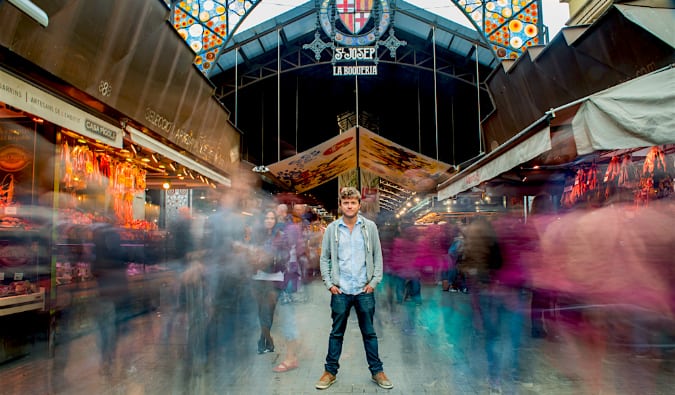
Many moons ago, a friend emailed me and said “Hey, my buddy is starting a website. Can you give him some advice?” I hate those emails, but as a favor to my friend, I said yes. That guy, Nathan Thornburgh, turned out to be really cool, and we became good friends. But this article isn’t about Nathan; it’s about his partner, Matt Goulding. Together they started one of my favorite travel websites, Roads and Kingdoms. It’s one of the few websites I read daily. Last year, they partnered with Anthony Bourdain (they introduced me to him at an event last year and I babbled incoherently for a bit — it was highly embarrassing), and as part of their partnership, they created a book, Rice, Noodle, Fish, about Japan. Now they have a new book called Grape, Olive, Pig about food in Spain.
In a long overdue interview, I sat down and talked to Matt about the intersection between food and travel, and where to find the best food in Spain (disclaimer: I did this for selfish reasons, as I wanted to know for an upcoming trip I’m taking!)
Nomadic Matt: How did you become a traveling food writer?
Matt G.: Wanderlust was emblazoned in my DNA from the onset. My mom was a travel agent, and my parents would take me and my three older brothers on some pretty staggering trips in our younger years: New Zealand, Fiji, Barbados, the Yucatán. Later, I thought cooking was going to be my ticket to see the world, so I studied and worked in the kitchen and wrote short stories on the side. I cooked wherever they’d have me: at an oyster house in North Carolina, fancy cafés in Los Angeles, on a fishing boat in Patagonia. But I saw pretty quickly that cooking required more patience and discipline than I had. I was writing bad fiction and cooking average food, which felt doubly frustrating. So I took off the toque and put away tortured prose and started to write about what I knew most: food and travel. It just so happens that the two go hand and hand, and that food became both the bridge and decoder ring for understanding the world at large.
I found out what a million writers before me already discovered: that writing about something I knew so intimately made a huge difference in the quality of my prose and the depth of my reporting. I started publishing longer, food-focused travel pieces in magazines and eventually landed a job as the food editor at Men’s Health.
Then something new came along when I met Nathan Thornburgh. We connected in Mexico City at a sprawling temple of smoked meat and pulque on the outskirts of the DF [Mexico City] and hatched a plan to leave behind our cushy jobs and try something new. He wanted more food and culture in his life as a writer and editor; I wanted more politics and foreign correspondence.
We toiled in relative obscurity for the first year or two, but it turned out that one of our early readers was Anthony Bourdain. I’m still not entirely sure how he found us or what he saw in R&K, but when we approached him in 2013 with the idea of a book series dedicated to the great food cultures of the world, he gave us his full support. Eventually, that support grew into a formal partnership, which, to put it lightly, changed the trajectory of Roads & Kingdoms substantially.
Your last book was about Japan. Why did you pick Spain this time?
I was passing through Barcelona six years ago, met a lovely Catalan girl in a bar, and never left. (At least, that’s the Cliff Notes version.) Since then, I’ve spent a lot of time eating my way across the country, falling deeper and deeper in love with Spain’s food culture. This book follows the same format and design as Rice, Noodle, Fish, but whereas the Japan book was about a newcomer experiencing the awesome power of Japanese food culture for the first time, Spain is more intimate, personal book, told from the perspective of someone with one foot inside and the other foot outside of the country.
What do you want people to get out of this book?
At the very minimum, I want to arouse in the reader an uncontrollable desire to travel to Spain. If someone reads the book and buys a plane ticket, then I am happy. But the easiest part of a travel writer’s job is to evoke wanderlust, just as the easiest part of a food writer’s job is to stir hunger. The more challenging part is to write a book that goes beyond food or travel — to give the reader a deeper understanding of Spain, its people, its ebbs and flows. I’m less interested in telling you where to go and what to eat than I am in giving you the tools and the context to understand what you see once you get here and begin to make your own discoveries.
That means not just telling you where to eat a good cocido, Madrid’s famous garbanzo-and-meat stew, but explaining where it comes from and what it says about Spanish history and culture. I dedicate 8,000 words in the book to three sisters who hunt gooseneck barnacles along the coast of Galicia — not because you need to stop everything you’re doing and travel to northwest Spain to eat barnacles but because theirs is a beautiful story that says a lot about Galicia and Spain in general. In the end, food is simply the lens through which I try to examine the DNA of this extraordinary country.
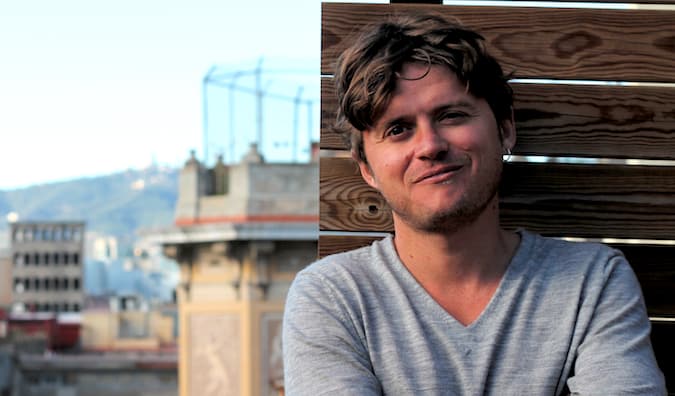
What makes Spanish cuisine so special?
Spanish cuisine has a certain split personality that I find deeply attractive: On one hand, you have modernist (what some people call “molecular” cuisine, to the annoyance of every Spanish chef I know), that highly technical, whimsical, sophisticated style of cooking popularized at El Bulli in the 1990s and 2000s and carried on to this day by many ambitious, deeply talented practitioners. It was this type of cooking that made Spain a serious food destination over the past decade. But really, it represents the tiniest fraction of Spain’s culinary greatness. At the heart of Spanish cuisine is an infallible formula: great ingredients + solid technique = good eating. The best Spanish food — a melting wedge of tortilla, a rosy slice of acorn-fed ham, a plate of sweet red shrimp bathed in garlic oil — is at its core very simple. But simple doesn’t mean easy. You have to take the time to buy the right ingredients and to treat them properly, and most Spanish cooks excel in both categories.
Is there really Spanish food, or a diverse set of food we really call Spanish food?
Spanish cuisine, like all great cuisines, is highly regionalized, but the homogenizing forces of modernity in general, and tourism specifically, threaten this diversity. These days you’ll find paella and sangria and patatas bravas in every corner of the country. But that just means as a traveler you need to be aware of where you are and make your food choices accordingly. Up in Galicia? Eat octopus and shellfish and gooseneck barnacles and wash it down with a crisp Albariño. When in Andaulsia, eat jamón and fried little fish and drink sherry. In Basque country, feast on thick-cut steaks and whole-grilled fish and a world of pintxos. The people who find Spanish food disappointing are the ones who order paella in Madrid and sangria in San Sebastián. Of course, there is a common language that unifies Spain’s cooking — high-quality olive oil, cured pork, an abiding love of seafood — but it expresses itself in very different ways as you move around the country.
I always tell people who come to Spain to first and foremost know where you are and eat and drink accordingly. Paella, for example, has a historical connection to Valencia and is at its very best in the region, but elsewhere, it’s often used to make a quick buck from tourists looking for a “typical” Spanish experience. (The worst-kept secret in Spain is that a huge percentage of paella is made industrially and sent out frozen across the country.) Instead, spend a bit of time learning about the great regional specialties of the country and seek them out aggressively. Grape, Olive, Pig tries to give the reader the type of detailed understanding of the Spanish culinary tapestry, so that he or she is equipped to eat as well as possible in every corner of the country. But even an hour or two of reading online will make your food experience exponentially better.
Why is Spain such a foodie culture? Food is life in Spain. How did that come about?
Spain thrives on the same foundational principles of all the great Mediterranean cuisines, where the forces of geography, climate, and history conspired to create not just a group of national recipes but a pervasive food culture that informs all aspects life on the Iberian Peninsula. There’s a very important word in Spanish that I use to explain to visitors the beauty of Spanish food culture: sobremesa, which literally means “on top of the table” but actually refers to the period after a meal that Spaniards use to linger at the table. Long after the last courses have been cleared, after the coffee has come and gone, Spaniards remain firmly planted at the table, talking, arguing, laughing, enjoying an extra hour or two together. No waiter is hovering with the bill; people aren’t on their phones messaging their other friends. There may be a digestivo or a round of gin and tonics, but no one is there to get drunk. They’re there to be with each other: to debate policy, air out grievances, celebrate a loved one, and to generally bask in the warm glow of each other’s company. In Spain, food is the means, not the end.
Do you see the Spanish food scene changing into a more “quick eats” American style or is it going to remain slow forever?
Spain is not immune to international food trends, including ones imported from the States. Burger joints have been sprouting like fungus across the country for the past five years, and there appears to be no end in sight. (Though I’m still waiting for a single great burger to break out from the sea of mediocrity.) Tacos are the new thing in the bigger cities, and there is no doubt some other amorphous food fad waiting in the wings (bao?). But Spanish food has roots deep enough to withstand the existential threats that might topple a weaker food culture. When the burger lust dies out and the taco fervor fades away, there will still be a bar down the street serving tortilla and croquetas.
If someone was heading to Spain soon, where should they go eat?
You’ll find amazing food across the country, but if eating well is your primary mission, go north. I’d rent a car and work my way across the Atlantic Coast. Start in the Basque Country, hitting up the pintxos bars in San Sebastián and Bilbao and asadores (grill restaurants) in coastal and mountain villages. Stop in Cantabria for some of the world’s finest anchovies, then push into Asturias to feast at the region’s heroic cider houses. End the adventure on the coast of Galicia, the heart of Spain’s seafood culture, where the Atlantic’s treasures require little more than salt and a splash of olive oil.
What region of Spain has the most underrated food?
Asturias isn’t a region on most people’s radars, but the food is extraordinary. You have a deep culture of mar y montaña (surf and turf), thanks to the dramatic combination of rugged coastline and soaring peaks. You can be in a cider house in a mountain town eating cave-aged cheeses and fabada (a stew of fat white beans, chorizo, and blood sausage — the king of the Asturian kitchen) for lunch and in a seafood restaurant on the coast feasting on spider crabs and sea urchin before the sun sets. To write the Asturias chapter of the book, I spent a week with the chef José Andrés, born in a coal mining town in Asturias, who went on to create one of the world’s greatest restaurant empires. José is a force of nature, and he unlocked the magic of that region in a way that keeps me coming back year after year.
OK, final questions. We’re going to do a lightning round:
- #1 restaurant people need to go visit?
Extebarri in the mountains of Basque country. Bittor Arguinzoniz is a grill god, and everything that comes out of his kitchen will haunt you for years to come.
- #1 thing visitors should avoid in Spain?
Eating or drinking anything on La Rambla in Barcelona.
- Madrid or Barcelona?
Barcelona, but I am far from objective. If I said Madrid, a few family members might disown me.
- La Tomatina: Drunk idiot fest or fun cultural experience?
A little bit of both, but with each passing year, it slouches sadly towards the former.
You can find more about Matt at his website, Roads and Kingdoms, or just get the book Grape, Olive, Pig (which was one of my favorites of 2016) and learn more about Spain!
WIN A COPY: I’m giving away TWO signed copies of the book. It’s signed by Matt AND Bourdain! How do you win? Just leave a comment sharing your favorite food experience on the road and we’ll randomly select a winner on Sunday!


