显示标签为“old”的博文。显示所有博文

2019年8月2日星期五

Finding Love and Home in Tbilisi, Georgia

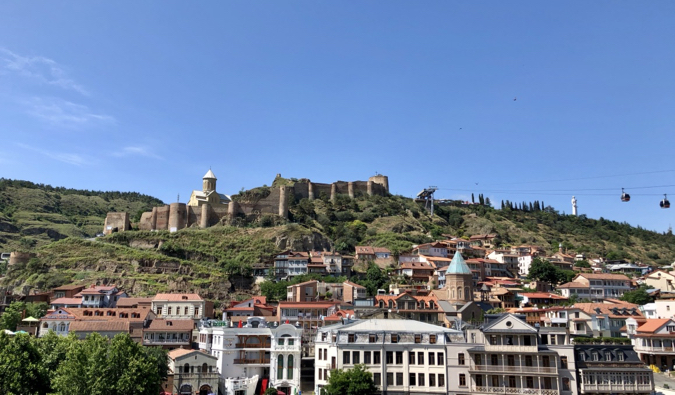
A view overlooking Tbilisi

A view overlooking Tbilisi
Post: 9/12/18 | September 12th, 2018

Post: 9/12/18 | September 12th, 2018

“When did you first hear of Georgia?” Mako asked after a long drag from her cigarette. She was a Georgian tour guide helping my friend Dave, who was also in the country. We were drinking wine outside Fabrika, an old Soviet fabric factory now converted into a multi-use center with bars, restaurants, co-working spaces, shops, artist studios, and a hostel.

“Hmm…” I replied. “That’s a good question. On one level, I’ve known about Georgia for a long time, because, well, I know my geography. But as a place that was more than just a name on a map, I would have to say it’s only been in the last few years — when I started thinking of more unique and off-the-beaten-path places to visit — that I really thought ‘Hmm, Georgia? That could be interesting!’”

When I left London for a trip to Azerbaijan in June, I added nearby Georgia to the itinerary too. Friends spoke highly of the country, and I wanted to see its mountain towns, beaches, and historic cities, and to taste the food and wine I had heard so much about.

My original plan was to spend about a little over a week there, hitting some of the highlights and whetting my appetite for another trip (to me, a week in a country is just never enough time).

But, after a change in plans that required me to head home earlier than expected, I only had time to see the capital of Tbilisi.

From the moment I got off the bus from Azerbaijan, I was in love. Yes, that’s a cliché. To fall for a place right away. But sometimes a destination just hits you to your core right way. The energy — the essence — of where you are just flows through your body and you feel like you’re coming home to a place you didn’t even realize was home.

It’s as if a part of you had always been there, and you were simply returning to make yourself whole again.
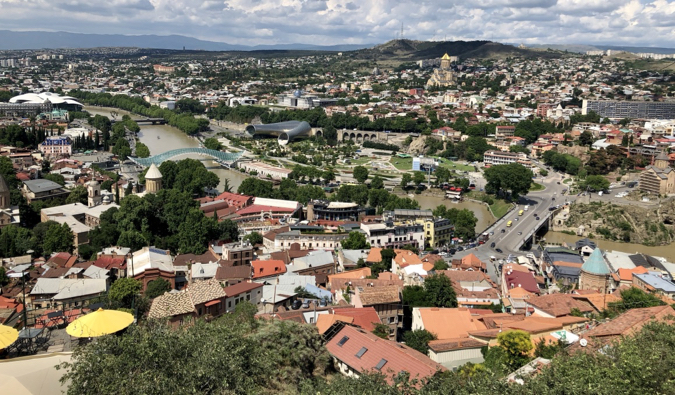
A view overlooking Tbilisi

A view overlooking Tbilisi

Over the next few days, that feeling only increased as I actually began exploring the city.

Before arriving, I had pictured a grimy old city with crumbling, ugly Soviet-era buildings and graffiti. In my mind, it was still frozen in the immediate fall of the Soviet empire.

Instead, I found a beautifully preserved Old Town with cobblestone streets and stunning buildings with ornate balconies; lots of spacious parks, wide streets, eclectic artist spaces, and funky cafés; and modern and sometimes futuristic architecture. It was a lot more like Europe than I had anticipated.
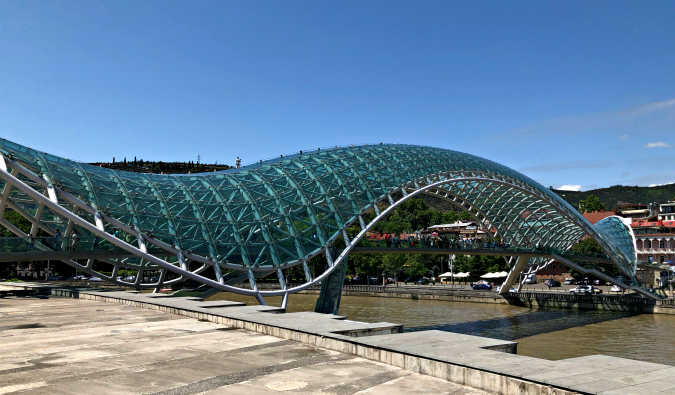
A pedestrian bridge in Tbilisi

A pedestrian bridge in Tbilisi

I spent my first day wandering the old town. I gazed at the Metekhi Church with its giant equestrian statue of King Vakhtang Gorgasali overlooking the Mtkvari River. This is where the king built his palace when he made Tbilisi his capital in the fifth century. (Legend has it that he founded Tbilisi while hunting and discovered the sulfur baths, but a city existed here long before he came along! He just revived it.) The simple, domed-shaped brick building is popular with locals, as legend says the fifth-century martyr St. Shushanik was buried here.

From there I walked across the bridge, toward the famous sulfur baths, a collection of brick-domed buildings containing subterranean bathhouses. These baths helped make Tbilisi famous, as the waters are claimed to help soothe symptoms in chronically ill patients, like arthritic pain or poor blood circulation. There used to be 63 of these baths in Tbilisi, but there are only a handful left now. They are still wildly popular, though I don’t see the charm in smelling like rotten eggs. (But I’m a weirdo, so what do I know?)
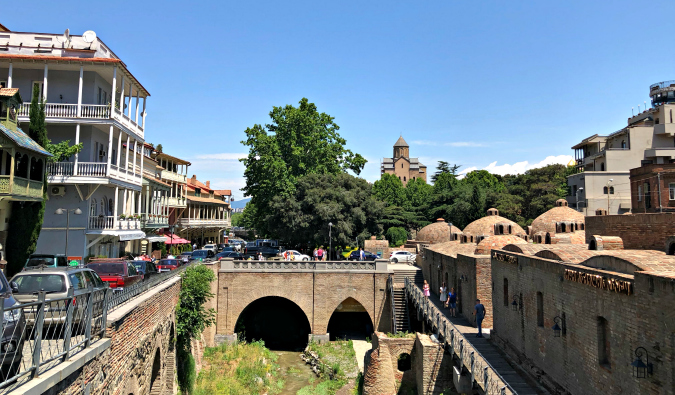
Buildings in Tbilisi

Buildings in Tbilisi

These bathhouses straddle a small river that feeds them and then meanders through a canyon that you can follow to the amazing Dzveli Tbilisi sulfur waterfall. There, the sound of the city melts away, and you feel more like you’re in a national park than a national capital.

I wandered some more and located the entrance to Tbilisi’s gigantic National Botanical Garden, where I found a zip line, tons more waterfalls and rivers to swim in (which, given the high temps during my visit, were well utilized by locals), hiking paths, and flowers and shrubbery. Amidst this peace, I often had to remind myself that I was in a chaotic major city and not some little quiet mountain town.
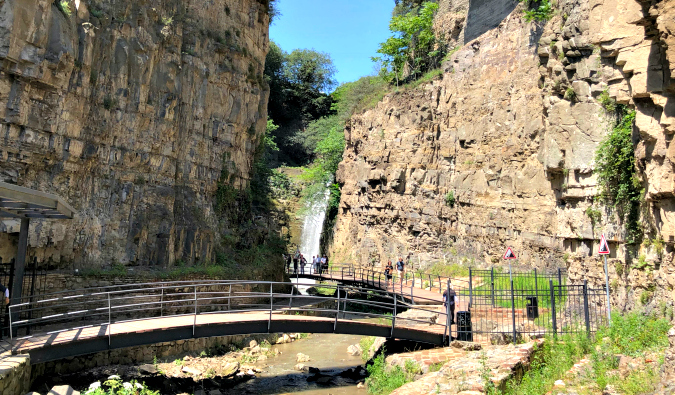
Hiking in Tbilisi

Hiking in Tbilisi

From there it was up to the Narikala Fortress, which dominates the skyline. Dating back to the fourth century, it was once a Persian citadel. Most of the walls were built in the eighth century, but in 1827 an explosion of Russian ammunition stored there wrecked the whole thing. The cliffs the ruins are on offer the best views of the entire city. You can see for miles, which is probably why the site was chosen for the citadel. A cable car connects it with Rike Park on the other side of the Mtkvari River.

The next day, I explored the city’s history museums (which, to my surprise, had a good amount of English translations). I highly recommend the Georgian National Museum, which has a detailed exhibit on the country’s history; the Nikoloz Baratashvili Memorial House-Museum, which houses materials related to the life and work of the romantic poet, period furniture, folk musical instruments, paintings, and lots of history about 19th-century Georgia; and the David Baazov Museum, which talks about Jewish history in Georgia (Israel and Georgia have a close relationship).

However, after having hiked a lot in Azerbaijan, walking in the stifling summer heat of Tbilisi wasn’t that exciting to me. So, after a day and half of sightseeing, I found myself indoors drinking tea, writing, consuming a (un)healthy amount of wine, gorging on food at Fabrika, talking to other travelers, getting to the know the staff at a local coffee shop, and hanging out with Dave.

I can’t say I really know Tbilisi. Sure, I can get around the subway now. I have an idea of what things cost. I know a little about the city and country. I met some cool people. I have a vague sense of place

But I don’t know it the way I know New York or Paris or Bangkok or a thousand other place I’ve lived or spent years traveling to.

But I feel like I know it.

Tbilisi is a city bursting with activity. A city of art and history. Of enjoyment. Of an energy that seemed to say, “Come enjoy the good life over wine. Don’t fret over things — just be.”

Tbilisi’s energy is my energy.

We are a match made in heaven.

And, though it’s terrible to end a travel article with the cliché “I can’t wait to go back,” I honestly can’t wait to go back.

I felt at home in that city.

And everyone loves the feeling of returning home.

Book Your Trip to Tbilisi: Logistical Tips and Tricks

Book Your Flight
Find a cheap flight to Tbilisi by using Skyscanner or Momondo. They are my two favorite search engines. Start with Momondo.

Book Your Accommodation
I highly recommend the hostel and co-working space Fabrika. To book another hostel in Tbilisi, use Hostelworld. If you want to stay elsewhere, use Booking.com as they consistently return the cheapest rates. (Here’s the proof.)

Don’t Forget Travel Insurance
Travel insurance will protect you against illness, injury, theft, and cancellations. I never ever go on a trip without it. I’ve been using World Nomads for ten years. You should too.

Need Some Gear?
Check out our resource page for the best companies to use!

Want More Information on Georgia?
Be sure to visit our robust Georgia travel guide for even more planning tips!

The Best Ruin Bars of Budapest in 2019: 9 Places Not to Miss

The Ruin Bars of Budapest

The Ruin Bars of Budapest
Updated: 1/5/2019 | January 5th, 2019

1/5/2019 | January 5th, 2019

One of the upsides to being an independent writer is that I’m my own boss. There are no deadlines, no one to pester me, and no outside burdens. I get to write about what I want when I want — the good, the bad, and the ugly. However, since the stories on this blog are based on what I see and do, I have no one to say things like, “Matt! There’s a cool new trend in this city. Here’s a plane ticket; go check it out and report back right away!”

And I never wished for that more than when I went in Budapest.

Because no one ever mentioned the “ruin bars” to me. It wasn’t until my second visit that I got to know what these bars were. Now, I visit them whenever I visit the city.

Ruin bars are all the rage in Budapest and have been around since the founding of Szimpla Kert, the mecca of all ruin bars. These bars are built in Budapest’s old District VII neighborhood (the old Jewish quarter) in the ruins of abandoned buildings, stores, or lots. This neighborhood was left to decay after World War II, so it was a perfect place to develop an underground bar scene. (Not so underground anymore, though.)

From outside, these bars look like normal homes. They don’t have large signs pointing the way, you don’t hear any loud noise, and there’s no line of people waiting to get in. But once you walk in and enter the inner courtyard, you find yourself in the middle of a hip, artsy, and funky bar bustling with crowds talking, dancing, and enjoying the laid-back atmosphere. Large bouncers inside, along with posted signs, ensure that people are quiet on their way out, so as to not disturb the neighbors.

Each of these ruin bars has its own personality, but they all follow a few basic principles: find an old abandoned place, rent it out (maybe?), set up a bar, fill it with flea market furniture, have a few artists come in to leave their mark on the walls and ceiling, add in some weird antiques, serve alcohol, and watch people flock in. Since all these bars are in abandoned buildings, they open, close, and move frequently depending on whether the neighbors find out, the patrons get too loud, or an investor comes and buys the property to renovate it.

When you’re in these bars, you feel like you’re drinking at your local thrift store. None of the furniture matches. It’s all old. It’s eclectic. It feels like they just ransacked your grandmother’s house. The ceilings are all designed differently. For example, Instant has a room where the furniture is on the ceiling, and Fogasház has bikes hanging from its ceiling. The places haven’t been repaired or fixed up, and there are still holes in the walls and visible pipes everywhere.

But it all adds to the “underground” feeling each ruin bar has. If these places hadn’t been pointed out to me, I never would have found them.

Though the ruin bar movement has become mainstream and less underground than it was when it started (or even a few years ago), many of the bars have done a good job of keeping their character and staying true to their roots – even as they fill up with more tourists.

Here is a list of the best ruin bars of Budapest:

Szimpla Kert
the colorful interior of the Szimpla Kert ruin bar in Budapest

the colorful interior of the Szimpla Kert ruin bar in Budapest
This was the original ruin bar. It opened in 2001 and starting this trend. It’s one of the biggest ruin bars and still one of the most popular. Once an abandoned factory, here you’ll find a large open courtyard, a top floor filled with eclectic furniture, cocktail bars, music, and even an old, stripped-down Trabant (a communist car) to have a drink in. All the rooms have a different theme. They also sell pizza, which, after a few drinks, makes for the perfect walking-home snack.

This was the original ruin bar. It opened in 2001 and starting this trend. It’s one of the biggest ruin bars and still one of the most popular. Once an abandoned factory, here you’ll find a large open courtyard, a top floor filled with eclectic furniture, cocktail bars, music, and even an old, stripped-down Trabant (a communist car) to have a drink in. All the rooms have a different theme. They also sell pizza, which, after a few drinks, makes for the perfect walking-home snack.

Kazinczy u. 14, +36 20 261 8669, szimpla.hu. Open 12pm-4am on weekdays, 9am-4am on Saturdays, and 9am-5am on Sundays.

Instant
The Ruin Bars of Budapest

The Ruin Bars of Budapest
Instant is located in an entire apartment building and the biggest ruin bar in the city. There are over twenty rooms here. It’s one of the more club-like ruin bars. In Instant, you can sit in what were once individual apartments and relax on furniture that looks like it was found on the street. They’ve knocked down many of the walls to connect the apartments and make space for the DJs and dancing. Given its popularity and the fact that it’s more “clubby,” drinks here are a little more expensive than in other ruin bars. But the vibe is still good.

Instant is located in an entire apartment building and the biggest ruin bar in the city. There are over twenty rooms here. It’s one of the more club-like ruin bars. In Instant, you can sit in what were once individual apartments and relax on furniture that looks like it was found on the street. They’ve knocked down many of the walls to connect the apartments and make space for the DJs and dancing. Given its popularity and the fact that it’s more “clubby,” drinks here are a little more expensive than in other ruin bars. But the vibe is still good.

Akácfa u. 49-51, +36 70 638 5040, instant.co.hu/en. Open daily from 10pm-6am.

Fogasház
The Ruin Bars of Budapest

The Ruin Bars of Budapest
Fogasház is smaller, lower-key, and less touristy than popular Instant and Szimpla Kert. The “House of Teeth” got its name from an old dentist’s office sign they found when they were building the bar. This bar has bicycles and glasses hanging from the ceiling and is artsier than the other ruin bars. Small tables dot the inner courtyard, and you don’t have loud music drowning out the conversation. They often host art exhibits here. They also have a ping-pong table. It’s a hipster’s paradise here.

Fogasház is smaller, lower-key, and less touristy than popular Instant and Szimpla Kert. The “House of Teeth” got its name from an old dentist’s office sign they found when they were building the bar. This bar has bicycles and glasses hanging from the ceiling and is artsier than the other ruin bars. Small tables dot the inner courtyard, and you don’t have loud music drowning out the conversation. They often host art exhibits here. They also have a ping-pong table. It’s a hipster’s paradise here.

Akácfa u. 49-51, +36 1 783 8820. Open daily from 4pm-6am.

Doboz
The Ruin Bars of Budapest

The Ruin Bars of Budapest
I’m not entirely sure if this place fits into the ruin bar culture. It was much fancier and trendier than the other bars I visited. It was like being in a “real” bar. However, I was taken there as part of a ruin bar tour, and, regardless, I love this place. You walk into the courtyard and are greeted by a tree with a red-eyed robot attached to it. It looks like a Transformer is about to attack you. There are two main rooms: one red, the other blue. They play a lot of dance music, and this place fills up toward the end of the night.

I’m not entirely sure if this place fits into the ruin bar culture. It was much fancier and trendier than the other bars I visited. It was like being in a “real” bar. However, I was taken there as part of a ruin bar tour, and, regardless, I love this place. You walk into the courtyard and are greeted by a tree with a red-eyed robot attached to it. It looks like a Transformer is about to attack you. There are two main rooms: one red, the other blue. They play a lot of dance music, and this place fills up toward the end of the night.

Klauzál u. 10, +36 20 449 4801, doboz.co.hu/en. Open Tu (5pm-2am), W-Th (5pm-5am), F-Su (5pm-6am), and closed on Mondays.

Corvin Teto
The Ruin Bars of Budapest

The Ruin Bars of Budapest
Located on top of a supermarket, Corvin Teto is popular due to its huge rooftop terrace, where you can get an expansive view of the hills of Buda and the buildings of Pest. This is another dance-heavy ruin bar, specializing in electronic music. I’d come up here for a drink during sunset and then move on elsewhere.

Located on top of a supermarket, Corvin Teto is popular due to its huge rooftop terrace, where you can get an expansive view of the hills of Buda and the buildings of Pest. This is another dance-heavy ruin bar, specializing in electronic music. I’d come up here for a drink during sunset and then move on elsewhere.

Blaha Lujza tér 1-2, +36 20 244 7230, corvinclub.hu. Open Thursday to Saturday from 9pm-6am.

Grandio
Grandio: an awesome Ruin Bar and hostel in Budapest, Hungry

Grandio: an awesome Ruin Bar and hostel in Budapest, Hungry
Grandio is a ruin bar and hostel in one. It’s famous for its outdoor, tree-filled courtyard but is mostly filled with travelers and people on bar crawls due to the fact that it’s also a hostel. This is a good place to start your night and meet other travelers. However, during the day you can find locals relaxing here with a drink in the garden.

Grandio is a ruin bar and hostel in one. It’s famous for its outdoor, tree-filled courtyard but is mostly filled with travelers and people on bar crawls due to the fact that it’s also a hostel. This is a good place to start your night and meet other travelers. However, during the day you can find locals relaxing here with a drink in the garden.

Nagy Diófa u. 8, +36 70 670 0390, grandio.insta-hostel.com.

Dürer Kert
durer kert ruin bar Budapest

durer kert ruin bar Budapest
A former university building, this ruin bar lets you tap into your inner college student as you drink few beers while playing foosball, Ping-Pong, darts, and a French game called pétanque (it’s fun). The courtyard garden is a good spot to enjoy all the live music that happens in this bar.

A former university building, this ruin bar lets you tap into your inner college student as you drink few beers while playing foosball, Ping-Pong, darts, and a French game called pétanque (it’s fun). The courtyard garden is a good spot to enjoy all the live music that happens in this bar.

Ajtósi Dürer sor 19-21, +36 1 789 4444, durerkert.com/hu. Open M-Sa (5pm-5am), Su (5pm-12am).

Mazel Tov
ruin bar mazel tov in Budapest

ruin bar mazel tov in Budapest
This is one of Budapest’s newest ruin bars. Mazel Tov (located in the old Jewish quarter) is a community center and restaurant serving traditional Jewish cuisine by day. At night, the courtyard is a party with DJs and live entertainment entertaining guests.

This is one of Budapest’s newest ruin bars. Mazel Tov (located in the old Jewish quarter) is a community center and restaurant serving traditional Jewish cuisine by day. At night, the courtyard is a party with DJs and live entertainment entertaining guests.

Akácfa u. 47, +36 70 626 4280, mazeltov.hu. Open M-Tu (12pm-1am), W-F (12pm-2am), Sa-Su (10am-2am).

Anker’t
ruin bar anker't Budapest

ruin bar anker't Budapest
Located in a former factory in downtown Budapest, this minimalist space is made up of large, connecting courtyards, a gigantic dance floor to get your party on, and plenty of couches to lounge on if dancing isn’t your thing. There’s a lot of funky art hanging on the walls and the place is pretty big. The bar also serves some decent food too.

Located in a former factory in downtown Budapest, this minimalist space is made up of large, connecting courtyards, a gigantic dance floor to get your party on, and plenty of couches to lounge on if dancing isn’t your thing. There’s a lot of funky art hanging on the walls and the place is pretty big. The bar also serves some decent food too.

Paulay Ede u. 33, +36 30 360 3389. Open M-W (2pm-12am), Th (2pm-1am), F-Sa (2pm-4am), Su (2pm-12am).

***Budapest may sell itself on history and thermal baths, but the ruin bars are by far the most unique thing about this city. Even if you don’t drink, come spend time at these ruin bars because they are such a funky way to see a popular and totally unique aspect of life in Budapest. You’ll meet a lot of locals when you visit! Don’t miss them.

Want to Learn How I Travel the World for Free?

Primer on Travel HackingPrimer on Travel HackingStop paying full price! Download our free guide to travel hacking and learn:

  • How To Pick a Credit Card
  • How To Earn Miles for Free Flights & Hotels
  • Is Travel Hacking Really a Scam?

GET THE FREE GUIDE

Book Your Trip to Budapest: Logistical Tips and Tricks

Book Your Flight
Find a cheap flight by using Skyscanner or Momondo. They are my two favorite search engines because they search websites and airlines around the globe so you always know no stone is left unturned.

Book Your Accommodation
You can book your hostel with Hostelworld. If you want to stay elsewhere, use Booking.com as they consistently return the cheapest rates for guesthouses and cheap hotels. I use them all the time. My favorite places to stay in Budapest are:

  • Retox – A big party hostel located next to Budapest’s biggest nightlife areas. This one is for serious partiers!
  • Carpe Noctum – The staff here will end up feeling like family, and there are organized trips out on the town every night.
  • Wombats – Another party spot, but Wombats is clean and comfortable, and one of my all-time favorites.
  • Hostel One – Great rooms, great staff, and plenty of common space to socialize. The staff will even cook for you!
  • Big Fish – New hostel located right on the main boulevard of Budapest. New beds, a huge kitchen, and a cozy common room!

Don’t Forget Travel Insurance
Travel insurance will protect you against illness, injury, theft, and cancellations. It’s comprehensive protection in case anything goes wrong. I never go on a trip without it as I’ve had to use it many times in the past. I’ve been using World Nomads for ten years. My favorite companies that offer the best service and value are:

  • World Nomads (for everyone below 70)
  • Insure My Trip (for those over 70)

Looking for the best companies to save money with?
Check out my resource page for the best companies to use when you travel! I list all the ones I use to save money when I travel – and I think will help you too!

Budapest may sell itself on history and thermal baths, but the ruin bars are by far the most unique thing about this city. Even if you don’t drink, come spend time at these ruin bars because they are such a funky way to see a popular and totally unique aspect of life in Budapest. You’ll meet a lot of locals when you visit! Don’t miss them.

Photo credits: 1, Jorge Franganillo, 3, 4, 5, 6, 7, 8, 9, 10

2019年7月26日星期五

Hanoi, Vietnam: 15 Things to See and Tips on Visiting the City in 2018

hanoi traffic in the old town
Updated: 11/19/2018 | November 19th, 2018

The chaotic capital of Vietnam, Hanoi is a busy and bustling city home to swarms of motorcycles, cheap beer, and budget backpackers.

Located in the north of the country, the city itself is often considered a little crowded, slightly run-down, and perhaps a little polluted. But what it lacks when compared to modern-day standards it makes up for with its quaint looks and charm, as well as its budget-friendly prices.

To be completely honest, I didn’t like Vietnam when I visited. But while my expdreince was less than stellar, I did enjoy my time in Hanoi.

A lot.

Time and poor rebuilding may have worn down the city. All over Hanoi, old French colonial homes lay crumbling as modern buildings spring up around them, slowly bringing the city into the modern age. The city’s old quarter, located right by Hoan Kiem Lake, is a fine example of French Colonial architecture. I imagine this is what New Orleans would look like if it was left to decay.

But Hanoi is a fascinating city where you’ll find amazing street side pho, tiny beer bars, and a fast pace where you need to follow the grandmothers as you cross the street or you’ll get run over.

Navigate tiny streets and outdoor markets as people crush you from all sides. Hanoi is very busy, and the old quarter is one of the busiest – flooded with bikes, buses, markets, and tourists. Buses cram down streets I didn’t think even motorbikes could get through. A bus of mine went down one the wrong way and I was sure we were done for. Crossing the street here is a fine art, as motorbikes and cars don’t stop for you. But, despite the crowds, these densely-packed streets have a lot of charm as the old battles the new for dominance.

No trip to Vietnam would be complete without a visit to Hanoi.

And no visit to Hanoi would be complete without seeing what the city has to offer. Here are my top suggestions to help you have an amazing trip.

Best Things to See and Do in Hanoi

Ho Chi Minh Museum, Hanoi
1. Visit the Old Quarter
The Old Quarter’s 2,000-year-old streets are a web of shopping opportunities and cheap eateries. Gold and silver jewelry, clothes, cosmetics, and even musical instruments can all be bought here alongside a myriad of other goods. There’s also a lot of fascinating old worn French architecture around and you can still see the strong French influence in the area. The old quarter is also a great place to sit and drink Bia Hoi, cheap Vietnamese beer. At 15 cents a beer, you can’t go wrong!

2. Visit Hoam Kiem Lake and Ngoc Son Temple
Get here early in the morning to watch throngs of people practicing Tai Chi, running, cycling and walking before their working day begins. In the center of the lake is the Tortoise Pagoda, a shrine to the famous giant turtles that live in the lake. The lake is very beautiful and there is a temple worth visiting on the north end of the lake.

Dinh Tien Hoang St, +84 8 3910 0555, denngocson.com. Open daily daily from 8am-6pm. Admission is 30,000 VND for adults and 15,000 VND for students.

3. Visit the Temple of Literature
Built in 1070, the Van Mieu temple is a great example of traditional Vietnamese architecture and is one of the oldest structures in the country. Originally dedicated to Confucius, you can wander the five courtyards decorated and see the stelae mark with the first diplomas for the university’s doctorate students.

Quoc Tu Giam Street, +84 43 823 5601, vanmieu.gov.vn/en. Open daily from 7:30am-6pm in the summer and 8am-6pm in the winter. Entrance is 30,000 VND for adults and free for kids under 15 as well as for people with disabilities.

4. Visit the Ho Chi Minh Museum
Looking for something morbid? You can check out the body of former leader Ho Chi Minh himself. Despite wanting his body to be cremated (so as to not waste agricultural land), his countrymen mummified him and put him on display. It’s a creepy sight and he looks very “plastic.” No cameras are allowed in, and soldiers stand guard to make sure you do not speak either. Make sure you time your visit right, though – Ho Chi Minh spends a few months out of the year in Moscow getting “worked” on. The museum is really more of a propaganda tool designed to show how Ho Chi Minh led a revolution against imperialist pigs instead of being a chronology of his life.

19 Ngoc Ha, Ba Dinh, +84 24 3846 3757, baotanghochiminh.vn. The museum is open daily from 8am-12pm and then again from 2pm-4:30pm every day except Monday and Friday. Tickets are 40,000 VND per person.

5. Escape the Hustle for Halong Bay
For those who find the hustle and bustle of Hanoi too much to handle, there are many trips outside the city you can take, too. You can head out to the World Heritage site, Halong Bay, and sail through limestone karsts. Or head west to Sapa, one of the most beautiful regions of the world and home to many hill tribes. Sapa was really beautiful. In fact, Vietnam’s natural beauty was the highlight of my time there.

6. Watch a water puppet show
Water Puppetry probably isn’t an art form you’re familiar with, but it’s been popular in Vietnam for over a millennium. Located near the lake, you can take in a show at the Water Puppet Theatre. The puppets are made of wood and the show itself is performed in small pool. This makes it seem like the puppets look like they’re walking in water. While the plays are performed in Vietnamese, they’re still a spectacle to behold.

57b Dinh Tien Hoang Street, +84 24 3824 9494, thanglongwaterpuppet.org/en. Performances usually occur 5 times per day and last around an hour. Admission is 100,000 VND for adults and 60,000 VND for children.

7. Shop at Dong Xuan Market
This is Hanoi’s oldest market and it’s located in the Old Quarter. It’s a huge area where you can find pretty much everything you could ever expect (especially a lot of knock-offs of popular brands). If you’re looking for cheap souvenirs, this is probably the best place for low-cost shopping in the city.

Dong Xuan (in the center of the Hoan Kiem district), chodongxuan.org. Open daily from 7am-6pm.

8. Visit the National Museum of Fine Arts
This is a must-see if you are interested in the various styles of Vietnamese art. There are incredible exhibits of folk art, silk and lacquer paintings, and Buddhist art. The museum’s most impressive feature though is Kuan Yin, the goddess of mercy who is depicted with a thousand arms and eyes.

66 Nguyen Thái Hoc, +84 24 3733 2131, vnfam.vn/en. Open daily from 8:30am-5pm. Admission is 40,000 VND for adults with discounts available for students and children.

6 Travel Tips for Visiting Hanoi

a busy street in Hanoi
To help you make the most of your trip to Hanoi, here are some helpful travel tips:

  • Eat from street stalls – For the cheapest food in the city head to the street stalls. You can get meals for a fraction of restaurant prices. My favorite food to eat is bahn mi or pho.
  • Negotiate – Barter for everything. Tourists are often quoted inflated prices, so talk to your hostel staff to make sure you know what you should be paying.
  • Drink Bia Hoi – This cheap beer is available on the streets throughout the city and is only around 3,000 VND per glass.
  • Take the bus – City buses are the cheapest way of getting around the city. They are comfortable and efficient and much less hassle than bartering for tuk-tuks.
  • Don’t hesitate – When crossing the street, just walk forward with intent. The scooters will zip by you, don’t worry. But if you hesitate and stop and go you’ll confuse them and be much more likely to get hit!
  • Ask permission – If you’re going to be taking photos of locals, ask first. Many consider it rude to be photographed without consent.

***

You’ll find a lot of things to see and do in Hanoi. This city will keep you entertained on your visit but what really makes Hanoi amazing is the charm of the city. It has that special something that makes it absolutely fascinating as much as it is frustrating as you try to make your way around in a place that seems never to notice you.

Visiting Hanoi is an adventure not to be missed.

Book Your Trip: Logistical Tips and Tricks

Book Your Flight
Find a cheap flight by using Skyscanner or Momondo. They are my two favorite search engines because they search websites and airlines around the globe so you always know no stone is left unturned.

Book Your Accommodation
To find the best budget accommodation, use Booking.com as they consistently return the cheapest rates for guesthouses and cheap hotels. I use them all the time. You can book your hostel – if you want that instead – with Hostelworld as they have the most comprehensive inventory. My favorite places to stay are:

  • Old Quarter View Hostel – Great location and a good social atmosphere.
  • Hanoi Old Town Hotel – A great budget-friendly hotel for those looking for private accommodation.

Don’t Forget Travel Insurance
Travel insurance will protect you against illness, injury, theft, and cancellations. It’s comprehensive protection in case anything goes wrong. I never go on a trip without it as I’ve had to use it many times in the past. I’ve been using World Nomads for ten years. My favorite companies that offer the best service and value are:

  • World Nomads (for everyone below 70)
  • Insure My Trip (for those over 70)

Looking for the best companies to save money with?
Check out my resource page for the best companies to use when you travel! I list all the ones I use to save money when I travel – and I think will help you too!

Want More Information on Hanoi?
Be sure to visit our robust destination guide on Hanoi for even more planning tips!

My Big Fat Greek Festival: The St. John's Festival on Ios

a festival in greecePosted: 07/05/2011 | July 5th, 2011

“Eat, it’s like deer,” Francesco said to me.

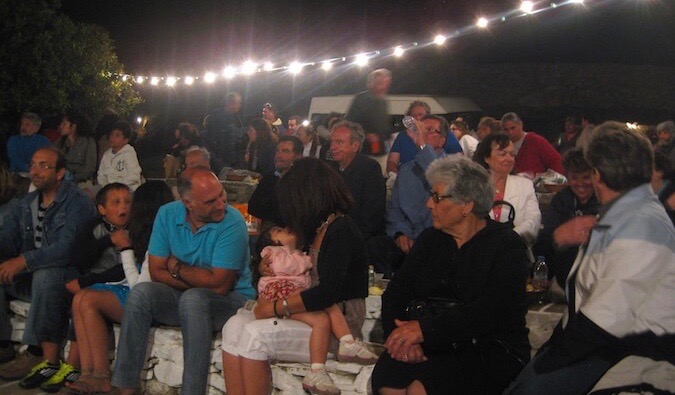
I was surrounded by little Greek ladies in black shawls with wooden canes, people doing traditional dances, kids running around, lots of wine, and cooked wild goat being shoved in my face.

Francesco, the owner of my hostel, had invited me to this festival of all things Greek. Francesco’s hostel is an institution on Ios. Everyone knows it. He and his wife remembered me from last year, and over the weeks, I’d become more and more integrated into the hostel family. It was like I worked there but didn’t have to do anything.

One night as I was turning up at the bar, Francesco asked me if I had any plans.

“You have any meetings now? What are you doing?” (It was 10 at night.)

“None, I’m just going to talk to people on the patio.”

“OK, I’m going to take you to the festival of St. John at the monastery in the mountains.”

“Uhh, sure.”

If there’s one thing people learn quickly on Ios, it’s that you never say no to Francesco. He has an imposing personality and is quite a big figure in the community. It may sound like he is asking, but he isn’t. Francesco has the great ability to phrase a command as a question.

Not that I would ever say no anyway. How could I skip an opportunity to have a truly Greek evening just to hang out with more tourists? I can do that any day. But the chance to be shown something like this? Wouldn’t dream of skipping it. This is the kind of stuff I travel for.

We headed up the mountain, me keeping my eyes shut as we veered along the tiny, winding mountain track in the dark. Francesco assured me we were fine, but I winced at every bump in the road. I don’t like heights, and I’m always afraid I’m going to tumble off the edge.

“You a city boy, huh? Don’t worry. I’ve been on these roads all my life!” he assured me.

Arriving at the festival at last, Francesco ushered me past the dancers and into the back garden of the tiny monastery. In front of me were Greek women cleaning large food bowls, as well as huge cooking pots heating soup and goat meat. Francesco grabbed me a bowl, poured some soup into it, and threw in some chunks of goat. I was merely a passive observer in this whole scene, following orders and doing what I was told.

a festival in greece

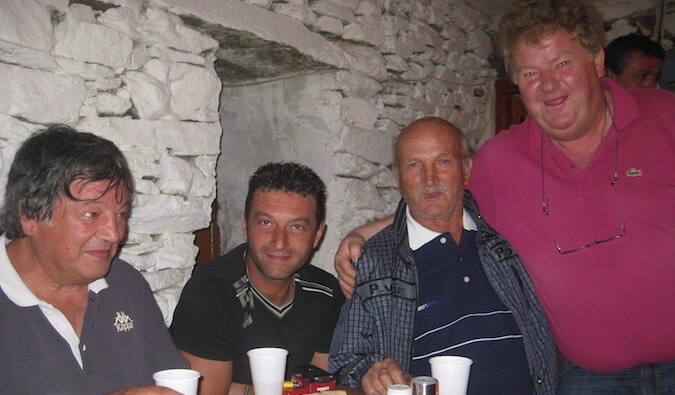
I sat down at a table full of Greek men who looked at me inquisitively. Francesco said a few things in Greek, and the men smiled, making an eating gesture. They stared as I ate as I ate every bit of food, looking at me like I was an alien. Here I was, a stranger in their world, and these old, cigarette-smoking Greek men were enjoying it as much as I was.

I’d never had wild goat before. In fact, I don’t think I’d ever had any kind of goat before. It was delicious. Tender, falling off the bone, it tasted a lot like lamb. I don’t know what the soup was made of, but that too was good. It had a thick, rice-porridge consistency. The bread was thick and obviously homemade, soaking up the hot soup well.

After the soup came wine and bread, and then different cheeses — “from Ios.” The soft goat cheese I was given by an old Greek man was some of the milkiest and smoothest goat cheese I’ve ever had. I cleaned the whole plate as a small Greek grandmother with a wooden cane and black shawl stopped and watched.

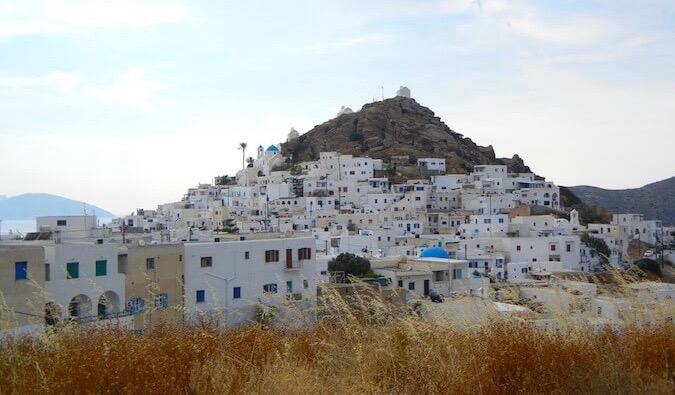
a city in greece

I’d come to watch their festival, but in some ways, their festival was watching me. They didn’t speak much English and I speak no Greek, but I think they got the idea that I liked it.

After the meal and another glass of wine, I left the old patriarchs to go watch the dancing. Sadly, it was mostly over by the time I got there, but I did manage to watch a few traditional dances, as well as a few drunk Greeks making up some moves on the dance floor. I simply sat there watching it and enjoying the music. I noticed a few Greeks looking at me, unable to decide if I was a local (when tan, I look very Greek) or a foreigner.

As the band played on and the night got later, the crowd began to thin out. In the old days, they would have taken donkeys up to the monastery to stay the night. Now people stay until around midnight before driving back into town.

Francesco came and got me a little while later. It was time to go. “It’s good. You like it?”

“Yeah, it was the most cultural Greek thing I’ve done in my three trips to Greece.”

“Good. Write about it. It will make a better story than about you getting drunk with other backpackers. This is real Greece. Not that other bullshit.”

And you know what? He was right.

So I did.

Book Your Trip to Greece: Logistical Tips and Tricks

Book Your Flight
Find a cheap flight to Greece by using Skyscanner or Momondo. They are my two favorite search engines. Start with Momondo.

Book Your Accommodation
You can book your hostel in Greece with Hostelworld. If you want to stay elsewhere, use Booking.com as they consistently return the cheapest rates. (Here’s the proof.)

Don’t Forget Travel Insurance
Travel insurance will protect you against illness, injury, theft, and cancellations. I never ever go on a trip without it. I’ve been using World Nomads for ten years. You should too.

Need Some Gear?
Check out our resource page for the best companies to use!

Want More Information on Greece?
Be sure to visit our robust destination tips on Greece for even more planning tips!

How This 70 Year Old Couple Traveled the World

don and alison, a happy senior couple traveling the world
When I saw him in the hostel, I couldn’t help but smile. There he was, a man who could have been my grandfather, hanging out with college-aged backpackers and having the time of his life. The younger travelers were enamored with his stories of past travels and his ability to drink them under the table. No one cared he was in his 70s. Age mattered not one bit.

I believe that most of my advice on this website is universal. Maybe as an older couple or family you’ll skip hostels or avoid Couchsurfing, but when we land in Paris, we all face the same costs and list of potential activities, regardless of age. But I think, especially here in the United States, there is a belief that you just can’t travel when you’re 70 or have medical problems. And while there are a few things to be more mindful of as you get older, I disagree that there is a special category called “senior travel.” The differences between how I travel and how a 70-year-old travels are really minimal.

So when Don and Alison approached me about their story, I had to share it. Because here is a “senior” couple, limited by some medical issues, engaging in adventures I only dream about. I think their story can teach and inspire a lot of us.

Nomadic Matt: Hi guys! Tell everyone about yourselves.
Don: I’m a 70-year-old retired neuropsychologist. Two years ago, I made a decision to retire, because I’d developed a number of medical problems due to stress from work. I was working myself into sickness. Alison (my wife, who is 63) and I didn’t have enough savings to be able to keep our home and do the kind of world travel we wanted to do. We agonized over what to do for a long time until it became clear that it came down to the question of “Do we want to have a home or do we want to have a life?” So we made the decision to sell our home. We’ve now been on the road, with occasional trips back to our hometown to restock our basic supplies and see our friends, for two years, and plan to continue living a nomadic life for the foreseeable future.
don and alison, a happy senior couple traveling the world
What inspired you to become nomadic?
Don: Initially it was the desire to see the places that were at the top of our bucket list, and after that to see as much of the world as we could before we got too old to travel.

Alison: Inspiration came first from Don writing daily “morning pages” (from Julia Cameron’s The Artist’s Way) in search of some answers to the retirement/income dilemma. One day out of the blue, he suggested to me that we could sell the condo and go traveling. I didn’t immediately say yes to this, but it was a seed that grew of its own accord until one day, we realized this is what we’d do. I had a nice life at home, but Don was done with work and struggling to keep going. Something had to give.

Where have your travels taken you so far?
Don: After selling our home, we went to Europe. Following that we went to Tiruvannamalai in Tamil Nadu, India, where we stayed for 10 weeks in order to spend time meditating at the ashram of Ramana Maharshi. From there we went to Bali, then to Australia to spend time with some of Alison’s family and friends. We’ve also been back to India, all over Southeast Asia, and most recently, Mexico.

Did your friends and family think you were crazy for doing this?
Don: Probably, although no one said that to our faces. Everyone was surprised, some of them seemed perhaps a bit shocked, and many of them told us that we had a lot of courage for taking this step and encouraged us to go for it.

Do you feel that your age was in any way a problem or limiting?
Don: When we first began traveling, I was concerned about my health and whether I’d be able to stay healthy, particularly when traveling in Third World countries. However, as we’ve traveled, I realized I can get sick overseas, take appropriate medications, and get well again. It’s not as hard as I thought to get the necessary care when you travel.

Alison: It never occurred to me that age has anything to do with anything. I’m young, fit, and healthy, and mostly do what I need to do to stay that way. At the same time, I’m aware that Don has some manageable health issues that we need to pay attention to, but nothing that really prevents us from doing what we want to do. He’s so much healthier and happier than when he was working.

Having said that, we’re not cavalier about our bodies. We know that things sometimes take longer to heal than when we were younger. For this reason, we draw the line at things like white-water rafting. Apart from the fact that neither of us are experienced at it, we know that one good jolt could result in whiplash that could take weeks to heal. Still, we’ve hiked in fairly difficult terrain, been swimming with elephants, gone kayaking, ridden camels at dawn in the desert, and climbed volcanoes in the dark.

don and alison, a happy senior couple traveling the worldHow did you save money for your travels?
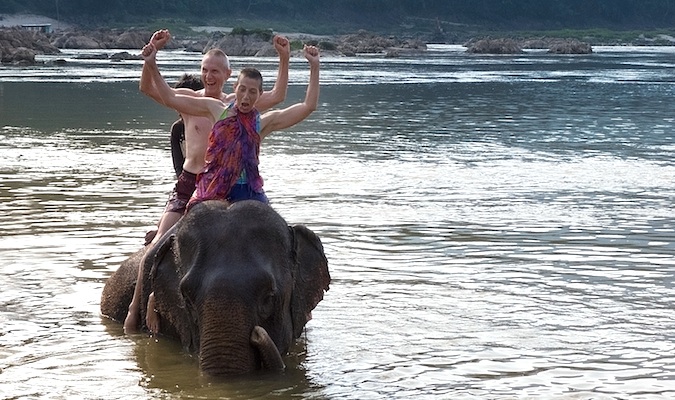
Don: I had been putting money into a Canadian Registered Retirement Savings Plan for many years. These savings and any interest earned on them are tax-free until such time as I begin to withdraw them. We sold our home at what appears now to have been the peak of the Vancouver housing market in August 2011 and put the money to work in investments. We also receive a monthly pension from a Canadian federal government plan that I contributed to from the time I was in my early 20s until I retired.

How do you manage your money on the road?
Don: We budget about $50 per day for our accommodation, plus another $50 for meals and entertainment. Recently, we’ve started staying in places for longer periods of time and have begun renting apartments instead of staying in hotels. The price per night is often about the same as a hotel room, but we save money by making our own meals. We regularly splurge on guided tours or treks, or big events like the Guelaguetza Festival in Oaxaca.

A lot of older couples and individuals feel that round-the-world trips are for young people. What would you say to them?
Don: Do it anyway while you still have the health and strength to do it. We’re more flashpackers than backpackers: we usually stay in three-star hotels because we can do that on our budget, and the rooms we rent must have Wi-Fi and an en-suite bathroom. We book hotel rooms or apartments online using Agoda.com, Booking.com, Wimdu.com, or Homeaway.com.

Alison: I think there are a lot of myths about “old age” that people live into. I don’t understand the idea that adventure and a love of life are only for “the young.” We’ve met a full-of-life 92-year-old who learnt to play the fiddle in his seventies and regularly jams with a group of buddies, a 78-year-old woman who says when she’s 80 she’ll be ready to sell her house and go traveling, and an eighty-something woman who was traveling alone in Myanmar. We love role models like this. Life’s what you make it, and you only get one chance to live this life.

Do you stay in hostels? When you meet young backpackers on your trip, how do they react? I usually find that they tend to get excited about senior travelers. It’s a “cool” thing.
Don: We haven’t stayed in hostels for two main reasons: the first being because of my concerns about the security of our belongings, and the second being that we like the luxury of a private bathroom. That being said, the young backpackers we’ve met on the road have been very positive about us doing what we’re doing at our age.

don and alison, a happy senior couple traveling the world

Did you have any fears about traveling before you started?
Don: Alison has always been much more adventurous than me, so when we first began traveling I had a lot of fears about getting sick in Third World countries. Now that we’ve been traveling for almost two years, a lot of those fears are gone because we’ve been sick and recovered without having to be sent back to Canada.

Alison: I don’t like flying. It’s one of my biggest fears. As long as things are going smoothly and I can immerse myself in a movie I’m fine. But any turbulence and I’m a white-knuckle mess. [Matt says: me too!] Apart from that I don’t think I was ever really afraid, because I’d done so much traveling when I was younger.

What was the biggest thing you’ve learned from your travels so far?
Don: That traveling really does broaden the mind. We’ve discovered that people are people wherever we go and that the great majority of them are friendly and helpful. If you approach people in a friendly and open-hearted way, that is what you are most likely to get back. We do our best to come with a sense of respect for the people we meet on our travels, regardless of their circumstances. We’ve also found that making the effort to learn a few basic words and phrases of the local language does wonders for connecting with the people of a country!

I’m much happier and healthier than I was two years ago. I now know from personal experience why people love to travel. The world and its peoples are much more friendly and much less scary than various government websites would have us believe.

Alison: Everything Don said, and always learn how to say “I’m sorry” in the local language. And presence. There’s no past, no future. Only now. The longer we travel the more this truth is actually lived. Whenever I feel vulnerable I return to the present because it is here that life is lived.

What advice would you give to people looking to do something similar?
Alison: Don’t go blind. Do your research. The more information you gather before you go, the better you’ll be prepared, and the less vulnerable you’ll feel. At the same time, don’t organize yourself into a tight schedule. Leave room for spontaneity. Trust yourself, and go for it. Until you do it you cannot even begin to imagine the rewards that come from such a life. The world is an astonishing place, and people are more open-hearted than you’d ever believe from watching the nightly news. Oh, that’s another thing — stop watching the news: it gives you a very negative view of the word!

Don and Alison are a real inspiration. They found a way to make travel work for them, and it even made Don a healthier and happier person! I really do love their story as well as what they had to say about their experience. The couple have set up a blog about their travels that you can read here.

Become the Next Success Story

One of my favorite parts about this job is hearing people’s travel stories. They inspire me, but more importantly, they also inspire you. I travel a certain way but there are many ways to fund your trips and travel the world. I hope these stories show you that there is more than one way to travel, and that it is within your grasp to reach your travel goals. Here’s another example of people who made traveling the world a priority a little later in life:

We all come from different places, but we all have one thing in common: we all want to travel more.

Make today the day you take one step closer to traveling — whether it is buying a guidebook, booking a hostel, creating an itinerary, or going all the way and buying a plane ticket.

Remember, tomorrow may never come, so don’t wait.

The Saturday City: Quito

Quito, Ecuador
Set high up in the mountains, Quito is the capital city of Ecuador. Outside of Rio, Buenos Aires, or Bogotá, I have always pictured South American cities to be past their prime — built up in the past and left to just decay. I had always imagined Quito to be dirty, grimy, and a bit unsafe, with a pocket of modernity. I’m not sure why I thought this way — probably too much American media and experiences in Central America that I lumped together.

Regardless, I came to Quito without high expectations. And in the end, I loved this city. It was phenomenal! Throughout town, I discovered amazing food: from delicious outdoor stalls to food markets to good Western food. Any city with good food is a city I love.

Despite the altitude, I walked and walked around the city, though sometimes my lungs felt like they were going to explode. I enjoyed the mix of Old World Spanish architecture and modern buildings. Moreover, the city was a lot cleaner than I expected. (After spending considerable time this year in Central America, it was nice to visit a city that didn’t have trash littered everywhere!) One day I was at Ejido Park and I came across an Ecuadorian version of The Three Stooges (an old American slapstick comedy group). My Spanish isn’t good enough to understand what they were saying, but their slapstick was funny. I sat watching them for a while.

If you are looking for things to do in Quito, I suggest the following activities:

El Panecillo – El Panecillo, or “The Bread Roll,” is a hill overlooking the city. It’s famous for its views and used to contain a temple before the Spanish arrived. On the hill is the statue of the Virgin Mary that was constructed in 1976 and is 41 meters tall.

Enjoy the architecture – Quito is home to a number of colonial and excellently preserved houses. The two best can be found in an alley called La Ronda: Casa de Benalcázar (one of the early founders of the city) and Casa de Sucre, where Field Marshall José de Antonio de Sucre, a leader of Latin American independence, lived.

Quito architecture

The equator – Given the country’s name, it shouldn’t be surprising that the equator is in the country. It’s located near Quito, and you can visit the real one and the fake one. The fake one is a 30-meter tall monument, constructed between 1979 and 1982. However, when they got GPS and checked it, it turned out they were off. Now you can visit a mini-museum paying homage to indigenous Ecuadorian culture that has the REAL equator in it. They have a few fun science experiments there too.

Plaza de San Francisco – Though you’ll see many churches in the city, San Francisco is one of the oldest and prettiest. The city’s oldest building (begun in 1534), it is baroque in its design. There is a huge plaza outside the church that is good for people-watching.

Cotopaxi – Approximately two hours south of Quito is the world’s highest active volcano (19,348 feet). It is a brilliant location for outdoor activities such as mountain climbing, hiking, horseback riding, and even camping.

Cotopaxi

Parque Metropolitano – Parque Metropolitano’s height provides the best views of the city. You can get a lot of good photos from here, and the surrounding neighborhood is quite nice. I recommend asking where the entrance is before you walk there or you’ll find yourself (maybe like me) using the tourist map only to find out that all the “entrances” are locked except the main one.

The Old Town – Most visitors concentrate their time in Old Town, which is a UNESCO site. Here you’ll find the city laid out according to Spanish planning requirements, with the central plaza at the heart. The plaza features the Palacio de Gobierno, the Cathedral, and the Palacio Presidencial. You will also find Independence Square here.

Old Town Quito

Museo del Banco Central – The Central Bank Museum has a good collection of artifacts from all of Ecuador’s regions and cultures. There are many pre-Incan artifacts too. I wouldn’t have thought a bank museum would have such things, but this one does and it’s not that expensive to get into.

La Mariscal – This is where all the expats and tourists seemed to be. I couldn’t walk five feet without a Texas BBQ or Irish pub popping up. This neighborhood was trendy, filled with bars and posh restaurants. It seemed like the place to be at night, what with all the bars and clubs, but during the day it was simply filled with tourists eating overpriced food. The houses in the area are nice and colorful though.

Quito was a lot different than I thought it would be. I expected a grimy South American city but instead found one rich in culture and architecture, and filled with good food. There’s a lot to do here, there’s plenty of history, good nightlife, and friendly locals. And what more could you ask for from a city? I would definitely like to go back there.

(However, I met a guy who worked for the American embassy while there. He and his girlfriend had nothing nice to say about Quito. To them, it was a dangerous place where people try to cheat you. I inquired what he did for the embassy and he said he dealt with all the emergency calls American tourists place. That experience probably colored his perception of the city since he only hears the bad stories. I was glad I met him at the end of my trip. His slanted view might have made me more guarded while I was there.)

I loved Quito. If you make your way to Quito, spend some extra time here to enjoy the city. Don’t just use it as a place to fly to the Galápagos Islands from.

Photo credits: 3

2019年7月25日星期四

Where to Go in Paris to Find Your Favorite Writers' Old Haunts

Ernest Hemingway once wrote, “If you are lucky enough to have lived in Paris as a young man, then wherever you go for the rest of your life, it stays with you, for Paris is a moveable feast.” The famed author lived in the City of Light during the 1920s, and wrote some of his prized novels while embedded in the gardens and cafes of the Left Bank.

South of the River Seine, the Left Bank was and still is the site of creatives — writers, poets, artists, and philosophers have claimed this neighborhood as their own. F. Scott Fitzgerald, Pablo Picasso, Jean-Paul Sartre and countless others have lived, worked and reimagined society on its cobblestone streets. Intellects studying at the Sorbonne and modern-day bohemians can be found sipping coffee, brainstorming and creating together.

Related: Why It's Illegal to Take Photos of the Eiffel Tower at Night

With such an influx of talent, artists and small business owners began catering to these visionaries. At a historic bookstore, writers and poets can stay as guests provided they read a book per day and help out at the shop. At a popular café, writers can enter a literary contest where the prize is free champagne for life. And just outside the University of Paris, students rub the shoe of a well-known statue to ensure success on their exams.

Marie Segura, a literature expert and Sorbonne student who works with Localers helped us discover the unique hotspots sought after by professional and aspiring writers alike.

Celebrity Kids Who Have More Passport Stamps Than You Do

Princess Charlotte turned one year old May 2, marking another milestone for the royal family this year. In honor of her big day, mom Kate Middleton and dad Prince William released several photos of the tot walking with a toy stroller at her parent’s home in Norfolk. And though she was enjoying some playtime at home, the youngster has already started racking up air miles with a recent trip to the French Alps.

If her big brother Prince George is any indicator of how many passport stamps she’ll soon have, then Charlotte could be a jet-setter before her next birthday. At just six months old, George enjoyed a tropical getaway to the Caribbean island of Mustique and later joined his parents on a royal tour of Australia and New Zealand—all before he turned one.

Of course, Charlotte and George aren’t the only tots with frequent flier miles that could rival any businessman’s. Many of Hollywood’s offspring have traveled around the world before they were even out of diapers.

Kim Kardashian and Kanye West’s daughter North has been to St. Bart’s, Mexico, Vail, New York, Thailand, and even Israel.  North’s pal Blue Ivy has traveled to Puerto Rico, the Dominican Republic, Paris, and Spain with mom Beyonce and dad Jay Z. Likewise, Suri Cruise has traveled France, Italy, Spain, and Brazil with parents Katie Holmes and Tom Cruise in her few short years on this planet.

And who could forget the Jolie-Pitt kids? Members of that six pack can check off London, Australia, the Galapagos, Turks and Caicos, Tokyo, and New Orleans—just to name a few.

So, in honor of Charlotte and her globetrotting future, we’ve rounded up the most well-traveled celebrity kids who have likely already crossed off most of your bucket list destinations.

Click through to see these jet-setting tots. 

Ground Transportation

There are many different ways to get around the globe: by land, by sea, and by air. And when it comes to ground transportation, Travel + Leisure can help you navigate the diverse (and sometimes complicated) systems.

After all, travelers can explore by foot or by bike; by car, van, or camper; by train — be it luxury travel like the luxurious Orient Express, or more mundane methods like the public subway — by bus, tram, streetcar; by funicular or by cable car; by golf cart or by Segway; by horse or by camel; even hopping in an Uber or hailing a classic New York City yellow cab.

Ground transportation touches just about everything the ground itself does. Travelers can now hail a taxi in Paris created exclusively for women, but should know that your Uber app won’t be of use during trips to London, where the ride-sharing company recently lost its license to operate.

Sometimes, ground transportation isn’t just about getting around — it’s also the main attraction. In Chicago, visitors can explore the underground Pedway tunnels beneath the downtown Loop, and learn about new plans to revitalize them.

And while it may not seem as luxurious as cruising or flying, ground transportation can still be impressive. On Travel + Leisure, for example, you can read about two 23-year-olds who took an old fashioned, but now relatively rare, route across the United States: by hitchhiking.

And while nothing is as basic or low-tech as taking a hike, ground transportation can be seriously forward-thinking and futuristic, too. Here, you can puzzle out the implications of Elon Musk’s proposed high-speed Hyperloop route from New York City to Washington, D.C., which promises a 29-minute inter-city commute.

Though flying is (usually) faster, ground transportation gets you places no plane can: whether it’s a motorbike on the back roads of Bali or a bucket list trek to the Incan citadel of Machu Picchu. Get the most useful tips on traveling by cars, buses, trains, bikes, and good old fashioned feet here at Travel + Leisure.