显示标签为“place”的博文。显示所有博文

2019年8月2日星期五

Paris is NOT a Touristy Destination (No place is)

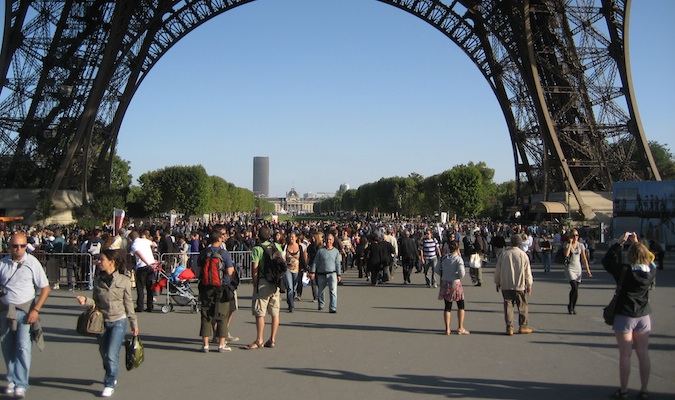
Tourists walking underneath the outside the Eiffel Tower in Paris

Tourists walking underneath the outside the Eiffel Tower in Paris
Updated: 07/23/18 | July 23rd, 2018

Updated: 07/23/18 | July 23rd, 2018

As winter continues on and the days get colder, I find people begin to think of travel: warmer places, tropical beaches, and spring trips. My inbox fills up more than normal with questions on where to escape to, what to see, and things to do.

But there is always a common theme to these emails: people want to avoid the “touristy” stuff. They want to avoid the crowds and see the local side of a city.

”I don’t want to go to Paris. It’s too touristy. Where else can I go that is like it but without the crowds?”

I cringe when I see statements like this. I understand the desire to explore places and find hidden gems. We want a glimpse at the local life. We want to be Indiana Jones and feel like we‘re discovering and experiencing something new, not simply joining a horde of other tourists and buying into mass consumption.

It’s good to see something different and explore what hasn’t been Disneyfied for tourists. But this idea that simply because a place is popular it’s become “too touristy” and thus ruined is….well, crap.

Paris is not touristy.

Neither is New York City.

Or Bangkok.

Or Cairns.

Or any other city in the world.

No place in the world is “too touristy.”

The problem isn‘t the destination — the problem is where you’re going when you’re there. The only thing that’s touristy are the spots you choose to see. The beaten path is beaten because it’s popular and everyone wants to see it. Why do the crowds clutter around the Eiffel Tower? Because it’s amazing. Why do people flock to Times Square? Because it’s iconic.

But if you’re sick of tourists and want a “local feel,” all you have to do is avoid those spots. Venture away from the crowds. Odds are good that you won’t find them a few blocks over. 90% never stray off the path. To say a city of millions of people is “touristy” is to focus on the tourist spots and then say that the whole city/country/region is like that.

And that’s just not true.

I live in New York City. Every day thousands of tourists wander its streets. I rarely notice them. I rarely see them. Why? Because I’m not walking around Times Square, clamoring to see the Wall Street bull, or fighting my way around the Met.

Instead, I hang out in my local neighborhoods and shops that most tourists won’t ever find or go to. My friends and I just live in this city and go where we know to go. I sometimes forget that NYC is one of the biggest tourist destinations in the world because in my day to day life I’m not involved in that side of a city.

If you‘re only visiting the most famous sights, you’ll find any place touristy. Walk away from that area and head down a back alley and into a new neighborhood, and suddenly you’re surrounded by locals and experiencing local life.

Next time you cringe at all the tourists, look at your surroundings. Are you in a famous, highly popular area? if so, change where you are. Don’t skip the Eiffel Tower or the Louvre, and make sure to walk the Champs-Élysées.

But then keep walking — you’ll leave behind the crowds who will never venture past that one block, and you’ll be free to explore new, untouristy areas all by yourself.

And once you start doing that, you’ll never call any city touristy ever again.

Get the In-Depth Budget Guide to Paris!

Nomadic Matt's Guide to ParisNomadic Matt's Guide to ParisFor more in-depth information, check out my guidebook to Paris written for budget travelers like yourself! It cuts out the fluff found in other guides and gets straight to the practical information you need to travel and save money in one of the most beautiful and romantic cities in the world. You’ll find suggested itineraries, budgets, ways to save money, on and off the beaten path things to see and do, non-touristy restaurants, markets, and bars, and much more!! Click here to learn more and get started.

Book Your Trip to Paris: Logistical Tips and Tricks

Book Your Flight
Find a cheap flight to Paris by using Skyscanner or Momondo. They are my two favorite search engines. Start with Momondo.

Book Your Accommodation
You can book your hostel in Paris with Hostelworld. If you want to stay elsewhere, use Booking.com as they consistently return the cheapest rates. (Here’s the proof.)

Don’t Forget Travel Insurance
Travel insurance will protect you against illness, injury, theft, and cancellations. I never ever go on a trip without it. I’ve been using World Nomads for ten years. You should too.

Need Some Gear?
Check out our resource page for the best companies to use!

Want More Information on Paris?
Be sure to visit our robust destination guide on Paris for even more planning tips!


A Visitor's Guide to Edinburgh: What to See, Do, & Where to Stay in 2019

View of Edinburgh Castle

View of Edinburgh Castle
Updated: 1/5/2019 | January 5th, 2019

Updated: 1/5/2019 | January 5th, 2019

The cobbled streets, tight quarters, the castle, the Gothic architecture of many of its buildings —Edinburgh’s beauty is inescapable.

Originally, I visited Edinburgh for my birthday back in 2009 and, enjoying the city’s beauty and history, have been coming back ever since, even spending a new year’s here a few years back! I absolutely love this city and its people.

Edinburgh has been the capital of Scotland since the 15th century (though people have lived here since 8,500 BC). The city was destroyed by the English in 1544, but eventually recovered and became the center of the Scottish Reformation in the 16th century. In the 19th century, Edinburgh lost it’s status as the #1 city in Scotland to the manufacturing city of Glasgow. However, Edinburgh was famous for its literary figures and became an educational and literary capital growing rapidly during the later 19th century.

In the 20th century, Edinburgh remained a city of banking, and education, growing rapidly in the later part of the century and early 21st century thanks to tourism and just a growing interest in Scotland.

Edinburgh is a small city with friendly people and history everywhere. I love walking down the small, cobblestone streets, and getting lost in the little squares and back alleys of the city. Here, locals will say hi to you and chat you up over a pint in the local pub.  It’s a magical town that inspires you at every turn.

If you’re going to visit Edinburgh, here are some of the best things to see and do in Edinburgh on your trip:

The Royal Mile
The Royal Mile

The Royal Mile
This historic street stretches from the Castle to the palace and is the most popular street in the city. It’s the main thoroughfare in the Old City and is a great place to people watch, sightsee, listen to buskers, and grab a bite to eat.

This historic street stretches from the Castle to the palace and is the most popular street in the city. It’s the main thoroughfare in the Old City and is a great place to people watch, sightsee, listen to buskers, and grab a bite to eat.

St. Giles Cathedral
St. Giles Cathedral

St. Giles Cathedral
This not-technically a cathedral (cathedrals need a bishop and this one has none) is very old and beautiful. Also known as the High Kirk of Scotland, St. Giles Cathedral was founded in the 12th century (though little remains from that period) and is the primary place of worship for the Church of Scotland. The cathedral is located between the Castle and the Palace, it’s a good place to see stunning Gothic architecture and good stained glassed windows.

This not-technically a cathedral (cathedrals need a bishop and this one has none) is very old and beautiful. Also known as the High Kirk of Scotland, St. Giles Cathedral was founded in the 12th century (though little remains from that period) and is the primary place of worship for the Church of Scotland. The cathedral is located between the Castle and the Palace, it’s a good place to see stunning Gothic architecture and good stained glassed windows.

High Street, +44 131-225-4363, stgilescathedral.org.uk. Open Monday-Friday from 9am-7pm (5pm during the off season), Saturday from 9am-5pm (closed during the off season), and 1pm-5pm on Sunday. Guided rooftop tours are 6 GBP per person, and a photo permit for the church (interior) is 2 GBP.

Take a ghost tour
The MacKenzie Poltergeist

The MacKenzie Poltergeist
Edinburgh is actually considered one of the

Edinburgh is actually considered one of the most haunted cities in the world . In the 17th century, Lord Advocate Sir George Mackenzie was appointed to round up religious dissidents. Some 18,000 people were rounded up and killed on his watch. the story goes that his tomb was disturbed by a homeless man, releasing his vengeful spirit. Since then of 500 people have claimed to have seen (or been attacked!) by the ghost of Mackenzie. This has led to the popularity of haunted walking tours around the city. There are plenty of different tours to choose from, including walking tours, underground tours, and bus tours (available during both the day and night). Some of the best companies to check out at Get Your Guide Mercat , and New Europe

Edinburgh Castle
Edinburgh Castle

Edinburgh Castle
The roots of Edinburgh castle were likely established around the 2nd century, though it wasn’t until the 7th where we start to see the formations of a castle take shape. Today’s castle was built in the 12th century, though many parts have been reconstructed over the years. While it’s not the best castle in the world, it has an interesting history, a daily cannon fire, great views, and historic artifacts in it. It’s definitely worth a tour if you’re into history or architecture!

The roots of Edinburgh castle were likely established around the 2nd century, though it wasn’t until the 7th where we start to see the formations of a castle take shape. Today’s castle was built in the 12th century, though many parts have been reconstructed over the years. While it’s not the best castle in the world, it has an interesting history, a daily cannon fire, great views, and historic artifacts in it. It’s definitely worth a tour if you’re into history or architecture!

Castlehill, +44 131-225-9846, edinburghcastle.scot. Open daily from 9:30-6pm (5pm in the winter). Admission is 18.50 GBP for adults (17 GBP if you book in advance) with discounts available for children.

The Scott Monument
The Scott Memorial

The Scott Memorial
This Gothic tower stands an impressive 61 meters high and is actually the second tallest monument to a writer in the world (the first is in Cuba). Sir Walter Scott was a novelist, playwright, and historian known for such books as Ivanhoe and Rob Roy. For a good view of the city, climb up the stairs!

This Gothic tower stands an impressive 61 meters high and is actually the second tallest monument to a writer in the world (the first is in Cuba). Sir Walter Scott was a novelist, playwright, and historian known for such books as Ivanhoe and Rob Roy. For a good view of the city, climb up the stairs!

E. Princes St Gardens, +44 131-529-4068, edinburghmuseums.org.uk/venue/scott-monument. Open daily from 10am-9pm (4pm in the winter). Admission is 8 GBP for adults with discounts available.<

The Elephant House
The Elephant House

The Elephant House
The cafe became super popular for one reason: Harry Potter. J.K Rowling spent many an hour here writing her epic Harry Potter saga. Once that fact became known, Harry Potter fans from all around the globe have flocked here to see the place with their own two eyes. More often than not, there are people outside taking photos and even a line to get in!

The cafe became super popular for one reason: Harry Potter. J.K Rowling spent many an hour here writing her epic Harry Potter saga. Once that fact became known, Harry Potter fans from all around the globe have flocked here to see the place with their own two eyes. More often than not, there are people outside taking photos and even a line to get in!

21 George IV Bridge, +44 131-220-5355, elephanthouse.biz. Open Monday-Thursday from 8am-10pm, Friday from 8am-11pm, Saturday from 9am-11pm, and Sunday from 9am-10pm.

Rosslyn Chapel
Rosslyn Chapel

Rosslyn Chapel
Built in the 15th century,

Built in the 15th century, this famous chapel is a Da Vinci Code lover’s dream. There are many (alleged) links to both the Freemasons and the Knights Templar. Even if you don’t believe in any of that, the detailed carvings are impressive and the chapel’s long history make it worth checking out. (It’s not far from the city and a good excuse to get out of Edinburgh for a bit!)

Chapel Loan, +44 131-440-2159, rosslynchapel.com. Open daily from 9:30am-5pm (6pm in the summer). Admission is 9 GBP, with discounts avilable. Interior photography isn’t permitted

Museum of Edinburgh
museum of Edinburgh

museum of Edinburgh
When you’re strolling down the Royal Mile, don’t forget to check out the Museum of Edinburgh. It will give you a much a better understanding of the city’s history and how it became the city that it is today. Best of all, this museum is free!

When you’re strolling down the Royal Mile, don’t forget to check out the Museum of Edinburgh. It will give you a much a better understanding of the city’s history and how it became the city that it is today. Best of all, this museum is free!

edinburghmuseums.org.uk/venue/museum-edinburgh. Open daily from 10am-5pm. Admission is free but donations are welcome.

Hike to Arthur’s Seat
Arthur's seat in Edinburgh

Arthur's seat in Edinburgh
If you want a sweeping view of the city you’re going to have to put in the work. It’s not a particularly difficult walk, but some parts can be a bit steep. The wind can get incredibly strong up there, but it’s the perfect place for a picnic to watch the sunset if you feel like stretching your legs.

If you want a sweeping view of the city you’re going to have to put in the work. It’s not a particularly difficult walk, but some parts can be a bit steep. The wind can get incredibly strong up there, but it’s the perfect place for a picnic to watch the sunset if you feel like stretching your legs.

Visit the Writer’s Museum
Edinburgh writer museum

Edinburgh writer museum
This museum covers the lives of 3 of the most famous Scottish writers: Waler Scott, Robert Burns, and Robert Louis Stevenson. You’ll learn about their personal lives as well as their work. There are numerous paintings, writings, and personal objects from their lives. It’s a neat museum that sheds some light into the history of some of Scotland’s most successful writers.

This museum covers the lives of 3 of the most famous Scottish writers: Waler Scott, Robert Burns, and Robert Louis Stevenson. You’ll learn about their personal lives as well as their work. There are numerous paintings, writings, and personal objects from their lives. It’s a neat museum that sheds some light into the history of some of Scotland’s most successful writers.

Lawnmarket — Lady Stair’s Close, +44 131-529-4901, edinburghmuseums.org.uk/venue/writers-museum. Open daily from 10am-5pm. Admission is free.

Scottish National Gallery
museum of Edinburgh

museum of EdinburghThis museum first opened in the 1850’s and is home to Scotland’s national collection of fine art. If you want to get a deeper understanding of Scottish history and culture, this is a great place to dive in.

This museum first opened in the 1850’s and is home to Scotland’s national collection of fine art. If you want to get a deeper understanding of Scottish history and culture, this is a great place to dive in.

The Mound, +44 131-624-6200, nationalgalleries.org/visit/scottish-national-gallery. Open daily from 10am-5pm (7pm on Thursdays). Admission is free, though some exhibits cost money.

The Scotch Whisky Experience
scotch whisky experience in Edinburgh

scotch whisky experience in Edinburgh
If you’re a fan of Scotch, you’ll not want to pass up a whiskey tasting. This is one of the best options in town, offering up tours, tastings, and a full day training school. Located on the Royal Mile, you can try all sorts of different local whiskeys. Since this isn’t a distillery you’re free to browse selections from across the country, making this a great choice for someone looking to sample a wider variety of whiskey.

If you’re a fan of Scotch, you’ll not want to pass up a whiskey tasting. This is one of the best options in town, offering up tours, tastings, and a full day training school. Located on the Royal Mile, you can try all sorts of different local whiskeys. Since this isn’t a distillery you’re free to browse selections from across the country, making this a great choice for someone looking to sample a wider variety of whiskey.

354 Castlehill, +44 131-220-0441, scotchwhiskyexperience.co.uk. Open daily from 10am-5pm (open later in the summer). A basic tour is 27 GBP, with discounts available. For their more comprehensive tours, prices will be higher and you’ll need to book in advance.

Do a pub crawl
people partying in Edinburgh

people partying in Edinburgh
If you’re planning on doing the rounds and searching for the city’s best drink, join a pub crawl. They are a great way to meet other travelers and you’ll be taken to bars, pubs, and nightclubs you might not have discovered otherwise. There are plenty of available pub crawls in the city, but the biggest (and best) is the Edinburgh Pub Crawl. They take you to 7 bars and your ticket includes 6 free drinks as well as some additional discounts.

If you’re planning on doing the rounds and searching for the city’s best drink, join a pub crawl. They are a great way to meet other travelers and you’ll be taken to bars, pubs, and nightclubs you might not have discovered otherwise. There are plenty of available pub crawls in the city, but the biggest (and best) is the Edinburgh Pub Crawl. They take you to 7 bars and your ticket includes 6 free drinks as well as some additional discounts.

69 Cowgate, +44 7547-022-182, edinburghpubcrawl.com. Pub crawls occur every night. Tickets are 7 GBP.

***If you’re planning to visit 

If you’re planning to visit Edinburgh , this list will help you get your trip started. It is one of my favorite places in Europe. While the city is a major tourist destination, it lacks a lot of the crowds that swamp other cities in Europe (except during major festivals, then this place is a zoo). And best of all? Edinburgh is not that expensive either! It’s a win-win!

Book Your Trip to Edinburgh: Logistical Tips and Tricks

Book Your Flight
Find a cheap flight to Edinburgh by using Skyscanner or Momondo. They are my two favorite search engines. Start with Momondo.

Book Your Accommodation
You can book your hostel in Edinburgh with Hostelworld. My suggested place is Castle Rock. If you want to stay elsewhere, use Booking.com as they consistently return the cheapest rates. (Here’s the proof.)

Don’t Forget Travel Insurance
Travel insurance will protect you against illness, injury, theft, and cancellations. I never ever go on a trip without it. I’ve been using World Nomads for ten years. You should too.

Need Some Gear?
Check out our resource page for the best companies to use!

Want More Information on Edinburgh?
Be sure to visit our robust destination guide on Edinburgh for even more planning tips!

Photo Credit: 1, 2, 3, 4, 5, 6, 7, 8, 9, 10, 11, 12, 13, 14, 15

Finding Love and Home in Tbilisi, Georgia

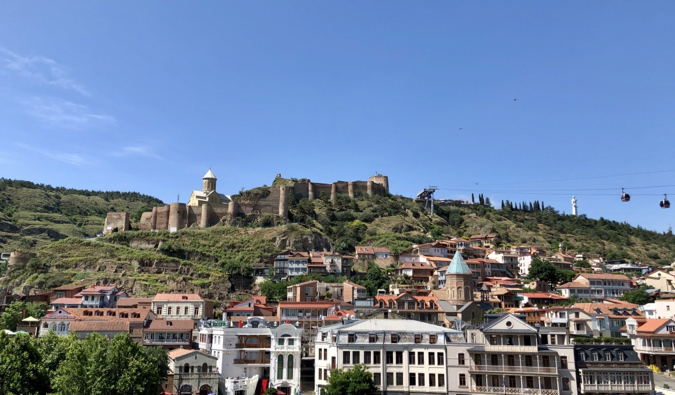
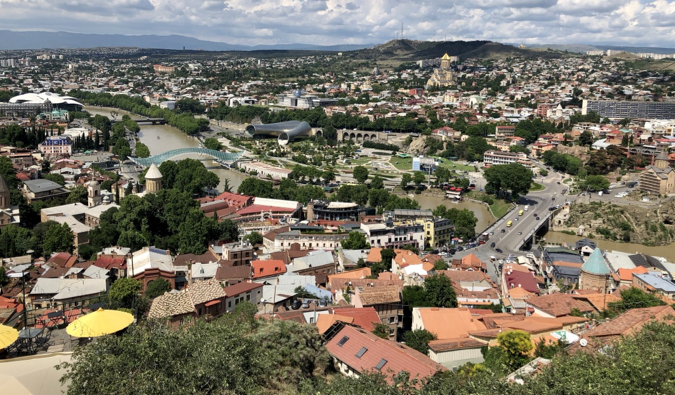
A view overlooking Tbilisi

A view overlooking Tbilisi
Post: 9/12/18 | September 12th, 2018

Post: 9/12/18 | September 12th, 2018

“When did you first hear of Georgia?” Mako asked after a long drag from her cigarette. She was a Georgian tour guide helping my friend Dave, who was also in the country. We were drinking wine outside Fabrika, an old Soviet fabric factory now converted into a multi-use center with bars, restaurants, co-working spaces, shops, artist studios, and a hostel.

“Hmm…” I replied. “That’s a good question. On one level, I’ve known about Georgia for a long time, because, well, I know my geography. But as a place that was more than just a name on a map, I would have to say it’s only been in the last few years — when I started thinking of more unique and off-the-beaten-path places to visit — that I really thought ‘Hmm, Georgia? That could be interesting!’”

When I left London for a trip to Azerbaijan in June, I added nearby Georgia to the itinerary too. Friends spoke highly of the country, and I wanted to see its mountain towns, beaches, and historic cities, and to taste the food and wine I had heard so much about.

My original plan was to spend about a little over a week there, hitting some of the highlights and whetting my appetite for another trip (to me, a week in a country is just never enough time).

But, after a change in plans that required me to head home earlier than expected, I only had time to see the capital of Tbilisi.

From the moment I got off the bus from Azerbaijan, I was in love. Yes, that’s a cliché. To fall for a place right away. But sometimes a destination just hits you to your core right way. The energy — the essence — of where you are just flows through your body and you feel like you’re coming home to a place you didn’t even realize was home.

It’s as if a part of you had always been there, and you were simply returning to make yourself whole again.

A view overlooking Tbilisi

A view overlooking Tbilisi

Over the next few days, that feeling only increased as I actually began exploring the city.

Before arriving, I had pictured a grimy old city with crumbling, ugly Soviet-era buildings and graffiti. In my mind, it was still frozen in the immediate fall of the Soviet empire.

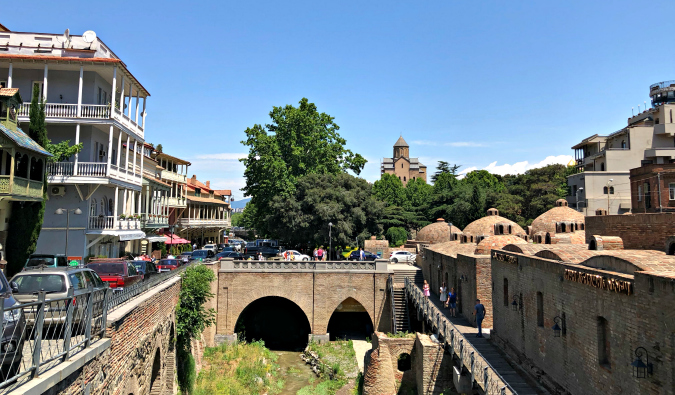
Instead, I found a beautifully preserved Old Town with cobblestone streets and stunning buildings with ornate balconies; lots of spacious parks, wide streets, eclectic artist spaces, and funky cafés; and modern and sometimes futuristic architecture. It was a lot more like Europe than I had anticipated.

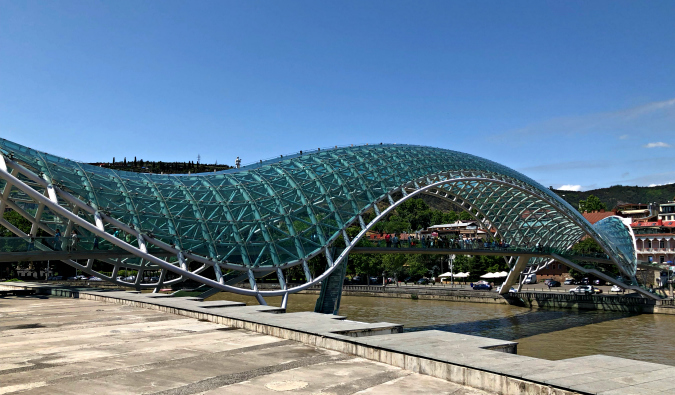
A pedestrian bridge in Tbilisi

A pedestrian bridge in Tbilisi

I spent my first day wandering the old town. I gazed at the Metekhi Church with its giant equestrian statue of King Vakhtang Gorgasali overlooking the Mtkvari River. This is where the king built his palace when he made Tbilisi his capital in the fifth century. (Legend has it that he founded Tbilisi while hunting and discovered the sulfur baths, but a city existed here long before he came along! He just revived it.) The simple, domed-shaped brick building is popular with locals, as legend says the fifth-century martyr St. Shushanik was buried here.

From there I walked across the bridge, toward the famous sulfur baths, a collection of brick-domed buildings containing subterranean bathhouses. These baths helped make Tbilisi famous, as the waters are claimed to help soothe symptoms in chronically ill patients, like arthritic pain or poor blood circulation. There used to be 63 of these baths in Tbilisi, but there are only a handful left now. They are still wildly popular, though I don’t see the charm in smelling like rotten eggs. (But I’m a weirdo, so what do I know?)

Buildings in Tbilisi

Buildings in Tbilisi

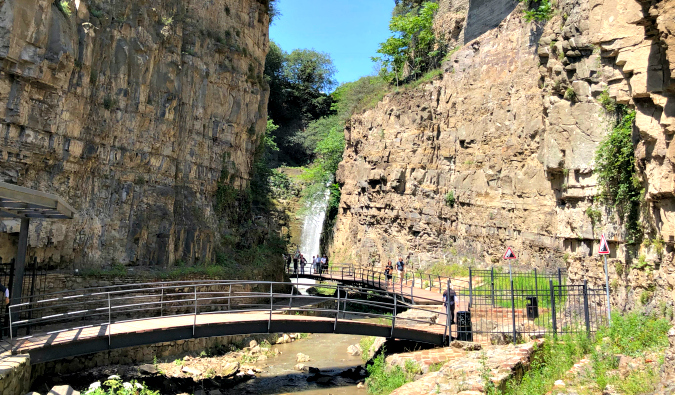
These bathhouses straddle a small river that feeds them and then meanders through a canyon that you can follow to the amazing Dzveli Tbilisi sulfur waterfall. There, the sound of the city melts away, and you feel more like you’re in a national park than a national capital.

I wandered some more and located the entrance to Tbilisi’s gigantic National Botanical Garden, where I found a zip line, tons more waterfalls and rivers to swim in (which, given the high temps during my visit, were well utilized by locals), hiking paths, and flowers and shrubbery. Amidst this peace, I often had to remind myself that I was in a chaotic major city and not some little quiet mountain town.

Hiking in Tbilisi

Hiking in Tbilisi

From there it was up to the Narikala Fortress, which dominates the skyline. Dating back to the fourth century, it was once a Persian citadel. Most of the walls were built in the eighth century, but in 1827 an explosion of Russian ammunition stored there wrecked the whole thing. The cliffs the ruins are on offer the best views of the entire city. You can see for miles, which is probably why the site was chosen for the citadel. A cable car connects it with Rike Park on the other side of the Mtkvari River.

The next day, I explored the city’s history museums (which, to my surprise, had a good amount of English translations). I highly recommend the Georgian National Museum, which has a detailed exhibit on the country’s history; the Nikoloz Baratashvili Memorial House-Museum, which houses materials related to the life and work of the romantic poet, period furniture, folk musical instruments, paintings, and lots of history about 19th-century Georgia; and the David Baazov Museum, which talks about Jewish history in Georgia (Israel and Georgia have a close relationship).

However, after having hiked a lot in Azerbaijan, walking in the stifling summer heat of Tbilisi wasn’t that exciting to me. So, after a day and half of sightseeing, I found myself indoors drinking tea, writing, consuming a (un)healthy amount of wine, gorging on food at Fabrika, talking to other travelers, getting to the know the staff at a local coffee shop, and hanging out with Dave.

I can’t say I really know Tbilisi. Sure, I can get around the subway now. I have an idea of what things cost. I know a little about the city and country. I met some cool people. I have a vague sense of place

But I don’t know it the way I know New York or Paris or Bangkok or a thousand other place I’ve lived or spent years traveling to.

But I feel like I know it.

Tbilisi is a city bursting with activity. A city of art and history. Of enjoyment. Of an energy that seemed to say, “Come enjoy the good life over wine. Don’t fret over things — just be.”

Tbilisi’s energy is my energy.

We are a match made in heaven.

And, though it’s terrible to end a travel article with the cliché “I can’t wait to go back,” I honestly can’t wait to go back.

I felt at home in that city.

And everyone loves the feeling of returning home.

Book Your Trip to Tbilisi: Logistical Tips and Tricks

Book Your Flight
Find a cheap flight to Tbilisi by using Skyscanner or Momondo. They are my two favorite search engines. Start with Momondo.

Book Your Accommodation
I highly recommend the hostel and co-working space Fabrika. To book another hostel in Tbilisi, use Hostelworld. If you want to stay elsewhere, use Booking.com as they consistently return the cheapest rates. (Here’s the proof.)

Don’t Forget Travel Insurance
Travel insurance will protect you against illness, injury, theft, and cancellations. I never ever go on a trip without it. I’ve been using World Nomads for ten years. You should too.

Need Some Gear?
Check out our resource page for the best companies to use!

Want More Information on Georgia?
Be sure to visit our robust Georgia travel guide for even more planning tips!

The Best Ruin Bars of Budapest in 2019: 9 Places Not to Miss

The Ruin Bars of Budapest

The Ruin Bars of Budapest
Updated: 1/5/2019 | January 5th, 2019

1/5/2019 | January 5th, 2019

One of the upsides to being an independent writer is that I’m my own boss. There are no deadlines, no one to pester me, and no outside burdens. I get to write about what I want when I want — the good, the bad, and the ugly. However, since the stories on this blog are based on what I see and do, I have no one to say things like, “Matt! There’s a cool new trend in this city. Here’s a plane ticket; go check it out and report back right away!”

And I never wished for that more than when I went in Budapest.

Because no one ever mentioned the “ruin bars” to me. It wasn’t until my second visit that I got to know what these bars were. Now, I visit them whenever I visit the city.

Ruin bars are all the rage in Budapest and have been around since the founding of Szimpla Kert, the mecca of all ruin bars. These bars are built in Budapest’s old District VII neighborhood (the old Jewish quarter) in the ruins of abandoned buildings, stores, or lots. This neighborhood was left to decay after World War II, so it was a perfect place to develop an underground bar scene. (Not so underground anymore, though.)

From outside, these bars look like normal homes. They don’t have large signs pointing the way, you don’t hear any loud noise, and there’s no line of people waiting to get in. But once you walk in and enter the inner courtyard, you find yourself in the middle of a hip, artsy, and funky bar bustling with crowds talking, dancing, and enjoying the laid-back atmosphere. Large bouncers inside, along with posted signs, ensure that people are quiet on their way out, so as to not disturb the neighbors.

Each of these ruin bars has its own personality, but they all follow a few basic principles: find an old abandoned place, rent it out (maybe?), set up a bar, fill it with flea market furniture, have a few artists come in to leave their mark on the walls and ceiling, add in some weird antiques, serve alcohol, and watch people flock in. Since all these bars are in abandoned buildings, they open, close, and move frequently depending on whether the neighbors find out, the patrons get too loud, or an investor comes and buys the property to renovate it.

When you’re in these bars, you feel like you’re drinking at your local thrift store. None of the furniture matches. It’s all old. It’s eclectic. It feels like they just ransacked your grandmother’s house. The ceilings are all designed differently. For example, Instant has a room where the furniture is on the ceiling, and Fogasház has bikes hanging from its ceiling. The places haven’t been repaired or fixed up, and there are still holes in the walls and visible pipes everywhere.

But it all adds to the “underground” feeling each ruin bar has. If these places hadn’t been pointed out to me, I never would have found them.

Though the ruin bar movement has become mainstream and less underground than it was when it started (or even a few years ago), many of the bars have done a good job of keeping their character and staying true to their roots – even as they fill up with more tourists.

Here is a list of the best ruin bars of Budapest:

Szimpla Kert
the colorful interior of the Szimpla Kert ruin bar in Budapest

the colorful interior of the Szimpla Kert ruin bar in Budapest
This was the original ruin bar. It opened in 2001 and starting this trend. It’s one of the biggest ruin bars and still one of the most popular. Once an abandoned factory, here you’ll find a large open courtyard, a top floor filled with eclectic furniture, cocktail bars, music, and even an old, stripped-down Trabant (a communist car) to have a drink in. All the rooms have a different theme. They also sell pizza, which, after a few drinks, makes for the perfect walking-home snack.

This was the original ruin bar. It opened in 2001 and starting this trend. It’s one of the biggest ruin bars and still one of the most popular. Once an abandoned factory, here you’ll find a large open courtyard, a top floor filled with eclectic furniture, cocktail bars, music, and even an old, stripped-down Trabant (a communist car) to have a drink in. All the rooms have a different theme. They also sell pizza, which, after a few drinks, makes for the perfect walking-home snack.

Kazinczy u. 14, +36 20 261 8669, szimpla.hu. Open 12pm-4am on weekdays, 9am-4am on Saturdays, and 9am-5am on Sundays.

Instant
The Ruin Bars of Budapest

The Ruin Bars of Budapest
Instant is located in an entire apartment building and the biggest ruin bar in the city. There are over twenty rooms here. It’s one of the more club-like ruin bars. In Instant, you can sit in what were once individual apartments and relax on furniture that looks like it was found on the street. They’ve knocked down many of the walls to connect the apartments and make space for the DJs and dancing. Given its popularity and the fact that it’s more “clubby,” drinks here are a little more expensive than in other ruin bars. But the vibe is still good.

Instant is located in an entire apartment building and the biggest ruin bar in the city. There are over twenty rooms here. It’s one of the more club-like ruin bars. In Instant, you can sit in what were once individual apartments and relax on furniture that looks like it was found on the street. They’ve knocked down many of the walls to connect the apartments and make space for the DJs and dancing. Given its popularity and the fact that it’s more “clubby,” drinks here are a little more expensive than in other ruin bars. But the vibe is still good.

Akácfa u. 49-51, +36 70 638 5040, instant.co.hu/en. Open daily from 10pm-6am.

Fogasház
The Ruin Bars of Budapest

The Ruin Bars of Budapest
Fogasház is smaller, lower-key, and less touristy than popular Instant and Szimpla Kert. The “House of Teeth” got its name from an old dentist’s office sign they found when they were building the bar. This bar has bicycles and glasses hanging from the ceiling and is artsier than the other ruin bars. Small tables dot the inner courtyard, and you don’t have loud music drowning out the conversation. They often host art exhibits here. They also have a ping-pong table. It’s a hipster’s paradise here.

Fogasház is smaller, lower-key, and less touristy than popular Instant and Szimpla Kert. The “House of Teeth” got its name from an old dentist’s office sign they found when they were building the bar. This bar has bicycles and glasses hanging from the ceiling and is artsier than the other ruin bars. Small tables dot the inner courtyard, and you don’t have loud music drowning out the conversation. They often host art exhibits here. They also have a ping-pong table. It’s a hipster’s paradise here.

Akácfa u. 49-51, +36 1 783 8820. Open daily from 4pm-6am.

Doboz
The Ruin Bars of Budapest

The Ruin Bars of Budapest
I’m not entirely sure if this place fits into the ruin bar culture. It was much fancier and trendier than the other bars I visited. It was like being in a “real” bar. However, I was taken there as part of a ruin bar tour, and, regardless, I love this place. You walk into the courtyard and are greeted by a tree with a red-eyed robot attached to it. It looks like a Transformer is about to attack you. There are two main rooms: one red, the other blue. They play a lot of dance music, and this place fills up toward the end of the night.

I’m not entirely sure if this place fits into the ruin bar culture. It was much fancier and trendier than the other bars I visited. It was like being in a “real” bar. However, I was taken there as part of a ruin bar tour, and, regardless, I love this place. You walk into the courtyard and are greeted by a tree with a red-eyed robot attached to it. It looks like a Transformer is about to attack you. There are two main rooms: one red, the other blue. They play a lot of dance music, and this place fills up toward the end of the night.

Klauzál u. 10, +36 20 449 4801, doboz.co.hu/en. Open Tu (5pm-2am), W-Th (5pm-5am), F-Su (5pm-6am), and closed on Mondays.

Corvin Teto
The Ruin Bars of Budapest

The Ruin Bars of Budapest
Located on top of a supermarket, Corvin Teto is popular due to its huge rooftop terrace, where you can get an expansive view of the hills of Buda and the buildings of Pest. This is another dance-heavy ruin bar, specializing in electronic music. I’d come up here for a drink during sunset and then move on elsewhere.

Located on top of a supermarket, Corvin Teto is popular due to its huge rooftop terrace, where you can get an expansive view of the hills of Buda and the buildings of Pest. This is another dance-heavy ruin bar, specializing in electronic music. I’d come up here for a drink during sunset and then move on elsewhere.

Blaha Lujza tér 1-2, +36 20 244 7230, corvinclub.hu. Open Thursday to Saturday from 9pm-6am.

Grandio
Grandio: an awesome Ruin Bar and hostel in Budapest, Hungry

Grandio: an awesome Ruin Bar and hostel in Budapest, Hungry
Grandio is a ruin bar and hostel in one. It’s famous for its outdoor, tree-filled courtyard but is mostly filled with travelers and people on bar crawls due to the fact that it’s also a hostel. This is a good place to start your night and meet other travelers. However, during the day you can find locals relaxing here with a drink in the garden.

Grandio is a ruin bar and hostel in one. It’s famous for its outdoor, tree-filled courtyard but is mostly filled with travelers and people on bar crawls due to the fact that it’s also a hostel. This is a good place to start your night and meet other travelers. However, during the day you can find locals relaxing here with a drink in the garden.

Nagy Diófa u. 8, +36 70 670 0390, grandio.insta-hostel.com.

Dürer Kert
durer kert ruin bar Budapest

durer kert ruin bar Budapest
A former university building, this ruin bar lets you tap into your inner college student as you drink few beers while playing foosball, Ping-Pong, darts, and a French game called pétanque (it’s fun). The courtyard garden is a good spot to enjoy all the live music that happens in this bar.

A former university building, this ruin bar lets you tap into your inner college student as you drink few beers while playing foosball, Ping-Pong, darts, and a French game called pétanque (it’s fun). The courtyard garden is a good spot to enjoy all the live music that happens in this bar.

Ajtósi Dürer sor 19-21, +36 1 789 4444, durerkert.com/hu. Open M-Sa (5pm-5am), Su (5pm-12am).

Mazel Tov
ruin bar mazel tov in Budapest

ruin bar mazel tov in Budapest
This is one of Budapest’s newest ruin bars. Mazel Tov (located in the old Jewish quarter) is a community center and restaurant serving traditional Jewish cuisine by day. At night, the courtyard is a party with DJs and live entertainment entertaining guests.

This is one of Budapest’s newest ruin bars. Mazel Tov (located in the old Jewish quarter) is a community center and restaurant serving traditional Jewish cuisine by day. At night, the courtyard is a party with DJs and live entertainment entertaining guests.

Akácfa u. 47, +36 70 626 4280, mazeltov.hu. Open M-Tu (12pm-1am), W-F (12pm-2am), Sa-Su (10am-2am).

Anker’t
ruin bar anker't Budapest

ruin bar anker't Budapest
Located in a former factory in downtown Budapest, this minimalist space is made up of large, connecting courtyards, a gigantic dance floor to get your party on, and plenty of couches to lounge on if dancing isn’t your thing. There’s a lot of funky art hanging on the walls and the place is pretty big. The bar also serves some decent food too.

Located in a former factory in downtown Budapest, this minimalist space is made up of large, connecting courtyards, a gigantic dance floor to get your party on, and plenty of couches to lounge on if dancing isn’t your thing. There’s a lot of funky art hanging on the walls and the place is pretty big. The bar also serves some decent food too.

Paulay Ede u. 33, +36 30 360 3389. Open M-W (2pm-12am), Th (2pm-1am), F-Sa (2pm-4am), Su (2pm-12am).

***Budapest may sell itself on history and thermal baths, but the ruin bars are by far the most unique thing about this city. Even if you don’t drink, come spend time at these ruin bars because they are such a funky way to see a popular and totally unique aspect of life in Budapest. You’ll meet a lot of locals when you visit! Don’t miss them.

Want to Learn How I Travel the World for Free?

Primer on Travel HackingPrimer on Travel HackingStop paying full price! Download our free guide to travel hacking and learn:

  • How To Pick a Credit Card
  • How To Earn Miles for Free Flights & Hotels
  • Is Travel Hacking Really a Scam?

GET THE FREE GUIDE

Book Your Trip to Budapest: Logistical Tips and Tricks

Book Your Flight
Find a cheap flight by using Skyscanner or Momondo. They are my two favorite search engines because they search websites and airlines around the globe so you always know no stone is left unturned.

Book Your Accommodation
You can book your hostel with Hostelworld. If you want to stay elsewhere, use Booking.com as they consistently return the cheapest rates for guesthouses and cheap hotels. I use them all the time. My favorite places to stay in Budapest are:

  • Retox – A big party hostel located next to Budapest’s biggest nightlife areas. This one is for serious partiers!
  • Carpe Noctum – The staff here will end up feeling like family, and there are organized trips out on the town every night.
  • Wombats – Another party spot, but Wombats is clean and comfortable, and one of my all-time favorites.
  • Hostel One – Great rooms, great staff, and plenty of common space to socialize. The staff will even cook for you!
  • Big Fish – New hostel located right on the main boulevard of Budapest. New beds, a huge kitchen, and a cozy common room!

Don’t Forget Travel Insurance
Travel insurance will protect you against illness, injury, theft, and cancellations. It’s comprehensive protection in case anything goes wrong. I never go on a trip without it as I’ve had to use it many times in the past. I’ve been using World Nomads for ten years. My favorite companies that offer the best service and value are:

  • World Nomads (for everyone below 70)
  • Insure My Trip (for those over 70)

Looking for the best companies to save money with?
Check out my resource page for the best companies to use when you travel! I list all the ones I use to save money when I travel – and I think will help you too!

Budapest may sell itself on history and thermal baths, but the ruin bars are by far the most unique thing about this city. Even if you don’t drink, come spend time at these ruin bars because they are such a funky way to see a popular and totally unique aspect of life in Budapest. You’ll meet a lot of locals when you visit! Don’t miss them.

Photo credits: 1, Jorge Franganillo, 3, 4, 5, 6, 7, 8, 9, 10