显示标签为“tour”的博文。显示所有博文

2019年8月5日星期一

How to Visit the Amazon Rainforest in Bolivia (Updated 2019)

https://www.flickr.com/photos/kj-an/8331938680/https://www.flickr.com/photos/kj-an/8331938680/
Updated: 8/5/19 | August 5th, 2019

Bolivia provides a budget-friendly option for exploring the rainforest. It’s cheaper and less crowded than the Amazon tours from Brazil. In this guest post, Erin from Never Ending Voyage shows us how we can experience the rainforest by going through Bolivia at a cheaper price!

The Amazon Rainforest. It’s the world’s largest tropical rainforest, covering some 5.5 million square kilometers. Offering the opportunity to see rare flora and fauna, it’ should come as no surprise that it’s at the top of many travelers “to-do” lists.

When most travelers think of the Amazon, they tend to think of Brazil.

Yet the Amazon basin actually stretches across nine countries in South America, which means that you don’t have to take an expensive tour in Brazil to see the jungle. For the budget-savvy traveler, Bolivia provides an amazing (and affordable) alternative from which to visit the basin.

Not only is it cheaper and less crowded but it’s just as biologically diverse as Brazil!

In this post, we’ll show you everything you need to know to have an amazing Amazon experience in Bolivia!

Where Do You Start?

The starting point for trips into the Bolivian Amazon is the town of Rurrenabaque. It’s straightforward here to sign up for tours, and it’ll be cheaper than if you book in advance in La Paz. Moreover, it’s a small town, so it’s easy to wander around and find a guesthouse for around $5-10 USD a night while you check out a few tour agencies.

There are two ways to visit the Amazon from here:

1. The Pampas
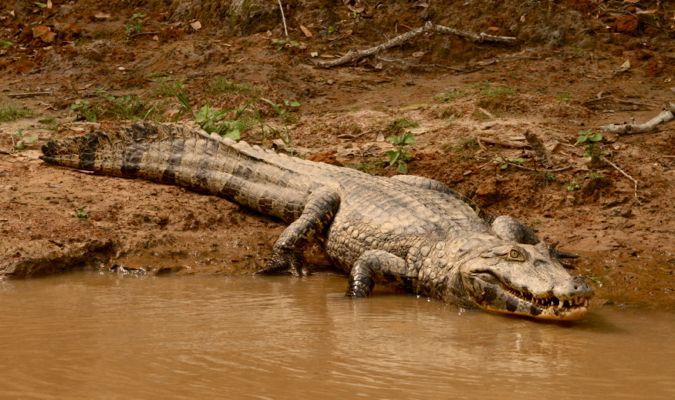
A large alligator near the water's edge in the Bolivian rainforestA large alligator near the water's edge in the Bolivian rainforest
The pampas tours are the cheapest option and are where you’ll see the most wildlife, including alligators, squirrel monkeys, and the giant rodent capybara. It may not be the classic Amazon jungle experience you envisioned, though, as the pampas are a wetland savannah on the edge of the Amazon basin rather than deep in the jungle, but the lack of trees means it’s much easier to spot wildlife.

All the tour operators operate nearly identical two-night/three-day trips for around $75 USD plus the park entrance fee (which will be around $20 USD). Tours generally include all transportation, food, and a guide. You get what you pay for, so expect basic accommodation and meals (I recommend bringing snacks), and your guide may not be the most knowledgeable if you go with a cheap operator.

Since guides are so important to the overall experience, make sure you ask around for a company with good, knowledgeable guides.

After a very bumpy three-hour jeep ride to the jungle, you’ll transfer to a motorized canoe and travel a further three hours along the river to your lodge. The river trip was the highlight for us, as we got up close to an amazing amount of wildlife: hundreds of alligators, entire families of capybara (giant semiaquatic rodents), turtles sunbathing on logs, and trees full of tiny yellow squirrel monkeys. All while birds such as egrets, herons, roseate spoonbills, blue kingfishers, eagles, and hoatzin (pheasant-like birds with blue faces and spiky hair) flew and nested around us.
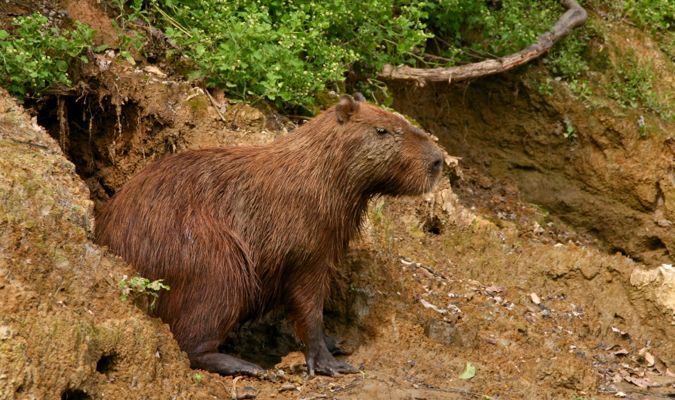
A brown capybara looking for predators in BoliviaA brown capybara looking for predators in Bolivia

The riverside camp is in a peaceful setting among the trees, with plenty of wildlife-spotting opportunities (I had monkeys peering into my room!). Accommodation is in shared wooden huts on stilts, and you’ll wake up to the raucous sounds of howler monkeys. A generator provides power until 10pm so you can enjoy cold beers while lounging in a hammock and watching the sunset over the river.

The pampas tours are a great way to view lots of wildlife for a very affordable price, but choose your tour operator carefully and make sure they don’t touch or feed any of the wildlife — especially the anacondas.

2. The Jungle
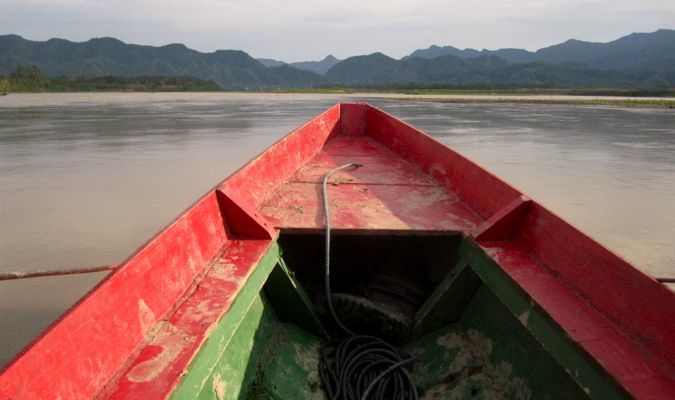
The tip of a red canoe as it floats along in the Bolivian amazon rainforestThe tip of a red canoe as it floats along in the Bolivian amazon rainforest

For a more classic Amazon experience, opt for a jungle tour. You can stay at an eco-lodge in the jungle and do activities from there, but this can be pricey. We (my other half and I) paid $207 USD each for a two-night/three-day tour with Madidi Travel to their Serere Lodge, but we did get a large, comfortable bungalow, great food, and a very professionally run trip. We also liked that profits from the trip go back into conservation work for the area.

Although triple the price of a pampas trip, this is still much less than you’d pay for a similar experience in Brazil.

Serere Lodge is reached by a three-hour canoe ride and a short trek through the jungle. You can choose from a range of activities, including canoe trips on the lake next to the camp (at night you can see the glowing red eyes of caiman), day and night treks in the jungle, piranha fishing, and making jewelry from nuts and seeds.

Jungle treks are tiring in the heat and humidity, and there were many more mosquitoes than in the pampas. It is also much more difficult to spot wildlife — you could spend hours and not see one monkey, while we’d canoed past dozens of them in the pampas. It was interesting to see colorful spiders and giant bugs, and learn about the medicinal uses of trees and plants, though.

In general, we just enjoyed the peace of being in the jungle, especially from the comfort of a hammock, even if we didn’t see a lot of wildlife.
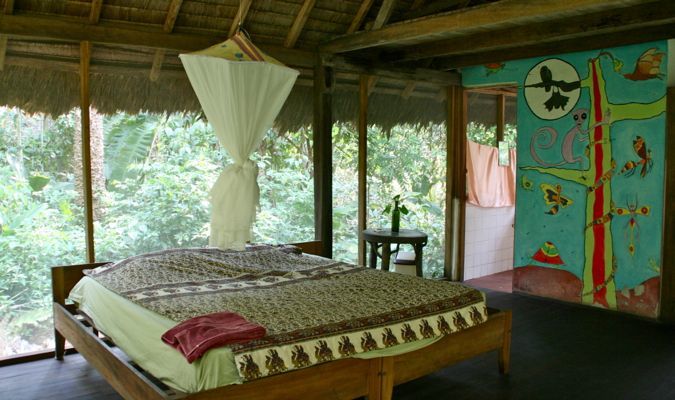
A fancy jungle lodge surrounded by lush jungle Bolivia rainforestA fancy jungle lodge surrounded by lush jungle Bolivia rainforest

There are cheaper jungle tours available with more basic accommodation for similar prices to the pampas trips. We also met someone who had hired a guide independently and trekked and camped out in the jungle. This will save you money and possibly be a more authentic experience, but conditions in the jungle are hard, so don’t undertake one of these treks lightly.

If you have the budget and time, I’d recommend both the pampas and jungle trips, but otherwise, you’ll need to prioritize spotting wildlife in the pampas or the classic jungle experience.

10 Travel Tips for the Bolivian Amazon

  1. You can get to Rurrenabaque from La Paz by a horrendous, bumpy 30-hour bus ride or take the scenic 35-minute flight across snowy mountains and into the jungle. We flew with Amaszonas for $75 each way, but TAM might be a little cheaper. Obviously, the $10 bus ride will save you money, but it might not be worth it for your sanity!
  2. The best time to visit the Bolivian Amazon is the dry season from May to October when there is more wildlife attracted to the rivers and fewer mosquitoes.
  3. There is no reliable ATM in Rurrenabaque, so bring plenty of cash.
  4. Many tour operators will offer anaconda hunts where you can pose for photos. Don’t go on these. Wild animals should be viewed from a distance only; they aren’t pets.
  5. The jungle trek is more physically demanding than the pampas tour so be sure to have good footwear and proper hiking clothing.
  6. Many guides will encourage you to get up close and personal with many of the animals that you see. For your own safety, don’t.
  7. To make sure you get a reliable tour operator, don’t pay less than around $90-100 USD for your tour. Anything below that price point will like be less than ideal.
  8. If you’re doing the jungle tour, you’ll want to wear waterproof hiking boots or shoes.
  9. Wear light trekking clothes as it can get warm, but also make sure to cover up so you aren’t attacked by mosquitoes. Bring bug spray with you as well.
  10. We did our pampas trip with Indigena Tours. I can’t say I recommend them, as it was quite badly organized, the food portions were too small, and our guide wasn’t very helpful. But at least they didn’t touch any of the animals, which is a common problem here. There are definitely worse tour companies in Rurrenabaque. Ultimately it’s a cheap trip and you get what you pay for (there aren’t any more expensive, better-run options), but it was worth it for us to get up close with so much wildlife.

***
Visiting the Amazon jungle is a highlight for many travelers in South America, and it’d be a shame to miss out because you can’t afford the high cost of trips in Brazil. For us, Bolivia made for a perfect affordable alternative.

Visiting the Amazon jungle is a highlight for many travelers in South America, and it’d be a shame to miss out because you can’t afford the high cost of trips in Brazil. For us, Bolivia made for a perfect affordable alternative.

If you’re heading to Bolivia anyway (and you should — it’s an amazing country!), be sure to consider taking an Amazon tour here. You won’t be disappointed!

Erin McNeaney and her partner Simon sold everything they owned and left the UK in March 2010 to travel the world forever. You can follow their adventures at Never Ending Voyage, or Twitter and Facebook.

Book Your Trip: Logistical Tips and Tricks

Book Your Flight
Find a cheap flight by using Skyscanner or Momondo. They are my two favorite search engines because they search websites and airlines around the globe so you always know no stone is left unturned.

Book Your Accommodation
You can book your hostel with Hostelworld as they have the largest inventory. If you want to stay somewhere other than a hostel, use Booking.com as they consistently return the cheapest rates for guesthouses and cheap hotels. I use them all the time.

Don’t Forget Travel Insurance
Travel insurance will protect you against illness, injury, theft, and cancellations. It’s comprehensive protection in case anything goes wrong. I never go on a trip without it as I’ve had to use it many times in the past. I’ve been using World Nomads for ten years. My favorite companies that offer the best service and value are:

  • World Nomads (for everyone below 70)
  • Insure My Trip (for those over 70)

Looking for the best companies to save money with?
Check out my resource page for the best companies to use when you travel! I list all the ones I use to save money when I travel – and that will save you time and money too!

2019年8月2日星期五

Is Morocco Safe? 9 Ways to Stay Safe During Your Visit in 2019

wandering the fez medina in morocco

wandering the fez medina in morocco
Updated: 12/15/2018 | December 15th, 2018

12/15/2018 | December 15th, 2018

Wandering around the Fez medina, I could feel the stares. “Where are you going? Want to go to the tanneries? I’ll take you. No money. Don’t worry!” the medina’s faux guides said as they chased me down the street.

“No, I’m fine,” I’d reply, trying to dodge them at every turn. Turning down side streets, stopping to look at a map, or admiring a view caused them and any nearby vendor to pounce and badger me, inviting me into stores, restaurants, and attractions.

There were moments when I would turn down streets only to have my spidey sense tell me to turn back. A few guys tried to corner me before I managed to slip into a store. Heck, even a little kid tried to pick my pocket. While other cities were not as intense as Fez, my visit to Morocco required a thick skin and a watchful eye.

Before my trip to Morocco, I queried a number of friends about their experiences. I’d heard horror stories of touts, harassment, pickpockets, and scams. While that is common everywhere, Morocco travel seemed to take it to another level. “Keep an eye out,” everyone warned.

After two weeks visiting Morocco (which is amazing — see this post, where I fawn all over it!) with Intrepid Travel on their Best of Morocco tour, I could see why people say Morocco demands extra diligence when it comes to staying safe in Morocco. Touts, scammers, and harassers abound and, while it wasn’t bad when I was with my group, when I was alone, it was intense. As I settled into the famous and secluded Café Clock in Fez to relax, I messaged fellow writers online to ask if I was overreacting or if they felt the same way.

“No, it’s not just you,” was the universal reply.

How to Stay Safe in Morocco

In truth, Morocco is a safe place to visit. There’s only really small crime there (scams and pickpockets) and you’re unlikely to be assaulted or seriously hurt as a tourist in the country. Morocco is super safe for tourists now. As a solo female traveler, you need to watch out a little more carefully but, overall, you are still unlikely to encounter serious problems.

Morocco travel requires extra vigilance because it’s easy to have something happen to you. You’re unlikely to ever be in any real physical danger in Morocco, but the petty crime and harassment require you to stay on guard — more so than other countries. However, if you follow a few rules, you can leave Morocco unscathed and without incidence.

Here are my 9 tips on how to stay safe when you visit Morocco:

  1. Don’t walk alone at night — While walking in well-lit and busy areas can be fine, be careful walking at night. You never know what lurks around the corner in the medinas. Petty crime is rampant here, especially against tourists.
  2. Don’t walk alone if you’re a woman — A woman alone will attract a lot of unwarranted attention from men, an increased chance of being followed, and the likelihood of groping. Even when I was with the girls on my trip, they got a lot of attention. I could only imagine how much worse it was when they were alone. And, as a female, especially do not walk alone at night!
  3. Dress conservatively — Morocco is a conservative Muslim country, and it’s not appropriate to wear skimpy clothing. Keep your arms, shoulders, and legs covered (especially if you are a woman) to avoid any unwanted attention and conform to local norms.
  4. Avoid flashy jewelry — A good universal rule, this takes on more urgency in a country where theft is common and people will see the jewelry as a sign of wealth and therefore try harder to scam you in stores or rob you on the streets.
  5. Don’t carry valuables — Since muggings and pickpockets are common, take the minimum you need when you leave your hotel or hostel. Don’t take your passport with you – leave it in the hotel! A few people on my tour carried it around with them and when my guide found out, he looked like he was about to have a heart attack!
  6. Avoid back alleys — The tiny alleys of the medina are beautiful to explore but sometimes they make you easy prey for scammers and thieves. Don’t venture too far away from the crowds.
  7. Watch for scams — If someone asks you into their shop for tea, they are going to use that as a pretext to get you to buy something and, thanks to the ingrained psychological idea of reciprocity, you’ll probably give in. Don’t let anyone ask you to write a letter or read a postcard that their “cousin” sent to them in English/French/whatever your native language is. It’s a ruse to get you into their store and wear you down. Same with letting someone put henna on your hand. Once these vendors have you, they will be relentless about you trying on clothes, buying something, or giving them money. Say “no thank-you” and walk away.
  8. Say no to tour guides — The people saying “no money” definitely want your money. They will try to get you into their shops or take you places and ask for money for the service. Be firm and tell them no. It doesn’t matter their age or how helpful they are, if they start walking with you, they will ask for money!
  9. Always negotiate taxi prices up front — Always negotiate the price for taxis before you get in, as prices are going to be substantially inflated when you arrive at your destination.

While this is good advice for any country, Morocco is more intense than your average destination due to the sheer number of people who will give you unwanted attention. It takes a lot of energy to always be on your guard in a place where the simple act of asking for directions often leads people asking for money.

Is Morocco safe? Yes, for the most part. But visiting Morocco requires you to be a little tougher and keep an eagle out for problems. It requires you to be a little bit more skeptical.

I was insulated because I was on a tour, but when I was alone or with just a few people, people came out of the woodwork, catcalled my friends, grabbed at the girls, and blocked entrances to restaurants in order to accost us. Even after a decade of travel, I found myself wishing I had a companion to share the mental burden and wanting to scream, “Leave me alone so I can just enjoy your country!”

Many people have asked me if they should go visit Morocco alone.

My honest answer? If you’re a first-time traveler, it might be hard.

This was my first time in North Africa and it was an adjustment for me (and I’ve a very experienced traveler). I was glad to be on a tour and have a guide. If you don’t have a lot of travel experience or are a woman traveling alone, it might just be too much. I might suggest going on a tour first instead of exploring the country solo. Moreover, it is hard to get into the remote desert and mountains on the public transportation systems. I wouldn’t drive here either as everyone races around mountain curves.

That said thousands of people come here alone and they are fine. If you’re OK in uncomfortable situations and a frenetic environment, you’ll be able to visit Morocco just fine!

Morocco was a battery on my senses — the food, the colors, the spices, the smells, and the scenery were unforgettable. (Also the doors — they have such ornate and colorful doorways in Morocco. I have dozens of pictures of doors).

I would 100% recommend to anyone that they visit the country, but make sure you keep an extra eye out (especially in Fez) and have a thick skin for all the people asking you to buy things!

Morocco won’t be easy but it’s worth the visit – and it’s a lot safer than you think!

Editor’s Note: I went to Morocco with Intrepid Travel on their Best of Morocco tour. It was part of my ongoing partnership with Intrepid Travel. They covered the cost of the tour, flight, and meals.

Want to Learn How I Travel the World for Free?

Primer on Travel HackingPrimer on Travel HackingStop paying full price! Download our free guide to travel hacking and learn:

  • How To Pick a Credit Card
  • How To Earn Miles for Free Flights & Hotels
  • Is Travel Hacking Really a Scam?

GET THE FREE GUIDE

Book Your Trip to Morocco: Logistical Tips and Tricks

Book Your Flight
Find a cheap flight by using Skyscanner or Momondo. They are my two favorite search engines because they search websites and airlines around the globe so you always know no stone is left unturned.

Book Your Accommodation
You can book your hostel with Hostelworld. If you want to stay elsewhere, use Booking.com as they consistently return the cheapest rates for guesthouses and cheap hotels. I use them all the time.

Don’t Forget Travel Insurance
Travel insurance will protect you against illness, injury, theft, and cancellations. It’s comprehensive protection in case anything goes wrong. I never go on a trip without it as I’ve had to use it many times in the past. I’ve been using World Nomads for ten years. My favorite companies that offer the best service and value are:

  • World Nomads (for everyone below 70)
  • Insure My Trip (for those over 70)

Looking for the best companies to save money with?
Check out my resource page for the best companies to use when you travel! I list all the ones I use to save money when I travel – and I think will help you too!

Want More Information on Morocco?
Be sure to visit our robust destination guide on Morocco for even more tips on how to plan your visit!

Announcing My "Ten Years a Nomad" Summer Book Tour

driving down a road with tall trees hanging overheaddriving down a road with tall trees hanging overhead
Posted: 6/19/2019 | June 19th, 2019

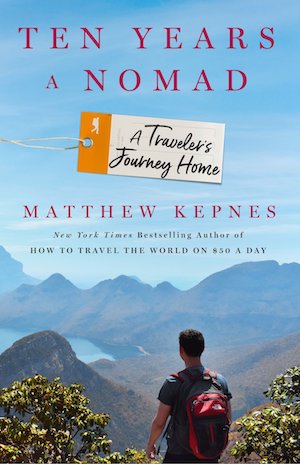
Last month, I announced the release of my next book, Ten Years a Nomad: A Traveler’s Journey Home.

It’s about how I became a traveler, my life as a backpacker, all the lessons I learned, and what those lessons mean for travelers. It features stories I’ve never told and goes deeper into my philosophy on travel than I ever have on this blog.

This book follows the “emotional” journey of a trip around the world: getting the bug, the planning, setting off, the highs, the lows, the friends, what happens when you come back — and the lessons and advice that come with all that.

And the early reviews have been pretty good!

Ten years a nomad book coverTen years a nomad book cover“In his heartfelt explanation and exploration, Matt runs through just why he’s been out there, backpacking the world for 10 years. By the end we’ve definitely realized, like Matt, how important travel is and how getting out there, on the road, can make you, me and the world a better place. It’s a great pity certain people at the very top of the world’s power pyramid never had just a little taste of the nomadic experience.” – Tony Wheeler, founder of Lonely Planet

“Throughout his ruminations on how travel affected him, Kepnes interweaves his tales of friends, girlfriends, and great loves discovered among exotic backdrops and how starting a blog (nomadicmatt.com) about his adventures altered the way he traveled. His story is one of heartbreak, self-discovery, and the constant travel itch he had to scratch in order to become the man he was supposed to be. An entertaining, quick read by a man who did what many of us only dream about.” – Kirkus Book Reviews

10 Years a Nomad book review10 Years a Nomad book review

The book comes out July 16th and I’ll be doing a book tour across the United States and Canada over the course of the summer!

If you want to join the book tour, here are our dates:

Ten Years a Nomad Book Tour

P.S. – There will be an afterparty in NYC after the initial book launch. It will be at Solas. Click here for details!

Hope to see you on the tour! It’s my first one in over four years and I’m very excited about it. It’s going to be a whirlwind!

And, as a reminder, I’m doing a pre-sale bonus so if you order the book in advance you can get free copies of my other books, one-on-one travel planning advice, free attendance at TravelCon, blogging courses, free hostel stays and flights, and more!

The packages are listed below. All you need to do to claim your bonuses is email me a copy of your receipt at matt@nomadicmatt.com.

The Basic Package (cost: $18, value: $48)
Purchase one copy of the book and get:

  • How to Build a Travel Blog ebook (value: $9.99)
  • The Ultimate Guide to Travel Hacking ebook (value: $9.99)
  • 27 Ways to Be a Master Traveler PDF (value: $5)
  • 50 Inspiring Travel Books and Movies PDF (value: $5)

***BEST VALUE*** The Tenner (cost: $182, value: $794)
Buy 10 copies of my book and get ALL THE ABOVE plus:

  • My 12 city and country guides (value: $150)
  • A signed copy of my book How to Travel the World on $50 a Day (value: $15)
  • A 15-minute planning call with me (ask me anything)! (value: $200)
  • The Business of Blogging course (value: $199)

The Bullseye (cost: $900, value: $2,493)
Buy 50 copies of my book and get ALL THE ABOVE plus:

  • One ticket to TravelCon in Boston (value: $399)
  • A 30-minute planning call with me (ask me anything)! (value: $400)

SUPER BONUS! The Centennial (cost: $1,800, value: $7,193)
Buy 100 copies of my book and get ALL THE ABOVE plus:

  • Lunch on me! I’ll come to your city and we’ll have lunch on me! (limited to those in the United States and Canada) (value: $2,000)
  • Round-trip airfare to TravelCon in Boston (from within the US and Canada) (value: $500)
  • One additional ticket to TravelCon in Boston (value: $399)

Conversely, if you’re not a blogger and don’t care about TravelCon, you’ll get four nights at any hostel in the United States and one round-trip domestic airfare.

SUPER BONUS! The Big Kahuna (cost: $4,500, value: $19,293)
Buy 250 copies of my book and get ALL THE ABOVE plus:

  • I’ll come to speak at your event for free! (value: $5,000)
  • You’ll be flown to NYC (from within the US and Canada) the book launch party, put up in a hotel for two nights, and get dinner with me! (value: $3,000)

Note: All digital bonuses will be sent when you send the receipt. Travel arrangements will be worked out between you and me and are valid for six months after purchase (i.e., you have to make a booking by then).

Order the book today, get your bonuses, and share your love of travel!


Want to Help Me Spread the Word About This Book?

I’m always looking for more opportunities to talk travel. Here’s how you can help me spread the word about the new book:

Want to interview me?
If you have a blog, podcast, vlog, or Instagram channel and want to interview me about the book and travel, let me know at matt@nomadicmatt.com using the subject line “Book Interview.” I’d love to talk with you!

Are you in the media and want to cover the book?
If you work for a major media outlet and want to interview me about the book or would like to review the book, let me know at matt@nomadicmatt.com using the subject line “Media Request.”

Know anyone that I should reach out to for promotion?
If you have suggestions on people who would love a copy of this book and would be a good fit for promoting the book, let me know in the comments, or feel to email me at matt@nomadicmatt.com with the subject line “Book Promotion Help.”

Book Your Trip: Logistical Tips and Tricks

Book Your Flight
Find a cheap flight by using Skyscanner or Momondo. They are my two favorite search engines because they search websites and airlines around the globe so you always know no stone is left unturned.

Book Your Accommodation
You can book your hostel with Hostelworld as they have the largest inventory. If you want to stay somewhere other than a hostel, use Booking.com as they consistently return the cheapest rates for guesthouses and cheap hotels. I use them all the time.

Don’t Forget Travel Insurance
Travel insurance will protect you against illness, injury, theft, and cancellations. It’s comprehensive protection in case anything goes wrong. I never go on a trip without it as I’ve had to use it many times in the past. I’ve been using World Nomads for ten years. My favorite companies that offer the best service and value are:

  • World Nomads (for everyone below 70)
  • Insure My Trip (for those over 70)

Looking for the best companies to save money with?
Check out my resource page for the best companies to use when you travel! I list all the ones I use to save money when I travel – and that will save you time and money too!
20 Fun and Intersting Things to See and Do in Bogotá in 2019

https://www.flickr.com/photos/pedrosz/36415484834https://www.flickr.com/photos/pedrosz/36415484834
Posted: 03/25/2019 | March 25th, 2019

The capital of Colombia, Bogotá was the home to the region’s indigenous people, the Muisca, when the Spanish came around plundering gold and resources, and it’s been the country’s main city ever since.

Before I went, everyone told me Bogotá wasn’t anything special: dirty, crowded, hard to get around, and lacking the charm of the other big cities in Colombia.

“Spend a few days there and move on,” they all said.

Well, I spent a few days there — and then a few more.

I LOVED Bogotá.

It felt like the most “Colombian” city I visited. It’s not like the gringofied cities in the rest of the country. Its “gritty” nature was what appealed to me.

Bogotá was a vibrant, lively city I couldn’t get enough of.

The museum scene is incredible, there’s a lot of history, a blossoming art community, an exciting food scene, a wild nightlife, and super welcoming people.

It is also a huge city with a ton of tours, day trips, and other things to do. You could easily spend a week here.

To help you make the most out of your visit, here are my top 20 things to see and do in Bogotá.

20 Things to See and Do in Bogotá

1. Take a Free Walking Tour
https://www.flickr.com/photos/pedrosz/28223935549https://www.flickr.com/photos/pedrosz/28223935549
One of my favorite things to do when I get to a new destination is to take a free walking tour. It’s a great way to get the lay of the land, see the main sights, and have a local expert answer any and all of my questions.

BeyondColombia has a great free walking tour that will give you a solid introduction to the city. It also has a free food tour, which is a terrific way to get a taste of some local Colombian dishes (you’ll spend around 18,000 COP/$6 USD on food for the tour). Just be sure to tip your guides!

For a more specialized tour, check out the Bogotá Graffiti Tour. This one operates by donation, using the money raised to reinvest in future community art projects.

2. Stroll in the Botanical Gardens
https://www.flickr.com/photos/troskiller/2897371556https://www.flickr.com/photos/troskiller/2897371556
Opened in 1955, the Botanical Garden of Bogotá is home to almost 20,000 plants. There is a focus on regional plants, usually those that are endemic to the Andes and other high-alpine regions of the continent. It’s a really peaceful place to walk around, and there are some food stalls nearby, so you can grab a quick bite as you explore the gardens and browse the exotic flowers and trees.

Cl. 63 No. 6895, +57 1-437-7060, jbb.gov.co. Open daily 8am-5pm (9am-5pm on weekends). Admission is 3,500 COP for adults and 1,800 COP for children.

3. Climb Monserrate
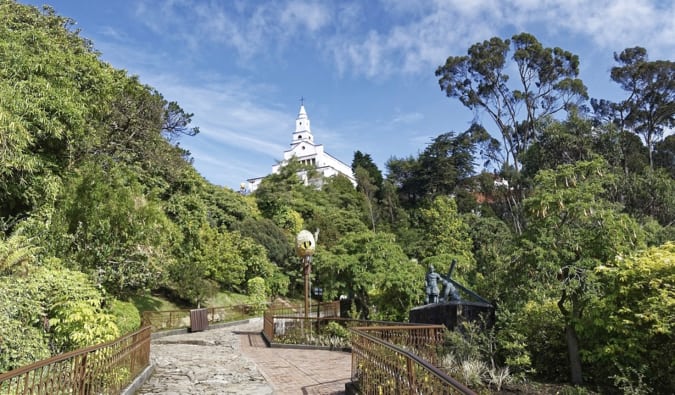
The old church surrounded by trees at the top of Monserrate in BogotaThe old church surrounded by trees at the top of Monserrate in Bogota
Standing tall at over 3,000 meters, you can see Monserrate from pretty much everywhere in town. It’s a popular spot to take in the view, and since there is a church at the summit, it’s also a popular spot for local weddings. You can walk up yourself in under an hour, or you can take a cable car or funicular to the top. Keep in mind that the walk up isn’t that safe at night or alone — thieves scout out the route. Be careful!

The funicular runs Monday-Saturday 6:30am-11:30am and Sundays 5:30am-4:30pm. The cable car is available Monday-Saturday 12pm-11:30pm and Sundays 10am-4:30pm. Tickets for either vehicle are the same price: round-trip tickets cost 21,000 COP for adults (12,000 COP on Sundays).

4. Visit the Museo del Oro (The Gold Museum)
https://www.flickr.com/photos/youngshanahan/29984491190https://www.flickr.com/photos/youngshanahan/29984491190
This is the most interesting museum in the entire country and sees over half a million tourists every year. Opened in 1939, the Gold Museum documents the importance and use of gold in pre-Hispanic civilizations in Colombia and is home to over 55,000 gold items. There’s a lot of information to take in, so be sure to get the audio guide (8,000 COP) or join one of the daily free tours.

Cra. 6 No. 15-88, +57 1-343-2222, banrepcultural.org/bogota/museo-del-oro. Open Tuesday-Saturday 9am-6pm and Sundays 10am-4pm. Admission is 4,000 COP for adults and free for children. Admission is also free for adults on Sundays, but it gets busy quickly so be sure to arrive early!

5. See the Salt Cathedral
https://www.flickr.com/photos/olliethebastard/2535002728https://www.flickr.com/photos/olliethebastard/2535002728
Located about an hour’s drive from the city in Zipaquirá, the Salt Cathedral is a Roman Catholic church that was built in the tunnels of an old salt mine. It’s 200 meters below ground, making this one of the more unique religious sites in the country, if not the world. Every Sunday, up to 3,000 people attend church services here.

Parque de la Sal, +57 315-760-7376, catedraldesal.gov.co. Open daily 9am-5:40pm. Admission is 58,000 COP for foreigners, with discounts available for seniors.

6. Check out the Museo de Botero
https://www.flickr.com/photos/banrepcultural/27085568558https://www.flickr.com/photos/banrepcultural/27085568558
Founded in 2000, this museum is home to one of Latin America’s most important art collections. The museum was created after Fernando Botero donated hundreds of his works to the Banco de la República de Colombia with the promise that they would be displayed in a free museum for everyone to see. In addition to his own pieces, included in the donation were works by Monet, Picasso, and other world-famous artists. Take a free tour or get the audio guide (not free).

Cl. 11 No. 4-41, +57 1-343-1316, banrepcultural.org/bogota/museo-botero. Open Monday and Wednesday-Saturday 9am-7pm and Sundays 10am-5pm (closed Tuesdays). Admission is free, and free guided tours are available daily; see the website for updated times. Audio guides are available for 10,000 COP.

7. Explore La Candelaria
https://ilo.m.wikipedia.org/wiki/Papeles:La_Candelaria,_Bogota,_Colombia_(5785130118).jpghttps://ilo.m.wikipedia.org/wiki/Papeles:La_Candelaria,_Bogota,_Colombia_(5785130118).jpg
I really loved this neighborhood. This is the old part of Bogotá. You can wander the narrow cobblestone streets and take in the eclectic architecture, with art deco, colonial, and baroque styles all calling the neighborhood home. Many of the city’s best attractions (also, many hostels) are here too, such as the Botero Museum, the Gold Museum, and several churches and universities. Watch live music while hanging at Plaza Chorro de Quevedo, try the local chicha (a drink made from corn, often fermented to be alcoholic) on the side streets, and take in some of the amazing restaurants in this district.

8. See the Santuario Nuestra Señora del Carmen
https://commons.wikimedia.org/wiki/File:Santuario_Nacional_de_Nuestra_Se%C3%B1ora_del_Carmen.JPGhttps://commons.wikimedia.org/wiki/File:Santuario_Nacional_de_Nuestra_Se%C3%B1ora_del_Carmen.JPG
The National Shrine of Our Lady of Carmen is a Gothic church located in La Candelaria. The church has a red-and-white striped pattern — both on the outside and inside — making it look like a giant candy cane. Built from 1926 to 1938, the church stands almost 60 meters tall has some incredible Byzantine and Moorish art.

Cra. 5 No. 8-36, +57 1-342-0972. Open Monday-Friday 7am-7:30am and 10am-4pm, Saturdays 7am-7:30am, and Sundays 7am-12:30pm.

9. Visit Simon Bolívar Metropolitan Park
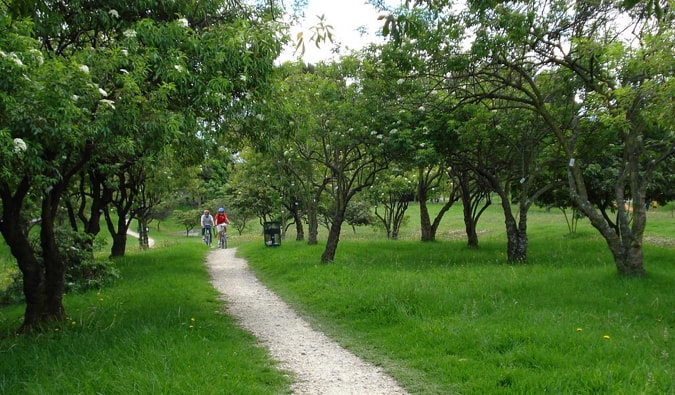
Locals cycling on a bike path in Simon Bolivar Park in BogotáLocals cycling on a bike path in Simon Bolivar Park in Bogotá
This is one of the most popular parks in Bogotá. Created in 1979, it spans almost 1,000 acres. You can find people exercising, relaxing, or attending concerts here. The park is named after the famous Simón Bolívar, who led the liberation of the region from its Spanish overlords.

Open daily 6am-6pm. Admission is free unless there is a concert or event in progress.

10. Wander Plaza Bolívar
https://es.m.wikipedia.org/wiki/Archivo:Plaza_de_Bolivar,_Bogota,_Colombia_(5770632336).jpghttps://es.m.wikipedia.org/wiki/Archivo:Plaza_de_Bolivar,_Bogota,_Colombia_(5770632336).jpg
This is the main square of Bogotá, home to Colombia’s Palace of Justice, the Cathedral of Bogotá, the mayor’s office, and the Capitol Building. It’s the historical heart of the city, with buildings from as early as the 16th century. Under the Spanish, the plaza was home to bullfights, circus acts, and public markets. Watch out for the plethora of pigeons!

11. Head to the Laguna de Guatavita (Lake Guatavita)
https://www.flickr.com/photos/leotisseau/23502895672https://www.flickr.com/photos/leotisseau/23502895672
If you want to take a break from the city and get some fresh air, head out on a day trip to Lake Guatavita. Located around 60 kilometers north of Bogotá, this small lake is a sacred site to the region’s indigenous people and is apparently where the rumors of El Dorado originated. There are also hot springs in the nearby town of Sesquilé if you’re in need of some relaxation.

Day trips to the area last around 6 hours and will vary in price. Expect to pay at least 180,000 COP per person.

12. Explore Parque 93
The grass and trees in Parque de la 93 in Bogota, ColombiaThe grass and trees in Parque de la 93 in Bogota, Colombia
This is the area of town with some of the best restaurants, nightclubs, and bars in the entire city. The park itself is home to an ongoing rotation of temporary art exhibitions. Located in one of the nicer areas of town, you’ll find a lot of good restaurants and cafés lining the park.

13. Attend Gringo Tuesdays
People partying with a DJ at Gringo Tuesdays in Bogota, ColombiaPeople partying with a DJ at Gringo Tuesdays in Bogota, Colombia
This is a weekly language exchange that evolves into an international party. Every Tuesday, you can meet with other locals and travelers for a few hours of conversation. Once that’s over, the real party begins and goes late into the night. It’s a fun, social night out if you’re looking meet fellow travelers. A lot of hostels organize party buses to the event, so if you’re coming from La Candelaria, this is a good transportation option.

Street 85 No. 11-53, Promenade del Faro, +57 311-492-0249, gringotuesdays.com/en. Every Tuesday, the language exchange occurs 4pm-8pm, followed by the party, which runs 8pm-3am.

14. Discover the National Museum of Colombia
The facade of the National Museum of Colombia in BogotaThe facade of the National Museum of Colombia in Bogota
Situated in the heart of Bogotá, this is the oldest and biggest museum in the entire country (and one of the oldest on the continent). Built in 1823, it’s home to over 20,000 pieces of art and historical artifacts, some dating as far back as 10,000 BCE. The building was actually used as a prison initially (it definitely looks imposing) until it transitioned into a museum in 1946. If you’re a history buff or just want to learn more about the country, this museum is a must.

Carrera 7 No 28-66, +57 1-381-6470, museonacional.gov.co. Open Monday-Saturday 10am-6pm and Sundays 10am-5pm. Admission is 4,000 COp for adults, 3,000 COP for students, and 2,000 COP for children aged 5-12.

15. Wander the Usaquén Market
A woman shopping at the Usaquén flea market in Bogota, ColombiaA woman shopping at the Usaquén flea market in Bogota, Colombia
Every Sunday, artisans line the cobblestoned streets to sell all sorts of local crafts and goods. While it’s usually referred to as a flea market, things here are a bit nicer and more upscale than some of the other markets. It’s still quite affordable, though, and makes for a fun way to spend the day.

The market runs 11am-4pm every Sunday in Usaquén.

16. Explore the Museo Santa Clara
The stunning interior of the Santa Clara Museum in Bogota, ColombiaThe stunning interior of the Santa Clara Museum in Bogota, Colombia
This church was built in the 17th century and is actually one of the oldest in the entire country. It was deconsecrated in the 1960s and converted into a museum by the government. There are over 148 baroque paintings that almost entirely cover its walls, making this one of the most beautifully decorated churches you’ll see in Colombia.

Cra. 8 No. 8-91, +57 1-337-6762, museocolonial.gov.co. Open Tuesday-Friday 9am-4:30pm and Saturday-Sunday 10am-3:30pm. Admission is 4,000 COP for adults and 2,000 COP for children.

17. Grab a snack from La Puerta Falsa
A delicious snack from La Puerta Falsa in Bogota, ColombiaA delicious snack from La Puerta Falsa in Bogota, Colombia
This little shop has been serving locals for over 200 years! La Puerta Falsa (The False Door) is a small restaurant with room for fewer than 20 people, yet the tamales and ajiaco soup have been community staples for generations. If you’re looking to try traditional Colombian food, this is the place to go!

Calle 11 No. 6-50, +57 1-286-5091, restaurantelapuertafalsa.inf.travel. Open daily 7am-10pm though its schedule isn’t set in stone.

18. Visit the Iglesia de San Francisco
the ornate gilded interior of the San Francisco church in Bogota, Colombiathe ornate gilded interior of the San Francisco church in Bogota, Colombia
Built in the 16th century, this Catholic church is the oldest surviving church in Bogotá. The interior is incredibly ornate, with a beautiful altar that dates back to the 17th century. It’s still in use, and you’ll likely see some locals praying during your visit, so make sure to dress appropriately and be respectful.

Av. Jimenez De Quesada No. 7-10, +57 1-341-2357. Open Monday-Friday 6:30am-10:30pm; 6:30am-12:30pm and 4pm-6:30pm on Saturdays; and 7:30am-1:30pm and 4:30-7:30pm on Sundays. Admission is free.

19. Sample the local brews
Some of the craft beers offered by the Bogota Brewing Company in ColombiaSome of the craft beers offered by the Bogota Brewing Company in Colombia
Bogotá (and the country has a whole) has a growing craft beer scene. Bogotá Craft Beer offers a four-hour tour that takes you to some of the best bars and breweries in town. The tour includes a knowledgable guide as well as secure transportation from place to place. I highly recommend it.

Tours are available daily 4pm-9pm and need to be booked in advance via their website. Tickets are around 95,000 COP per person.

20. Take a food tour
A delicious local dish in Bogota, ColombiaA delicious local dish in Bogota, Colombia
Bogotá is a great city for foodies, and the best way to get a sense of the culinary offerings is to take a food tour. Bogotá Food Tour will take you around La Macarena, Bogotá’s bohemian and artistic neighborhood. The tour lasts three hours and will take you to three different restaurants where you can sample a local dish and drink. Tours also include pickup and drop-off at your accommodation.

Tours are available Monday-Saturday and begin around 7pm. Booking in advance is required so you can secure your transportation. Tickets are 188,500 COP per person.

***

It’s true that Bogotá is an “edgy city” with a lot of petty crime. Yet I loved the atmosphere and vibe of the city. It had grit (kind of like Naples, Italy). I loved the art, the museums, the food. The city has so much to offer travelers. You can really fill a lot of time between all the sights, tours, parks, and activities. I would have liked to stay longer in Bogotá if I could.

I’d budget three to five days for your visit. It will definitely be worth it.

Book Your Trip to Colombia: Logistical Tips and Tricks

Book Your Flight
Find a cheap flight by using Skyscanner or Momondo. They are my two favorite search engines because they search websites and airlines around the globe, so you always know no stone is being left unturned.

Book Your Accommodation
You can book your hostel with Hostelworld. If you want to stay somewhere other than a hostel, use Booking.com as they consistently return the cheapest rates for guesthouses and cheap hotels. I use them all the time. My favorite places to stay are:

  • Masaya Hostel – This is a cool hostel located in La Candaleria. It has lots of common space where you can meet people and some comfy hammocks you can relax in; it also hosts all sorts of activities and excursions, from live music to salsa lessons.
  • Botánico Hostel – This cool hostel is relvatively new. The beds are comfy, it’s in a good location, and it offers free breakfast too!

Don’t Forget Travel Insurance
Travel insurance will protect you against illness, injury, theft, and cancellations. It’s comprehensive protection in case anything goes wrong. I never go on a trip without it, as I’ve had to use it many times in the past. I’ve been using World Nomads for ten years. My favorite companies that offer the best service and value are:

  • World Nomads (for everyone below 70)
  • Insure My Trip (for those over 70)

Looking for the best companies to save money with?
Check out my resource page for the best companies to use when you travel! I list all the ones I use to save money when I travel — and I think they will help you too!

Want More Information on Colombia?
Be sure to visit our robust destination guide on Colombia for even more planning tips!

Photo credits: 13, 14, 15, 16, 17, 18, 21, 20, 21