显示标签为“better”的博文。显示所有博文

2019年8月2日星期五

Why I Love Solo Female Travel More in My Thirties

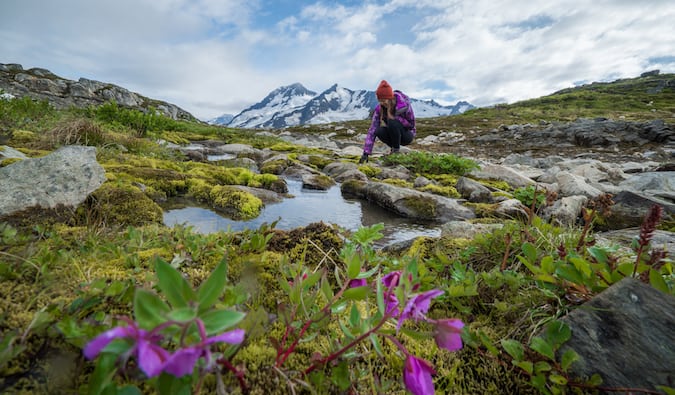
Kristin Addis in the outdoors in Alaska

Kristin Addis in the outdoors in Alaska
Posted: 11/1/2018 | November 1st, 2018

11/1/2018 | November 1st, 2018

Kristin Addis from Be My Travel Muse writes our regular column on solo female travel. It’s an important topic I can’t adequately cover, so I brought in an expert to share her advice for other women travelers to help cover the topics important and specific to them!

The first time I went overseas alone, I was 21 years old and terrified. Everything was an unknown. Would I meet people? Would I be safe? Did I have what it took?

I had landed in Taiwan as a language student and finding a place to live, opening a bank account, and setting up a cell phone all seemed like insurmountable obstacles. I spent my first three days on the road hiding in a hotel room, afraid to emerge, and fumbled at a language I barely knew.

But, eventually, I met my new roommate via a forum online, made friends with her friends, and grew to love everything that traveling solo entailed.

That positive experience was the start to a journey that had me quitting my job to travel around the world at twenty-six.

Traveling solo in my twenties was fun and social. Staying in dorms made meeting people easy. All I had to do is walk into the dorm room, say hello, and, usually, I had a few built-in friends right off the bat. As anyone who frequents dorms knows, they tend to be party places. Almost every hostel has a bar and a common way of experiencing the freedom of being abroad is to do so with a drink in hand. My main objective back then was to go for as long as I could on the money I’d saved up and to have as much fun as possible.

As I crossed into my 30s I suddenly found that – without ever really realizing it – my travel style changed. I stopped wanting to stay in hostels, I stopped having as much interest in bars, I started to really like sleep and having my own room.

When I geared up to go backpacking again this year, I began to worry, am I going to be a weird girl who is in between, not staying in dorms as much anymore but still wanting to be social? Is traveling solo going to get tougher? Will it get harder to meet people?

I found that a lot has changed about how I travel now, but traveling in my thirties is proving to be much more fulfilling than in it was my twenties.

Why?

I can afford better accommodation.

Kristin on the beach of a resort

Kristin on the beach of a resort
For most

For most gap yearers and twentysomething travelers, it’s all about going for as long as possible on a tight budget. One of the easiest ways to do that is to stay in cheap dorms. They’re great for meeting others, and for two solid years in my 20s, I adored them. But for all of the benefits, there’s one big problem with dorms: They’re not so great if you actually like sleep.

Getting older has meant making a bit more money to spend on accommodation. I’ve been in my career for longer, have figured out budgeting a bit better, and have shifted my spending priorities. I now prefer staying in an Airbnb or a hotel over sharing a room with five other people and waiting in line for my turn to use the bathroom. So my dorm days are behind me. Gone are the days of suffering through someone snoring or gyrating in the bunk above me.

Though this means I have to work harder to meet people than just walking into a dorm room and asking someone where they’re from, this has pushed me to meet people in other ways. This leads me to the next big change:

I establish deeper connections with the people I meet.

Kristin hanging out with hostel guests

Kristin hanging out with hostel guests
Traveling in my twenties came with a pretty standard way of socializing: dorms and bars. I’d meet people where I was staying and wouldn’t worry about using other avenues. These connections were fun, but they also felt like the movie Groundhog Day. Someone was always leaving; someone was always arriving. Someone was always asking where I was from and where I’d been. I still made deep connections, but now I tend to spend more time with fewer people because I simply don’t meet as many, so I can give more individualized attention to those I do meet.

Traveling in my twenties came with a pretty standard way of socializing: dorms and bars. I’d meet people where I was staying and wouldn’t worry about using other avenues. These connections were fun, but they also felt like the movie Groundhog Day. Someone was always leaving; someone was always arriving. Someone was always asking where I was from and where I’d been. I still made deep connections, but now I tend to spend more time with fewer people because I simply don’t meet as many, so I can give more individualized attention to those I do meet.

These days I use tours and activities as a way to meet people, like a snorkeling day tour in Siargao, Philippines, or a cooking course in Chiang Mai, or a yoga class, a meditation retreat, a hiking trail, a diving trip, or a day at the beach. I find that when I’m in a position to meet people with similar interests, it gives us a chance to bond over a shared activity we’re both passionate about. By already having a shared passion, we have a common ground other than partying and can often have more meaningful connections this way.

I hang out with more locals.

Kristin with a local on a beach

Kristin with a local on a beach
When I was living the dorm life and hanging out in backpacker zones, that’s exactly who I was surrounded by — other backpackers. That was what I wanted back then – it was fun and easy – so I didn’t push myself outside of it.

When I was living the dorm life and hanging out in backpacker zones, that’s exactly who I was surrounded by — other backpackers. That was what I wanted back then – it was fun and easy – so I didn’t push myself outside of it.

But when I returned to some of the same places in my thirties, I realized that I was more likely to hang out with actual local residents or expats, since I was going to places like yoga studios or small cafés, or local cultural events I’d seen on flyers, and striking up conversations. To find local events, I often look on Facebook for regional groups of activities I enjoy, like Ecstatic Dance, or meditation, or even a workout class (I’m into pole but there are other activities like Soul Cycle, or aerial yoga, or rock climbing, depending on your pleasure).

Things like this often give me a better insight into the places I’m visiting because I am doing what the locals are doing and not just what travelers are doing. It’s not that this couldn’t happen before. It just didn’t as much before because I was so comfortable in my little bubble.

I care more about having nicer meals.

Kristin at a kaiseki meal in Japan

Kristin at a kaiseki meal in Japan
I knew street food was delicious in my twenties — and it’s still true in my thirties. I still love having a cheap bowl of soup — but I also love turning around and spending triple that on a latte, or going for a 5-star meal that you can only get from that chef in this place.

I knew street food was delicious in my twenties — and it’s still true in my thirties. I still love having a cheap bowl of soup — but I also love turning around and spending triple that on a latte, or going for a 5-star meal that you can only get from that chef in this place.

There were many times I had to give a one-of-a-kind dining experience a pass in my twenties due to budget constraints. I think I still could have made it work sparingly back then, but my priorities were different. I preferred a night out partying to eating more expensive food, and I now realize my mistake. Food is one of the best gateways to understanding a culture, and while street food can provide that gateway, it’s only one of many.

For example, I recently ate at a kaiseki restaurant in Japan, which is a multi-course meal that typically costs a bare minimum of $150. Weeks later, I’m still thinking about how creative the meal was, and how unique of an experience it was to sit across from the chefs as they made the food and presented it to me. That was an experience I’ll probably never forget, and though I love cheap noodles, I don’t often think about them the same way weeks later.

Sometimes being an (older) adult is awesome for joys like this.

I’m more comfortable with me.
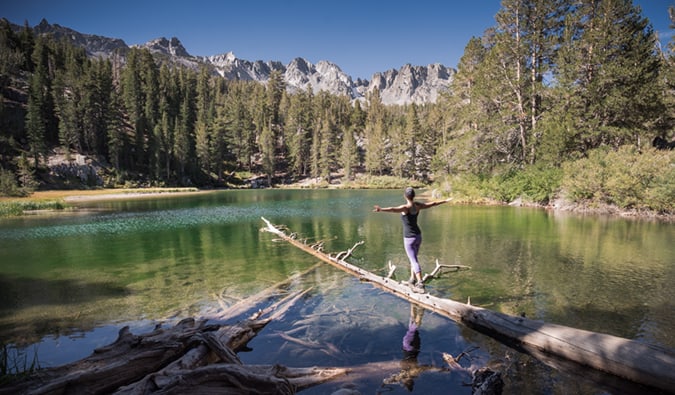
Kristin in a mountain landscape

Kristin in a mountain landscape
I spent my 20s feeling serious FOMO if I wasn’t out enjoying the social aspect of traveling. I also spent way too much time worrying about what other people thought and I didn’t have a very strong sense of self. Traveling, especially solo, forced me to spend more time with myself than I ever had before,

I spent my 20s feeling serious FOMO if I wasn’t out enjoying the social aspect of traveling. I also spent way too much time worrying about what other people thought and I didn’t have a very strong sense of self. Traveling, especially solo, forced me to spend more time with myself than I ever had before, made me realize how resourceful and capable I am, and set me up for a more confident next decade.

Now I relish the time that I spend alone. I’m seeing a whole new world that was missing from my twenties, like the sunrise every day in Thailand, the first surf in Kuta, Indonesia, or the cenote in Mexico (a limestone sinkhole or cave with crystal clear water at the bottom) that doesn’t have anyone else around because they’re all sleeping off tequila hangovers, because they couldn’t handle the FOMO.

I thought that my twenties were the decade when I was supposed to be super energetic and that I would be old and decrepit in my thirties, but it turns out that since I am making healthier choices and setting different intentions with my travels, I actually accomplish so much more!

***

Though the changes have been slow and unconscious — there was never a pivotal “aha!” moment — I’m a different traveler now. Although I don’t have any more stories about late nights out or neon paint on the beach, there’s more purpose to my travels now instead.

And I’m ok with that.

I feel that the perks of being older and wiser keep compounding, and at an even quicker rate than they did in my twenties, when I was less sure of myself and where I wanted to go, both figuratively and while on the road. The confidence that came with more life experience has translated to even better trips abroad.

None of this is to say that traveling in one’s twenties is somehow inferior or less genuine, or that this is everyone’s travel progression. We’re all on our own personal journeys.

But for me, like a fine kombucha, traveling seems to just get better and better with age.

Conquering Mountains: The Guide to Solo Female Travel

conquering mountains: solo female travel by kristin addisconquering mountains: solo female travel by kristin addisFor a complete A-to-Z guide on solo female travel, check out Kristin’s new book, Conquering Mountains. Besides discussing many of the practical tips of preparing and planning your trip, the book addresses the fears, safety, and emotional concerns women have about traveling alone. It features over 20 interviews with other female travel writers and travelers. Click here to learn more about the book and start reading it today!

Kristin Addis is a solo female travel expert who inspires women to travel the world in an authentic and adventurous way. A former investment banker who sold all of her belongings and left California in 2012, Kristin has solo traveled the world for over four years, covering every continent (except for Antarctica, but it’s on her list). There’s almost nothing she won’t try and almost nowhere she won’t explore. You can find more of her musings at Be My Travel Muse or on Instagram and Facebook.

Book Your Trip: Logistical Tips and Tricks

Book Your Flight
Find a cheap flight by using Skyscanner or Momondo. They are my two favorite search engines because they search websites and airlines around the globe so you always know no stone is left unturned.

Book Your Accommodation
To find the best budget accommodation, use Booking.com as they consistently return the cheapest rates for guesthouses and cheap hotels. I use them all the time. You can book your hostel – if you want that instead – with Hostelworld as they have the most comprehensive inventory.

Don’t Forget Travel Insurance
Travel insurance will protect you against illness, injury, theft, and cancellations. It’s comprehensive protection in case anything goes wrong. I never go on a trip without it as I’ve had to use it many times in the past. I’ve been using World Nomads for ten years. My favorite companies that offer the best service and value are:

  • World Nomads (for everyone below 70)
  • Insure My Trip (for those over 70)

Looking for the best companies to save money with?
Check out my resource page for the best companies to use when you travel! I list all the ones I use to save money when I travel – and I think will help you too!

2019年8月1日星期四

Google Translate's Camera Just Got Way Better

 cleanString alt

Getty Images

Google Translate is already a great tool in every traveler’s app arsenal. The service, originally launched in 2015, allows people to translate menus, signs, and even speech to text in seconds. And on Wednesday, Google announced the service’s instant camera translations are getting even better.

For those unfamiliar with the service, you can start by downloading the Google Translate app. The instant camera feature allows you to point your phone camera at foreign text and have it instantly translated into English.

 cleanString alt

Google

Now, in order to make this feature more useful to more global users, Google is increasing the supported languages. There are now 88 languages, from Afrikaans to Zulu, that can be translated into more than 100 languages. So instead of just being able to translate French or Arabic into English, travelers can now translate Belarusian into Igbo or Irish into Persian.

Google is also unveiling a new auto-detect feature, so you can select “Detect language” as the source language. The translate app will then automatically detect the language and translate to your chosen language.

“When traveling abroad, especially in a region with multiple languages, it could be challenging for people to determine the language of the text that they needed to translate,” Google said in a blog post. “We took care of that — in the new version of the app, you can just select ‘Detect language’ as the source language, and the Translate app will automatically detect the language and translate.”

Google is also introducing Neural Machine Translation within its instant camera translations. The technology was first implemented in the product in 2016, and will now allow for greater language translation accuracy and reduce translation mistakes by up to 85 percent from previous app iterations.

Google is rolling the new service out to 1 percent of users today, and to all users in the next few weeks.

So, before you head off on your next great adventure, make sure to download the app. (Available on iOS and Android.) This way you can safely order off the menu, get directions, and make new friends — with a little help from your phone.

I’ve Never Slept Better When Traveling Thanks to This Tiny Sound Machine

 cleanString alt

Getty Images

Traveling to an unfamiliar place means experiencing a new culture and making incredible memories, but it also means you might be out of your comfort zone — especially when it comes to your sleep environment. If you’re someone who can fall asleep anywhere, like in an airport seat waiting at your gate or in a small pod hotel, I envy you. When it comes to falling asleep, I’ve always needed some sort of fan or white noise to help me drift off when traveling, though, I’ve ended up sleeping in silent hotel rooms that keep me tossing and turning. 

That’s why I finally invested in a portable sound machine, and it’s now one of my favorite travel accessories I’ll always pack. While I’m sure I could use some sort of app on my phone to produce the same noises, I’m not worried about leaving the Lectrofan Micro2 Sleep Sound Machine on all night long, and I think it’s actually louder than a typical phone speaker. 

LectroFan Micro2 Sleep Sound Machine

 cleanString alt

Courtesy of Amazon

To buy: amazon.com, $30

Measuring in at only two-inches tall and wide, this sound machine is small enough to fit in most pouches of your carry-on bag, but it’s mighty in sound. It has 11 different sound options including your choice of five different fan sounds (my favorite!), four white, pink, or brown noise variations, and two ocean surf sounds. And if you’re a light sleeper but hate wearing earplugs, you’ll also love that the LectroFan as an easy solution to falling asleep faster for longer. Plus, with more than 2,500 five-star reviews on Amazon, other customers seem to  agree with me this is one of the easiest-to-use portable sound machines that actually works and is worth carrying with you. While LectroFan’s original noise machine ($50; amazon.com) has 20 different sound variations, the LectroFan2 is way more portable thanks to its tiny size. 

But what I love most about this little sound machine that fits in the palm of your hand is that it also doubles as a Bluetooth travel speaker. hen you’re listening to music or your sleep sounds for the night, you can also swivel the Lectrofan so the speaker faces you. At full charge, the Lectrofan can last up to 40 hours in sleep mode, so you won’t have to worry about charging it too often while on the go. 

When you can’t justify another night of bad sleep on the road, the LectroFan Micro2 is here to help — because there’s nothing worse than being too tired to enjoy The Louvre in Paris or a beautiful beach day in the Bahamas. And really, what’s another travel gadget to carry when it’s this small?

12 Tips on How to Travel Better with Your Dog (Updated 2019)

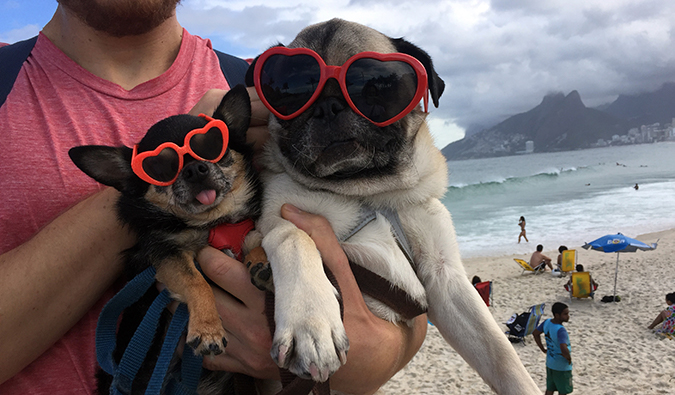
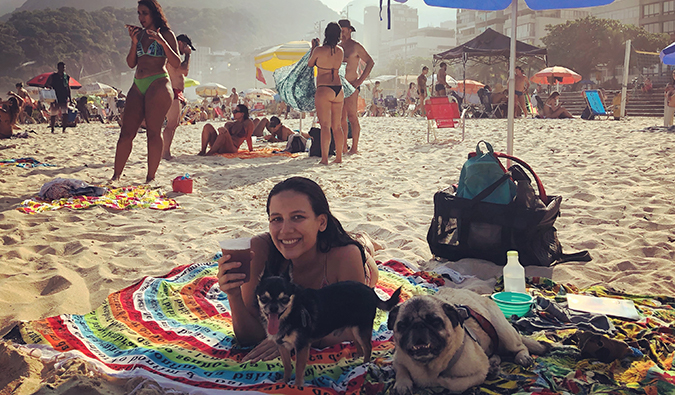
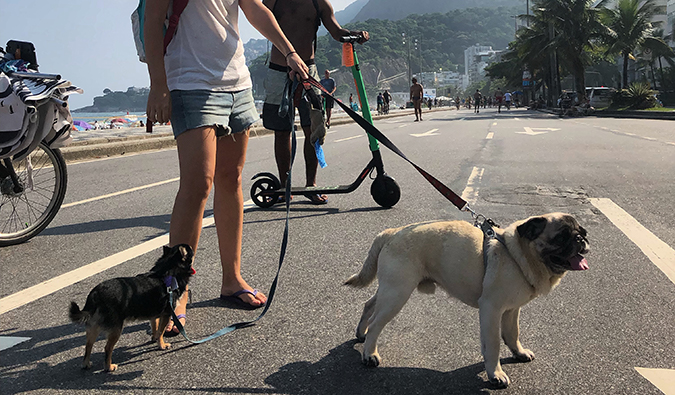
Boogie the pug and Marcelo the chi at the beachBoogie the pug and Marcelo the chi at the beach
Posted: 7/18/2019 | July 18th, 2019

This is a guest post from Candy Pilar Godoy, who blogs about pet travel at Boogie The Pug. She travels the world with her pug, Boogie, and her tiny chihuahua, Marcelo. She’s here to tell you how you can do the same with your dog!

Many people assume that it’s supremely difficult — if not impossible — to travel with dogs. So most assume that they’ll need to fork over a truckload of cash to cover the dog-sitting costs of leaving their pooches behind while they travel.

However, I learned that, with research and a little extra planning, you can take your furry friends along with you on most travel adventures — and it’s not as difficult as you might think.

According to the 2017–2018 National Pet Owners Survey, 68% of US households own a pet. That’s 89 million dogs, an increase of 56% since 1988.

And of that number, about 37% of pet owners actually travel with their pets every year, up from just 19% a decade ago. The International Pet and Animal Transportation Association reported that, worldwide, more than four million live animals are transported on planes every year.

The travel industry has had to adapt to this growing demand, and today, traveling with your dog is easier than ever.

As someone who is extremely passionate about traveling AND dogs, I wanted to share what I’ve learned on the road about this emerging trend.

1. Don’t assume it’s a no

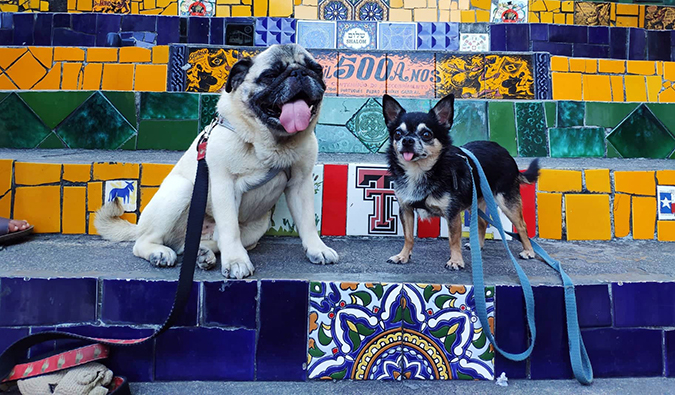
Boogie the pug in Rio de JaneiroBoogie the pug in Rio de Janeiro
Travel with animals increases every year, and it’s taken establishments time to catch up, meaning lots of places don’t have dog policies in place just yet (or their policies have yet to be thoroughly fleshed out). I’ve heard plenty of stories of restaurants and hotels whose websites and/or social media have listed themselves as dog friendly, when in reality they’re not. It happens.

When in doubt, always ask. Never assume that dogs are or are not allowed. It’s great to look for a “No Pets Allowed” sign or a “Pet Friendly” notice, but whether a place has one or not, it’s always best to double-check. A quick email or phone call can save you a lot of time, confusion, and frustration. For example, I’ve been pleasantly surprised to learn that dogs are welcome in most shopping malls in Rio de Janeiro. Who knew?

2. Make copies of pet-related documents

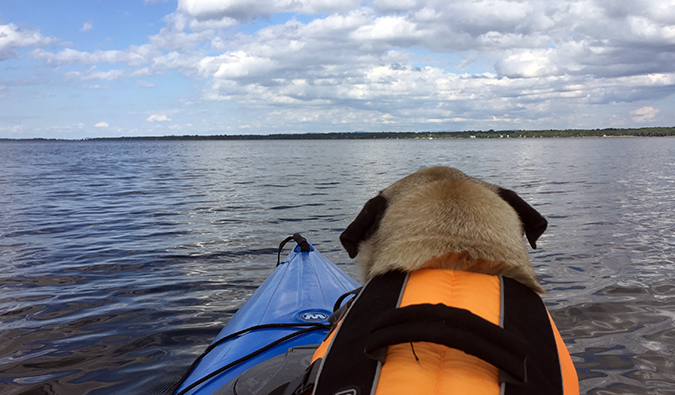
Boogie the pug kayaking in VermontBoogie the pug kayaking in Vermont
If you’re planning to cross borders or travel internationally, you’ll need your dog’s health records on hand (sort of like us humans and our passports). These are necessary to prove that your dog is healthy and vaccinated. Officials ask to see them, and depending on who you deal with, they’ll either keep the originals or make a copy. Additionally, if you need to visit a new vet abroad, you’ll be able to provide them with your furry friend’s medical history.

For these reasons, I like to keep multiple copies of my dogs’ medical records and vet information on us at all times. This includes both a virtual copy on my phone and printed copies in my day bag.

3. Use dog-friendly apps

Boogie the pug in PhiladelphiaBoogie the pug in Philadelphia
There are plenty of apps that can help when on the road with your pup. It’s become a lot easier than when I used to travel the world sans iPhone. My favorites include:

  • All Trails – This has the largest collection of trail maps (over 50,000). Browse photos and reviews, and filter your search by dog-friendly trails so you know which hikes to hit with your dog.
  • Bring Fido – The Yelp of the dog world. Bring Fido helps you locate nearby hotels, attractions, and restaurants that welcome pets.
  • Pet First Aid by American Red Cross – This app helps you locate the nearest emergency animal hospital, and provides step-by-step instructions for common pet emergencies.

4. Skip hotel fees

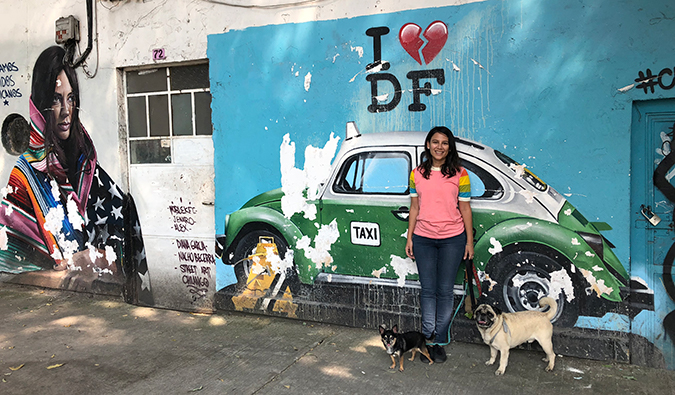
Boogie the pug and Marcelo the chi in Mexico CityBoogie the pug and Marcelo the chi in Mexico City
Many hotels charge additional fees to accommodate your pet. These can range from a one-time fee of $50–$250 to a daily charge of $10–$50 on average. These extra costs add up, increasing the price of your trip and putting pressure on your budget. If you book a hotel with a $50/night pet fee for a week, that’s an additional $350!

There are some hotel chains, however, that welcome your pets without asking for any extra cash — no additional fees, no deposits, and no one-time charges. Consider one of these hotels when you’re booking your next trip. My favorite pet-friendly hotels with no extra fees include:

  • Kimpton – With no additional fees or deposits, Kimpton Hotels rank high in terms of pet-friendliness. Plus, there’s no size or weight limit, and no limit on the number of pets allowed.
  • Red Roof Inn – This upscale economy chain has over 580 locations in the US, and additional locations in Brazil and Japan. They allow all family pets weighing 80 lbs. or less.
  • Motel 6 – Motel 6 hotels are a great option for anyone on a US road trip, with over 1,400 locations across the United States and Canada. They welcome all well-behaved pets, with a maximum allowance of two pets per room.

Can’t find a good hotel in the area? Try airbnb.com. They have an easy search function that filters for pet-friendly homes. We often use Airbnb when traveling internationally.

Pro tip: Before booking with any hotel, ask these questions to ensure that your stay is comfortable.

5. Take a pet carrier

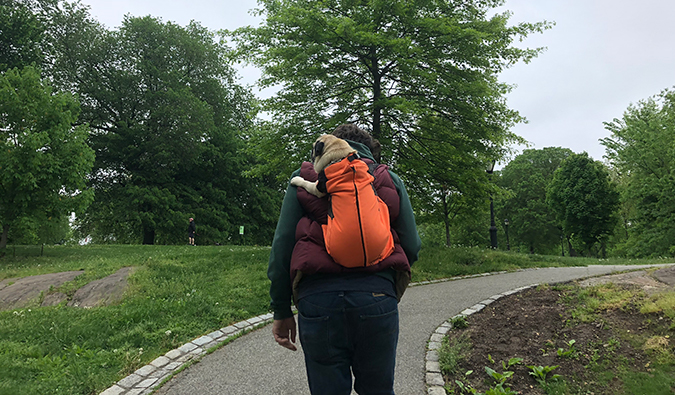
Boogie the pug in a backpackBoogie the pug in a backpack
There are many options on the market when it comes to pet carriers. My favorites include the k9 Sport Sack, a dog carrier backpack that fits dogs of up to 40 lbs. (psst — use the promo code BOOGIE for 10% off). It comes in multiple colors and can be personalized with patches. I also use The Roodie, a pet-carrier hoodie that holds dogs weighing up to 15 lbs.

6. Be respectful of the people you meet

a dog playing in a water sprinkler in Berlina dog playing in a water sprinkler in Berlin
No matter where you go with your dog, be honest and considerate with those around you. Some people love animals, while others can be terrified of even a tiny puppy. Be polite and know your dog’s limits.

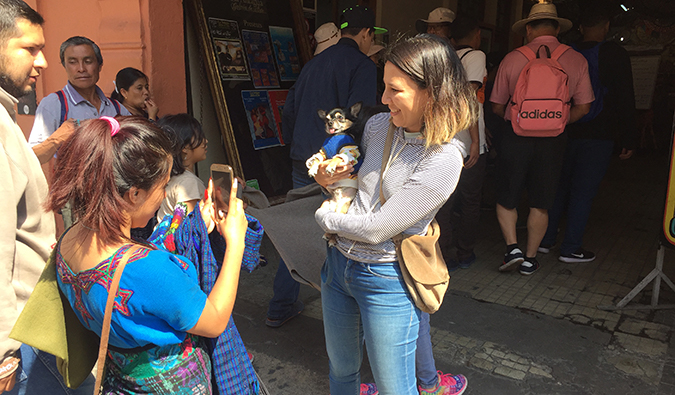
Remember that human relationships with dogs vary incredibly across cultures. For example, in Guatemala, we saw more street dogs than pets. People were often surprised to learn that our dogs travel on planes, and even more taken aback to learn that they sleep in our bed. Try to be aware of these cultural differences, and be sensitive to the human-canine boundaries to which people are accustomed.

Moreover, if your pet tends to be unfriendly with humans (or other dogs), make that very clear to anyone approaching. You don’t want to end up in a situation that could have been avoided with a clear warning. After all, dogs are animals — as owners we are the ones responsible for them.

7. Triple-check airline pet policies

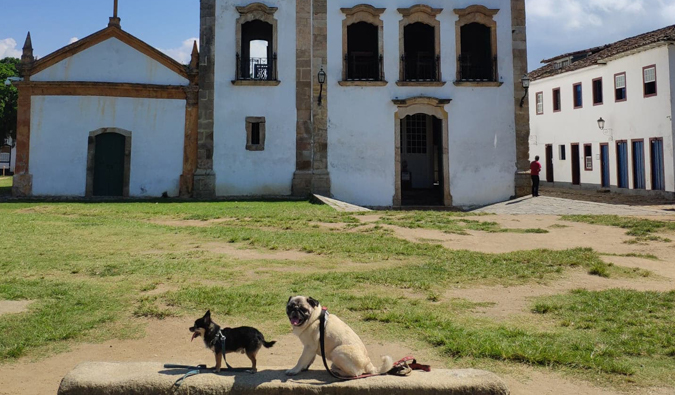
Boogie the pug and Marcelo the chi in Paraty, BrazilBoogie the pug and Marcelo the chi in Paraty, Brazil
When flying, especially internationally, we always double-check, if not triple-check, airline pet policies. Policies are constantly in flux, and rules are always changing. You want to make extra certain that you and your dog are both welcome on that flight. I usually check the airline’s website, give them a call, and send an email confirmation when I’m bringing my dogs on a flight.

Policies and prices for flying with your pet also vary according to a few factors. They usually depend on the airline, the country you’re traveling to, and the size and breed of your pet. There’s also the option of air travel in the cabin, in cargo, and in baggage. (Want to know the difference between these three? Click here.)

Some of my favorite dog-friendly airlines include American Airlines, Delta Airlines, Air France, and JetBlue.

8. Countries differ

Boogie the pug and Marcelo the chi at the beachBoogie the pug and Marcelo the chi at the beach
When it comes to crossing borders, countries differ in their rules and regulations for allowing your pup entry. Some only ask for a rabies vaccine and paperwork from your vet, while others require a pet quarantine and high fees. There’s also a list of banned breeds for whom some countries won’t allow entry at all.

The hardest countries to enter tend to be islands, like Australia, Japan, Fiji, and Iceland. The easiest are countries in the European Union (if your pup has an EU passport!). Research the rules of your destination country thoroughly and far enough in advance to ensure that you can meet all the requirements.

9. Make dog friends

Boogie the pug and Marcelo the chiBoogie the pug and Marcelo the chi
As I said earlier, dogs are social animals. When you’re out walking or spending time at the local park, befriend other dogs and their owners. They’ll let you in on their favorite hangouts, the best dog-friendly restaurants in the area, and which vets they trust. Dog owners know best, and they’re a great resource to have. Here are the best ways to find a local dog community online or IRL:

  • Go on a walk – Grab your pup and head out for a walk around the neighborhood. Stop to sniff a butt or two, and talk to dog people. Speaking to local dog owners is the best way to get the lowdown on the area, and all of the dog-friendly places around town.
  • Instagram – These days, dogs everywhere have their own Instagram profiles. Look up hashtags, like #dogsof and enter in your location. You’ll find dogs all over the world. Find some local pups and send them a message asking for tips.
  • Visit a dog park – Dog parks are a great place to exercise and socialize. Many major cities have them. If there aren’t any official dog parks in your area, ask local dog owners or people online about unofficial places where your dogs can romp around.
  • Find an online community – Online platforms host a myriad of groups based on things like breed, location, dog size, and activity level. I recommend searching Facebook and Meetup.com. Many online communities host meetups and social gatherings that you and your pup can join. They’re also a great place to ask questions.
  • Go to a pet store – Local pet shops are great resources for information. Many post flyers for local dog services, or information on nearby dog-related activities for you and your four-legged friend.

10. Pack the essentials

Boogie the pug and Marcelo the chi at the beachBoogie the pug and Marcelo the chi at the beach
As much as you’d like to just grab your dog and go, there are a few things you’ll definitely need to bring along. Poop bags, a leash and harness, and ID tags are just a few. Pack your pup’s essentials in case you can’t find them on the road (not every location has a good pet store!).

Here’s a checklist of things you might need. It includes things like:

  • Dog food and water
  • Collapsible bowls
  • Toys
  • A bed
  • Flea and tick medicine
  • Medical records and travel documents

Also, make sure your dog is microchipped and always up to date on standard vaccinations.

11. Teach your dog manners

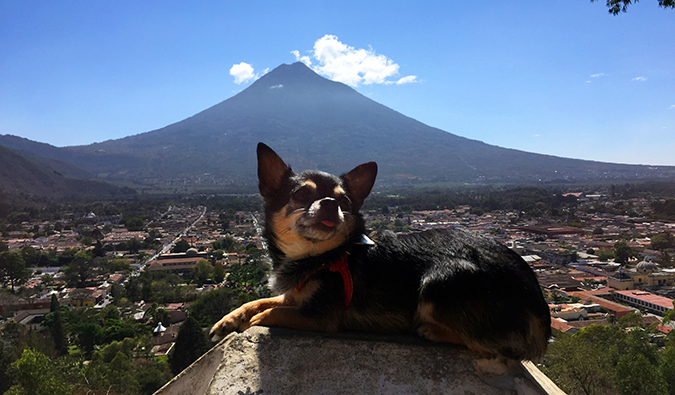
Marcelo the chihuahua in GuatemalaMarcelo the chihuahua in Guatemala
Before you hit the road, it’s best if your dog knows a thing or two. Basic commands, like “sit” and “stay,” will make managing a dog while traveling easier. A well-trained dog can be left behind in a hotel room or rental to rest for a few hours while you have a nice dinner or visit a museum.

Plus, you’re more likely to get a “yes” to your requests if people see that your dog is well behaved. No one wants to be around a barking or rowdy dog who won’t listen!

Work on obedience and manners, and make sure your pup always puts their best paw forward.

If you need help, working with a certified trainer is best. There are also many resources online to help ensure that your dog is obedient and ready to venture out into the world. I recommend the AllThingsPups training tips — they have a YouTube channel, Instagram account, and podcast.

12. Say hello!

Boogie the pug getting lots of attention in GuatemalaBoogie the pug getting lots of attention in Guatemala
Seeing a dog always puts a smile on a stranger’s face. Be polite to people you encounter with your pup. Kindness goes a long way.

On a recent flight, a friendly exchange with a dog-loving airline worker led to my pups and me getting a whole row to ourselves. Extra legroom and seat space are always welcome!

I’ve also gotten free treats, lots of useful tips, and other upgrades all because of a smile, some amicable banter, and of course, my friendly pups.

***

Travels with my dogs are more colorful and locally focused, and force me to explore parts of my destination that I would have never experienced had I been dogless. My dogs help me meet more people, see more places, and live in and cherish the present. There’s no better way to appreciate a new place than with a dog!

Candy Pilar Godoy has visited almost 40 countries across six continents, and speaks three languages. She often travels with her dogs, and writes about pet travel on her blog Boogiethepug.com. Candy currently lives in Rio de Janeiro with her two dogs, Boogie and Marcelo, and cat Kitty. Follow them on Twitter, Facebook and Instagram.


P.S. – I just released a new book! It’s called “Ten Years a Nomad” and it’s about my ten years backpacking the world and the lessons I learned from it. It features tons of stories I’ve never told on this blog and is a book that delves into the why of travel! Click here to learn more, grab your copy today, and meet me on my book tour!

Book Your Trip: Logistical Tips and Tricks

Book Your Flight
Find a cheap flight by using Skyscanner or Momondo. They are my two favorite search engines because they search websites and airlines around the globe so you always know no stone is left unturned.

Book Your Accommodation
You can book your hostel with Hostelworld. If you want to stay somewhere other than a hostel, use Booking.com as they consistently return the cheapest rates for guesthouses and cheap hotels. I use them all the time.

Don’t Forget Travel Insurance
Travel insurance will protect you against illness, injury, theft, and cancellations. It’s comprehensive protection in case anything goes wrong. I never go on a trip without it as I’ve had to use it many times in the past. I’ve been using World Nomads for ten years. My favorite companies that offer the best service and value are:

  • World Nomads (for everyone below 70)
  • Insure My Trip (for those over 70)

Looking for the best companies to save money with?
Check out my resource page for the best companies to use when you travel! I list all the ones I use to save money when I travel – and I think will help you too!

2019年7月25日星期四

Better Booking: T+L Editors Share Their Tips For Getting The Best Fares

The team at Travel + Leisure is on the road regularly, checking out new destinations and experiences as much as we can. It’s made us avid planners, ever after a great deal and always scouting fares.

We’ve done deep dives into the best time to book flights for optimal rates—54 days, according to CheapAir.com, though there’s more to it than that. “There’s a sweet spot for domestic fares that CheapAir calls the ‘Prime Booking Window,’ and it spans from 21 to 112 days ahead of your departure date. Booking in that three-month span will offer maximum odds for a bargain booking,” Nikki Ekstein wrote.

Meanwhile, when Kayak released its 2016 Travel Hacker Guide, we summarized the top 10 U.S. destinations for travel, and the best times to book for airfare deals to each, citing the average highs and lows for rates in every spot. 

We’re regularly on the lookout for ways to travel better, testing out airfare search tools, special travel services, and other tricks for starting your trip off right (and making sure it’s perfect until it’s time to come home). After our latest discussion on flight and train planning, we thought we should collect all of this finely tuned intel into a resource we can all use, again and again.

Our editors shared their tried-and-true booking strategies, from planning and research tools to tech tips and how they set up their flight alerts. We’ve got tips on getting the best savings on trains, how to secure the seat you most want, getting discounts on rental cars, and a number of sites we never plan a trip without visiting.

Read on for our advice, and use it to plan your next getaways. Want some inspiration for where to go? Take a look at the Best Places to Travel in 2016.